Table of Contents
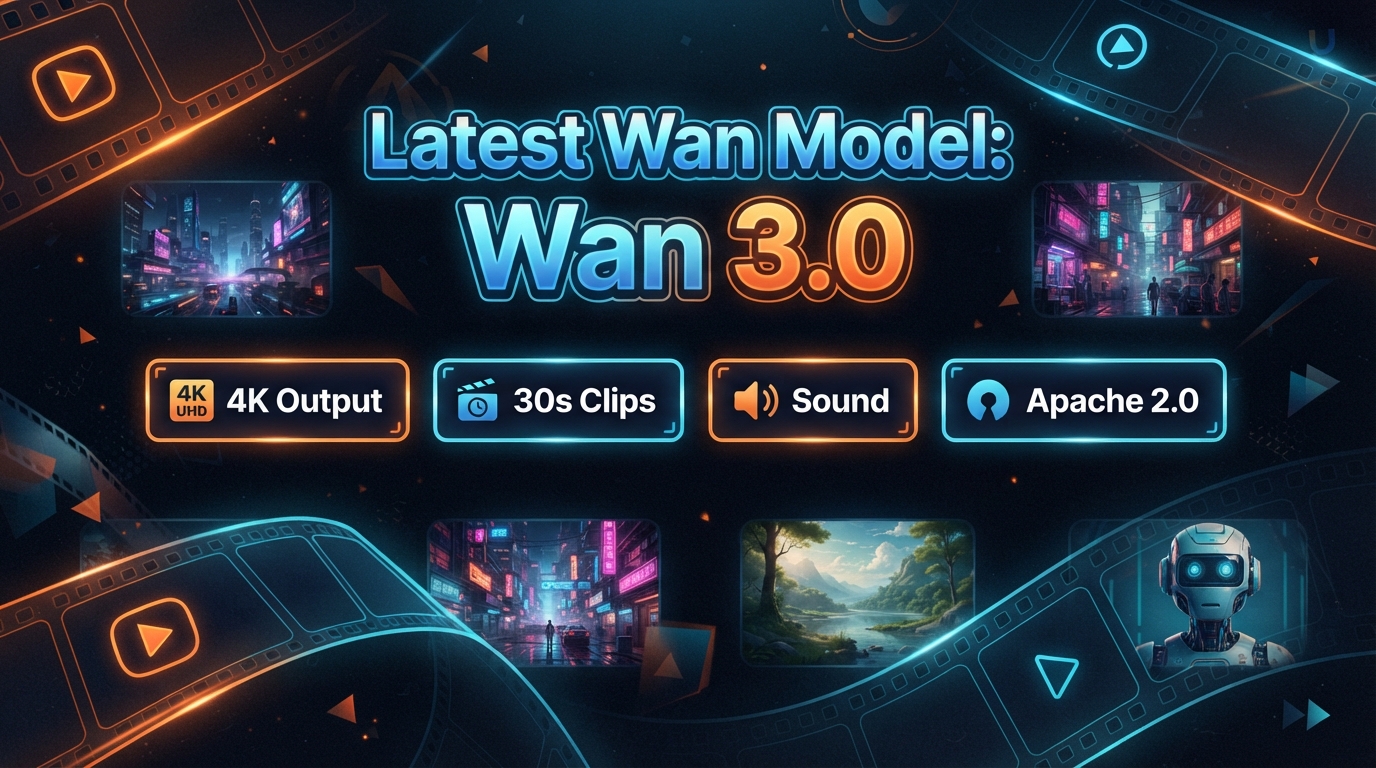
What Is the Latest Wan Model? Wan 3.0 and Every New Wan Release in 2026
As of August 2026, the latest Wan model is Wan 3.0 — Alibaba Tongyi Lab's next-generation AI video model, released as Apache 2.0 open weights in a lightweight 1.3B version for consumer hardware and a professional 14B version (LinkedIn, "Alibaba Releases Wan 3.0 Open-Weight Video Models," Apr 27, 2026). On top of that flagship, the newest releases in the Wan family as of July 2026 are three Apache 2.0 ecosystem models: WanSong (text-to-music), Wan-Dancer-14B (music-to-dance), and Wan-Streamer (real-time streaming interaction). There is no Wan 3.5 — or any other successor — announced yet, so Wan 3.0 remains the answer to "what is the latest Wan model" today.
This guide explains what "latest" actually means across Wan's release channels (open weights vs. API), walks through every version from Wan 2.1 to Wan 3.0, breaks down what's new versus Wan 2.7, and shows you where to run or test the newest models — including a Wan 3.0 AI video generator if you want results without running weights locally.
What "latest Wan model" means in practice
Wan doesn't ship as a single product. Different channels update at different speeds, and that's where most of the confusion about "the latest Wan model" comes from:
| Release channel | Latest as of Aug 2026 | Notes |
|---|---|---|
| Open weights (Hugging Face) | Wan 3.0 (1.3B + 14B) | Apache 2.0, weights shipped ~April 2026 |
| Ecosystem models (open) | WanSong, Wan-Dancer-14B, Wan-Streamer | July 2026, Apache 2.0 |
| API / hosted platforms | Varies by provider | wan-3.io currently exposes the Wan 2.7 model in its selector; Wan 3.0 API access is rolling out |
| Official GitHub org | github.com/Wan-Video | Check here first for new checkpoints |
The pattern matters for a historical reason: Wan 2.5 was pre-announced as open but never shipped weights, and Wan 2.6 was closed entirely, so "latest model" and "latest open model" were different things during late 2025. With Wan 3.0, Alibaba returned to the open strategy of Wan 2.1/2.2 — the 1.3B and 14B weights are the flagship release, not a teaser.
Every Wan version from 2.1 to 3.0
| Version | Released | License | Key character |
|---|---|---|---|
| Wan 2.1 | Feb 2025 | Apache 2.0 | Fully open-weight; the architectural base for later versions |
| Wan 2.2 | Jul 2025 | Apache 2.0 | Fully open-weight; community favorite |
| Wan 2.5 | Sep 2025 | Commercial API | Pre-announced open, weights never shipped |
| Wan 2.6 | Dec 2025 | Closed API | API-only, no open release |
| Wan 2.7 | Mar 2026 | Apache 2.0 (partial) | Select models open (incl. Wan 2.7-Image), premium features API-only |
| Wan 3.0 | 2026 (open weights ~Apr 2026) | Apache 2.0 | Next-gen: 4K, 30s clips, sound, character consistency |
| WanSong / Wan-Dancer-14B / Wan-Streamer | Jul 2026 | Apache 2.0 | Music, dance, and streaming ecosystem |
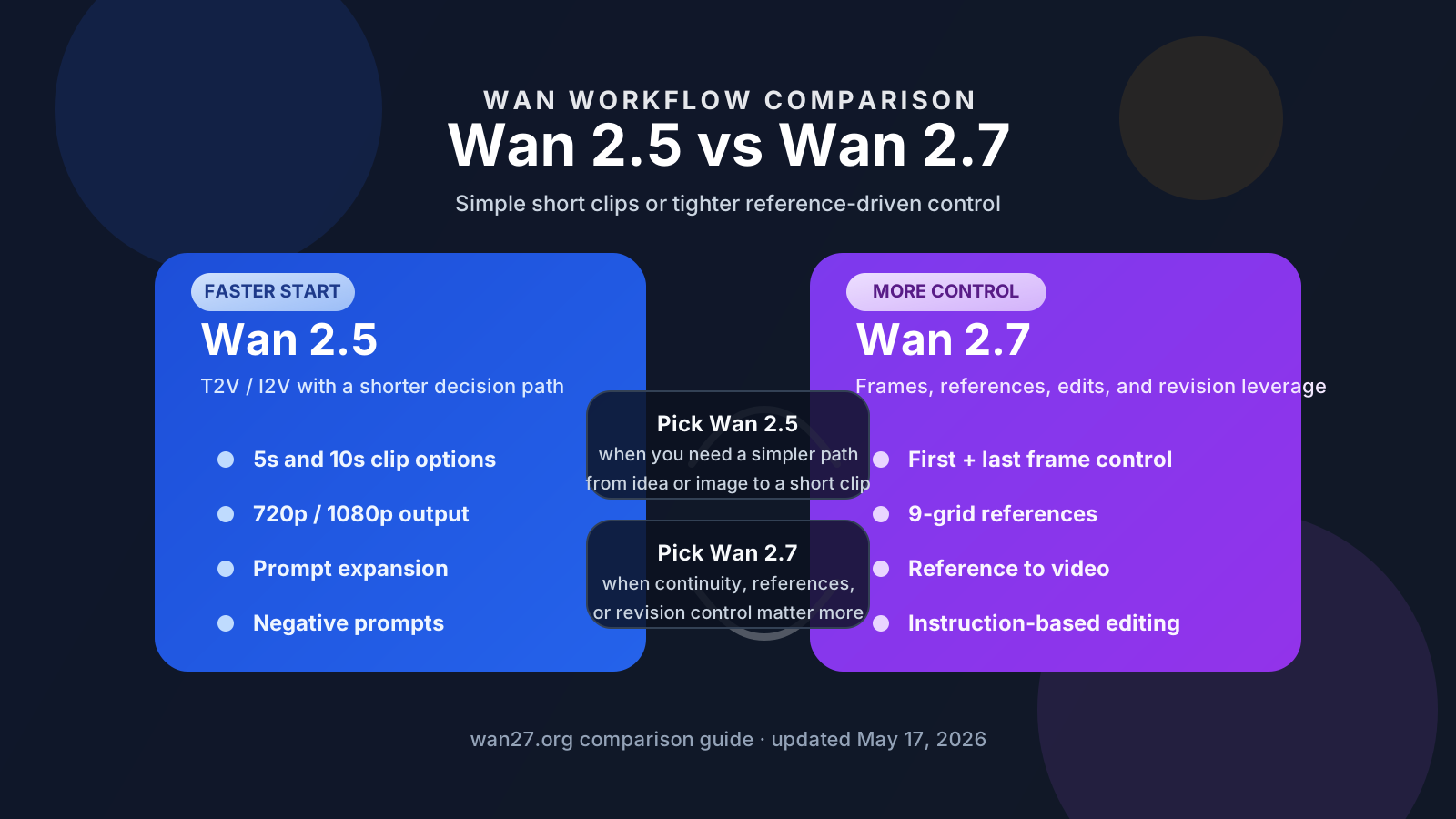
If you're deciding which version to actually use, the practical shortlist is Wan 2.7 or Wan 3.0. Wan 2.7 is the most battle-tested open release and what most platforms (including wan-3.io) currently serve in their model selector; Wan 3.0 is the newest and most capable, but its integration is still rolling out across hosted tools. Our complete Wan 2.7 guide covers the earlier model in depth, and our Wan 2.7 release date and open-source history explains how the community pressure around that release shaped Alibaba's open strategy.
What's new in Wan 3.0 vs. Wan 2.7
If you've used Wan 2.7, the headline upgrades in Wan 3.0 are easy to remember — it roughly doubles each canvas dimension and max clip length, and adds a whole new sensory channel (sound):
- Native 4K output. Wan 2.7 caps at 1080p; Wan 3.0 generates at native 4K resolution in a single pass.
- 30-second clips. Wan 2.7 generates up to ~15 seconds per clip; Wan 3.0 extends that to 30 seconds, which matters for ads, short-form scenes, and multi-shot cinematic output.
- Sound in generated video. Wan 2.7 only produces audio through its Reference-to-Video (R2V) system — voice reference, multi-character audio, and audio cues — and it doesn't cover music, which still needs an external tool plus post-production (see our Wan 2.7 audio guide). Wan 3.0 generates audio/sound directly in the video, so there's no separate music or SFX pass.
- Strong character consistency across shots. Face and character identity carry over between shots, a long-standing pain point in open-source video models (and the top complaint about "plastic"-looking Wan 2.7 output on r/StableDiffusion and r/comfyui).
- Multi-modal inputs. Text-to-video and image-to-video are core; reference-to-video and video-edit are available through the API.
For a deeper look at the roadmap that led here, see our earlier roundup: Wan 3.0: everything we know.
Is Wan 3.0 actually open?
Yes — with the caveat that it's a return to form rather than a guarantee. Alibaba publicly pledged Wan 3.0 as an Apache 2.0 open-weight release, and the 1.3B + 14B weights shipped around April 2026 (LinkedIn); some outlets describe the initial release as "early 2026" (flowith.io). Given Wan 2.5's broken open promise and Wan 2.6's closed release, the community reaction has been "the weights actually shipped" rather than "how good is it" — a healthy sign for local use.
Can I run it on my own GPU?
The 1.3B model is designed for consumer hardware and is welcomed by the community for 8GB-class GPUs. The 14B version needs roughly 24GB+ of VRAM. Reddit threads across r/StableDiffusion and r/comfyui in mid-2026 recommend Wan 3.0 alongside Seedance 2.0 for local video generation, and the VRAM split is the single most-discussed practical question — know which tier fits your machine before downloading.
The newest Wan ecosystem models (July 2026)
Three Apache 2.0 releases landed in July 2026 that extend Wan beyond video generation — none of them carry a "Wan 2.x" label, which is one of the clearest signals that they're built on the Wan 3.0-era architecture (Hugging Face blog: Wan 3.0 ecosystem signals):
- WanSong — text-to-music, roughly 25B parameters. Generates music from a text prompt, complementing Wan 3.0's built-in video sound with full-length audio tracks.
- Wan-Dancer-14B — music-to-dance. Takes an audio track and generates dance motion, which pairs naturally with WanSong output.
- Wan-Streamer — real-time streaming interaction. The most experimental of the three; its "real-time" framing suggests interactive/streaming generation rather than the batch generation Wan users are used to.
If someone asks "what is the newest Wan model" in a Reddit thread, they usually mean the video flagship (Wan 3.0) — but technically, Wan-Streamer is the newest release in the family as of August 2026.
Where to access the latest Wan models
- Hugging Face — open weights for Wan 3.0 (1.3B/14B), WanSong, Wan-Dancer-14B, and Wan-Streamer. Start here for local use, ComfyUI workflows, and quantization.
- wan27.org — our guides and hands-on coverage of every Wan release, from Wan 3.0 to Wan 2.7.
- Wan 3.0 platform — hosted Wan video generation: text-to-video and image-to-video in one workspace, free credits on signup, 16:9/9:16/1:1 aspect ratios, 720p/1080p, and 5s/10s durations with model-aware controls. The model selector currently serves Wan 2.7; Wan 3.0 access is being added. For developers, the Wan 3.0 API guide documents the T2V, I2V, R2V, and VideoEdit endpoints, auth, and rate limits.
Which should you pick? If you have an 8GB+ GPU and want full control (or no cloud dependency), download the 1.3B weights. If you need 4K, 30-second, sound-on video without fighting VRAM, a hosted platform is the pragmatic route today — the Wan 3.0 AI video generator gets you to a render in minutes, with Wan 2.7 in the selector now and Wan 3.0 access rolling out.
How to check for newer Wan releases
Because Wan's release cadence has been roughly every 2–5 months (2.1 → 2.2 → 2.5 → 2.6 → 2.7 → 3.0), "latest" changes often. Three checks keep you current:
- The official GitHub org (github.com/Wan-Video) — new checkpoints and code drop here first.
- Alibaba's announcement channels — Wan 3.0 was pre-announced around April 2026 with weights following; majors get public pre-announcements before the release.
- Hugging Face — watch the model pages for new versions; the ecosystem releases (WanSong, Wan-Dancer, Wan-Streamer) all appeared there in July 2026.
As of the publish date of this article (August 2, 2026), no Wan 3.5, Wan 4.0, or successor to the July ecosystem models has been announced — any page claiming otherwise is speculating.
FAQ
Is Wan 3.0 the latest Wan model?
Yes. As of August 2026, Wan 3.0 (Apache 2.0 open weights, 1.3B + 14B) is the latest and flagship Wan model. There is no confirmed successor yet.
What is the newest Wan video model?
Wan 3.0 is the newest Wan video model — native 4K, 30-second clips, built-in sound, and strong character consistency. The newest releases in the family overall are the July 2026 ecosystem models: WanSong (text-to-music), Wan-Dancer-14B (music-to-dance), and Wan-Streamer (real-time streaming).
Is there a Wan 3.5?
No confirmed Wan 3.5 exists as of August 2026. Wan's version history is 2.1 → 2.2 → 2.5 → 2.6 → 2.7 → 3.0, and no 3.5 announcement has been made. Treat "Wan 3.5" claims as unconfirmed rumors until Alibaba or the Wan GitHub org announces them.
What's the difference between Wan 3.0 and Wan 2.7?
Wan 3.0 doubles native resolution (4K vs. 1080p), doubles max clip length (30s vs. ~15s), adds sound generated in the video, and improves character consistency across shots. Wan 2.7 remains the more widely integrated model in hosted tools like wan-3.io.
Can I run the latest Wan model locally?
Yes. The Wan 3.0 1.3B model runs on 8GB-class GPUs; the 14B version needs roughly 24GB+ VRAM. Wan 2.7 checkpoints also remain fully runnable locally if you need maximum ecosystem compatibility.
Try the latest Wan video generation today
Wan 3.0 is open, but you don't need to run weights to use it. If you want to create videos with Wan 3.0 — or with the current Wan 2.7 model while 3.0 rolls out — the platform offers free credits on signup, text-to-video and image-to-video workflows, and model-aware controls. For the developer path, read the Wan 3.0 API guide to wire T2V, I2V, R2V, and VideoEdit endpoints into your own app. And keep an eye on wan27.org for coverage of whatever Alibaba ships next.