
Table of Contents
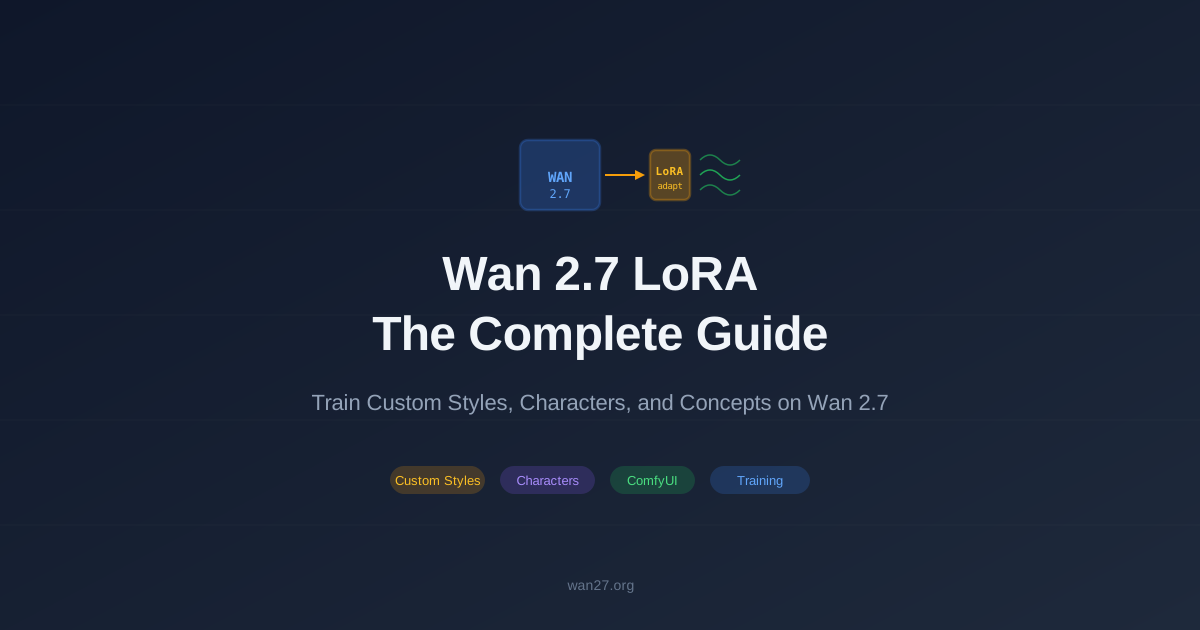
You got Wan 2.7 running. The first few generations look good. The motion is smooth. The prompt following works.
Then you hit the wall.
You want the same character across three shots. You want a consistent art style for a series. You want the model to understand a specific object or product instead of guessing from a text prompt.
You try describing it in the prompt. Close, but not there. You try reference images. Better, but drifts.
What you actually need is a way to bake that knowledge into the model itself — without retraining 14 billion parameters from scratch.
That is what LoRA does.
What LoRA Actually Does for Wan 2.7
LoRA (Low-Rank Adaptation) is a small set of trainable weights that sit alongside the main model. Think of it as a plugin, not a replacement.
The base Wan 2.7 model stays frozen. The LoRA adapter — typically a few hundred megabytes at most — learns a specific concept, style, or character. At inference time, the adapter modifies the model's output without changing the original weights.
The practical result: you can make Wan 2.7 reliably produce things it was never specifically trained on.

What You Can Do With a Wan 2.7 LoRA
The range is wider than most people think.
| Use Case | What LoRA Learns | Example |
|---|---|---|
| Character consistency | Face, body proportions, outfit | Same person across a multi-shot ad |
| Art style | Color palette, texture, composition | Anime style, oil painting, pixel art |
| Product visualization | Shape, materials, details | Same product in different scenes |
| Motion style | Camera movement patterns | Smooth dolly, handheld shake |
| Specific object | Unique features of one thing | Your brand mascot, a custom device |
| NSFW / uncensored | Removes safety filters | — |
Character consistency is the most common use case, but product and style LoRAs are quietly where the commercial value is. If you sell a physical product and want to generate marketing videos of it in different settings, a product LoRA is more reliable than hoping the prompt alone gets the details right.
What You Need to Train a Wan 2.7 LoRA
Hardware
Training a LoRA is less demanding than generating video with the full model.
| GPU | Can Train? | Training Time (rough) |
|---|---|---|
| RTX 4090 24GB | Yes | 30 min – 2 hours |
| RTX 3090 24GB | Yes | 45 min – 3 hours |
| RTX 4080 16GB | Yes, with gradient checkpointing | 1 – 4 hours |
| RTX 4070 12GB | Tight, smaller dims only | 2+ hours |
| Cloud A100 | Yes, fast | 10 – 30 min |
| Cloud A6000 | Yes | 20 – 60 min |
Training is more accessible than video generation because you can use smaller batch sizes and gradient checkpointing to trade speed for VRAM.
If you can run Wan 2.7 inference, you can almost certainly train a LoRA on the same hardware.
Training Images
The quality of your LoRA depends almost entirely on the quality of your training images.
Minimum: 10-15 images. Recommended: 20-50 images.
What makes a good training set:
- Variety within consistency. Different angles, different lighting, different backgrounds — but always the same subject or style.
- High resolution. 1024x1024 or higher. Wan 2.7 was trained on high-quality data, and LoRA training inherits that expectation.
- No watermarks, no text overlays. The model will learn those as part of the concept.
- Diverse but not random. If you are training a character, include close-ups, full body, profiles. If you are training a style, include different subjects all rendered in that style.
- Avoid duplicate or near-duplicate images. They add noise, not signal.
The number one reason a LoRA produces bad results is not the training settings. It is bad training data.
Captions
Every training image needs a text caption. This is how the model learns what part of the image is the "concept" versus the "background."
Good caption format for Wan 2.7:
A photo of [trigger word] wearing a blue jacket, standing in a park, natural lightingBad caption:
IMG_2047.jpgThe trigger word is how you will call the LoRA at inference time. Pick something unique — not a common word the model already knows. A nonsense word like "zxbl" or a unique name works better than "woman" or "character."
Caption rules of thumb:
- Describe everything EXCEPT the thing the LoRA is learning. If you are training a character's face, describe the clothes, the background, the lighting. Let the trigger word carry the face.
- Be consistent in how you format captions. Same style, same level of detail.
- Include what is NOT in the image if it matters. Example: "wearing a red hat" when the character never wears hats — this helps the model not hallucinate hats.
How to Train a Wan 2.7 LoRA
There are several training tools. The most common path uses the diffusers training scripts adapted for Wan 2.7, or community tools built on top.
Step 1: Prepare Your Dataset
Organize your images in one folder. Create a metadata file (JSON or TXT) mapping each image to its caption.
training_data/
  image_01.jpg
  image_02.jpg
  ...
  metadata.jsonl
Each line in metadata.jsonl:
{"file_name": "image_01.jpg", "text": "A photo of zxbl character sitting at a desk, office lighting"}Step 2: Choose Your Training Script
The two most-used options as of May 2026:
- Kohya SS (kohya-ss/sd-scripts) — Widely used for Stable Diffusion LoRA training, with growing Wan 2.7 support. Good GUI. Best for beginners.
- Diffusers LoRA training script — HuggingFace's official training example. More control, less GUI. Best for developers.
For most people, start with Kohya SS. The GUI reduces the chance of config mistakes.
Step 3: Set Training Parameters
The key parameters for Wan 2.7 LoRA training:
| Parameter | Recommended | What It Does |
|---|---|---|
rank (dim) | 16 – 64 | LoRA size. Higher = more capacity, larger file. 32 is a good default. |
alpha | 8 – 32 | Scaling factor. Usually set to half of rank. |
learning_rate | 1e-4 | How fast the LoRA learns. Too high = overcooked. Too low = undercooked. |
batch_size | 1 – 4 | Images per training step. Lower if VRAM-constrained. |
epochs | 5 – 20 | How many passes through the dataset. More is not always better. |
resolution | 1024 | Match your training image resolution. |
network_alpha | 16 | Network dimension scaling. |
optimizer | AdamW8bit | Memory-efficient optimizer. |
Start with conservative settings. Train one epoch, generate a test image with your trigger word. If the LoRA is too weak, train more epochs. If it is overcooked (outputs look distorted or the trigger word overpowers everything), reduce epochs or lower the learning rate.
Step 4: Run Training
With Kohya SS, this is a GUI operation. With diffusers, the command looks roughly like:
accelerate launch train_lora_wan.py \
  --pretrained_model_name_or_path "Wan-AI/Wan2.7-T2V-14B" \
  --dataset_name "./training_data" \
  --output_dir "./wan27_lora_output" \
  --rank 32 \
  --learning_rate 1e-4 \
  --train_batch_size 2 \
  --num_train_epochs 10 \
  --resolution 1024
Training a LoRA on 20-30 images with a 4090 takes roughly 45-90 minutes.
Step 5: Test and Iterate
Do not train for 20 epochs and then check the result. Check early.
- Train 1-2 epochs.
- Generate a test image/video with your trigger word.
- If the concept is present but weak: train more.
- If the output is distorted or the trigger word dominates: reduce epochs or lower
learning_rate. - If the LoRA does nothing: check your captions. They might be too generic, or the trigger word might be getting drowned out.
The fastest way to waste hours is to train a full 20-epoch run without checking intermediate results.
Using LoRA in ComfyUI
Once your LoRA is trained, using it in ComfyUI is straightforward.
- Place the
.safetensorsLoRA file inComfyUI/models/loras/ - Add a "Load LoRA" node to your workflow
- Connect it between the model loader and the sampler
- Set the LoRA strength (0.5 – 1.0; start at 0.8)
- Include your trigger word in the prompt
The LoRA strength controls how strongly the adapter influences the output. At 1.0, the LoRA is at full effect. At 0.5, it is a mix of the base model and the LoRA. If your LoRA is well-trained, 0.7-0.8 is usually the sweet spot — strong enough to be consistent, weak enough to still respond to the prompt.
You can also stack multiple LoRAs. For example, a character LoRA at 0.8 and a style LoRA at 0.5. The effects add together, though too many stacked LoRAs will start to degrade quality.
Common Mistakes That Waste Training Time
Bad captions
The most common mistake. If your captions are too sparse, the model does not know what to ignore. If they are too detailed, the model does not know what to learn.
The fix: describe the context, not the subject. The trigger word IS the subject.
Too few images
10 images of a face, all from the same angle, same lighting. The LoRA learns "that specific photo" instead of "that person."
The fix: 20+ images with variety. Different angles, expressions, lighting conditions.
Too many epochs
The LoRA overfits. Outputs become distorted. The trigger word produces the same image regardless of the rest of the prompt.
The fix: check intermediate results. Stop when the concept is clear and the prompt still works.
Training on low-res images
Wan 2.7 expects high-quality input. Training on 512x512 images and then trying to generate 1080p video will produce artifacts.
The fix: train at 1024x1024 or the resolution you intend to generate at.
Wrong trigger word
Using "girl" or "style" as a trigger word. The model already has strong associations with these words, and the LoRA has to fight the base model.
The fix: use a unique, made-up word. "zxbl_character" will train faster and work more reliably than "woman."
FAQ
Can I train a LoRA for Wan 2.7 video generation?
Yes. A LoRA trained on images transfers to video generation because the underlying model architecture is shared. A character LoRA trained on still images will influence how that character appears in generated video. For best results, include some video frames in your training set if motion-specific details matter.
How big is a Wan 2.7 LoRA file?
Depends on the rank. At rank 32, typically 100-300 MB. At rank 64, roughly double that. Compare this to the 30 GB base model and you see why LoRA is practical.
Can I share or sell Wan 2.7 LoRAs?
Yes. Apache 2.0 permits distribution of derivatives. You can share LoRAs on Civitai, HuggingFace, or sell them. The LoRA file is a derivative work under the license.
Do I need a Wan 2.7 LoRA for every character or style?
Yes, each LoRA learns one concept. But you can train a multi-concept LoRA by including multiple subjects in the training set, each with its own trigger word. The trade-off: multi-concept LoRAs need more training images and higher rank to avoid confusion.
How is LoRA different from Dreambooth or full fine-tuning?
Dreambooth modifies the base model weights, producing a full checkpoint (30 GB+). LoRA is a small adapter (100-300 MB). Dreambooth can produce slightly higher fidelity for a single concept, but LoRA is faster to train, easier to share, and you can swap LoRAs in and out without duplicating the base model.
Can I use a Wan 2.7 LoRA with the API version?
No. Most API providers do not support loading custom LoRAs. LoRAs are a local-deployment or self-hosted feature. This is one of the main reasons to move from API to local once you need custom content.
Bottom Line
If you need Wan 2.7 to produce consistent characters, styles, or products, LoRA is the tool.
It trains on a single GPU in under two hours. The output is a small file you can swap, share, and stack. And it works across Wan 2.7's video and image generation modes.
The thing that determines whether your LoRA works is not the training code. It is your training images and captions. Get those right, and the rest is straightforward.
Ready to train? You need the base model running first. Start with the Wan 2.7 ComfyUI Local Guide to get your local setup ready, then come back here for the LoRA training workflow.