Table of Contents
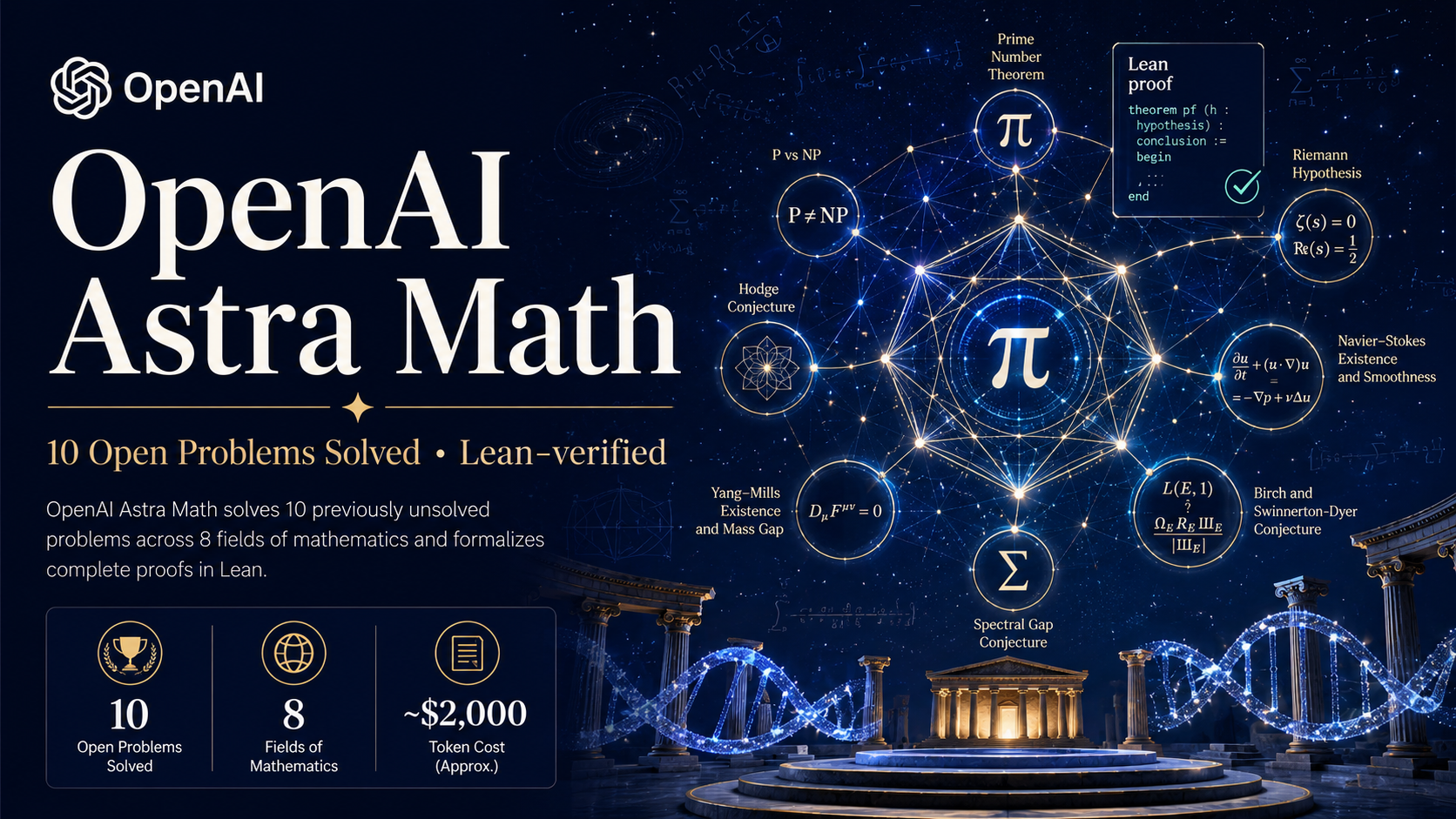
On August 1, 2026, OpenAI published a research paper titled "Ten advances in mathematics and theoretical computer science," announcing that an internal version of Astra — its "next major model" — produced solutions to ten problems that had seen no progress for at least a decade, and in most cases much longer.
The OpenAI Astra math solutions are not benchmark scores. They are new mathematical results: constructions, counterexamples, and bounds that professional mathematicians had not been able to produce, now released with machine-checkable proofs in the Lean theorem prover. Researchers are still digesting the claims, with reactions ranging from "big news" to "sadly, no Millennium Prize Problems (yet)."
What OpenAI Announced
The results span eight fields: high-dimensional geometry, coding theory, arithmetic circuit complexity, group theory, operator algebras, quantum complexity, lattice cryptography, and extremal combinatorics. OpenAI says the tokens needed to find the solutions would cost roughly $2,000 at Sol API rates.
After the model produced the mathematical arguments, humans worked with the same model to turn them into manuscripts. The model then formalized each argument as a Lean certificate, made public in the openai/ten-proofs repository, and OpenAI released a reasoning walkthrough for each solution.
The Ten OpenAI Astra Math Solutions at a Glance
| Problem | Field | What Astra produced |
|---|---|---|
| High-dimensional sphere packing | Geometry | New upper bounds on packing density down to the Cohn–Elkies threshold |
| Binary and spherical codes | Coding theory | Exponentially improved bounds on maximum code size at any minimum distance |
| Non-sofic groups | Group theory | A construction proving non-sofic groups exist — a central open question |
| Connes's rigidity conjecture | Operator algebras | A counterexample to a longstanding conjecture about group von Neumann algebras |
| Arithmetic circuit complexity | Complexity theory | New lower bounds for the permanent, including an n^4 / log n formula bound |
| Quantum parallel repetition | Quantum complexity | An exponential parallel repetition theorem for two-player quantum games |
| Closest vector problem | Lattice cryptography | Polynomial-factor hardness of approximation, relevant to post-quantum cryptography |
| Ehrhart's volume conjecture | Geometry | The sharp maximum volume in every dimension |
| Multicolor Ramsey numbers | Combinatorics | A superexponential lower bound for multicolor triangle Ramsey numbers, resolving Erdős problem 183 |
| Extremal number conjectures | Graph theory | Counterexamples to the compactness and degeneracy conjectures, resolving Erdős problems 146 and 180 |
Two results stand out: the non-sofic groups construction, which answers a central group theory question, and the closest vector problem, at the heart of lattice cryptography.
Why These Results Matter
The significance is best explained by the people who study these problems. Thomas Bloom, a mathematician at the University of Manchester who runs erdosproblems.com, called the results "big news" on X, arguing they are more significant than the AI-generated disproof of the Erdős unit-distance conjecture OpenAI shared in May. "Maybe not bigger than a proof of unit distance would have been, but in terms of constructions, this is big," Bloom wrote.
What sets this apart from earlier AI math milestones is scale and verification: ten results at once, each machine-checkable. May's disproof has already inspired follow-up research, including Bloom's sum-product conjecture work with collaborators.
What Is Astra?
Astra is not a feature update. According to The Information, as reported by The Decoder, it is OpenAI's next major model family, designed to coordinate multiple agents over long horizons — hours or even days — to tackle especially hard problems. CEO Sam Altman reportedly demoed the system to policymakers in Washington, D.C., and Astra is expected to be the first model to go through the U.S. government's planned review framework before release. Whether it ships as GPT-6 or as a variant in the GPT-5 line — something like GPT-5.7 — reportedly has not been decided.
How the Results Were Verified
OpenAI took unusual steps to make the results checkable:
- Lean formalization: every proof has a Lean 4 certificate in the openai/ten-proofs repository that anyone can build and verify
- Reasoning walkthroughs: a model-generated narration of the thinking process for each solution
- Independent checking: Comparator challenges let the formalizations be verified with an independent tool
OpenAI also took a position on attribution: claiming human authorship for a proof generated entirely by an AI system would misrepresent both the system's contribution and the nature of genuine human intellectual work, and the company pointed to the Leiden Declaration on AI and Mathematics as a reference. OpenAI says it helped prepare the manuscripts and formalize the proofs and takes responsibility for their correctness — but the mathematical arguments themselves came from Astra.
Reactions and Open Questions
Noam Brown, one of the researchers behind the test-time reasoning techniques used by Astra, said on X that OpenAI had also tried and failed to crack other major problems: "Sadly, no Millennium Prize Problems (yet)." The Clay Mathematics Institute offers $1 million for each Millennium Prize Problem; only one of the seven has been solved since 2000. Brown added that OpenAI "didn't spend a lot on each problem" and that it is possible to push test-time compute much further, calling Astra a "major step for scientific reasoning."
Bloom rejected the idea that AI is replacing mathematicians: the model draws on more than a century of mathematical theory, was built by mathematicians, and trained on everything mathematicians have written. The open questions now are verification and trust — the community must engage with the proofs and build on their ideas.
What Comes Next
Three things are worth watching:
- Release form: whether Astra ships as GPT-6 or a GPT-5 variant, and at what price — the $2,000 token estimate suggests the capability is not compute-hungry
- The regulatory path: Astra is expected to be the first model reviewed under the planned U.S. government framework, which could affect timing
- The research roadmap: OpenAI wants an AI system with research-intern-level skills as early as September 2026 and a fully autonomous AI researcher by early 2028; the math solutions are the strongest public evidence so far that this timeline is realistic
The takeaway for developers is simple: the model line behind the OpenAI Astra math solutions is the one to watch for reasoning-heavy workloads. If an internal Astra cracked decades-old problems for roughly $2,000 in tokens, the ceiling for test-time reasoning is nowhere in sight.