Table of Contents
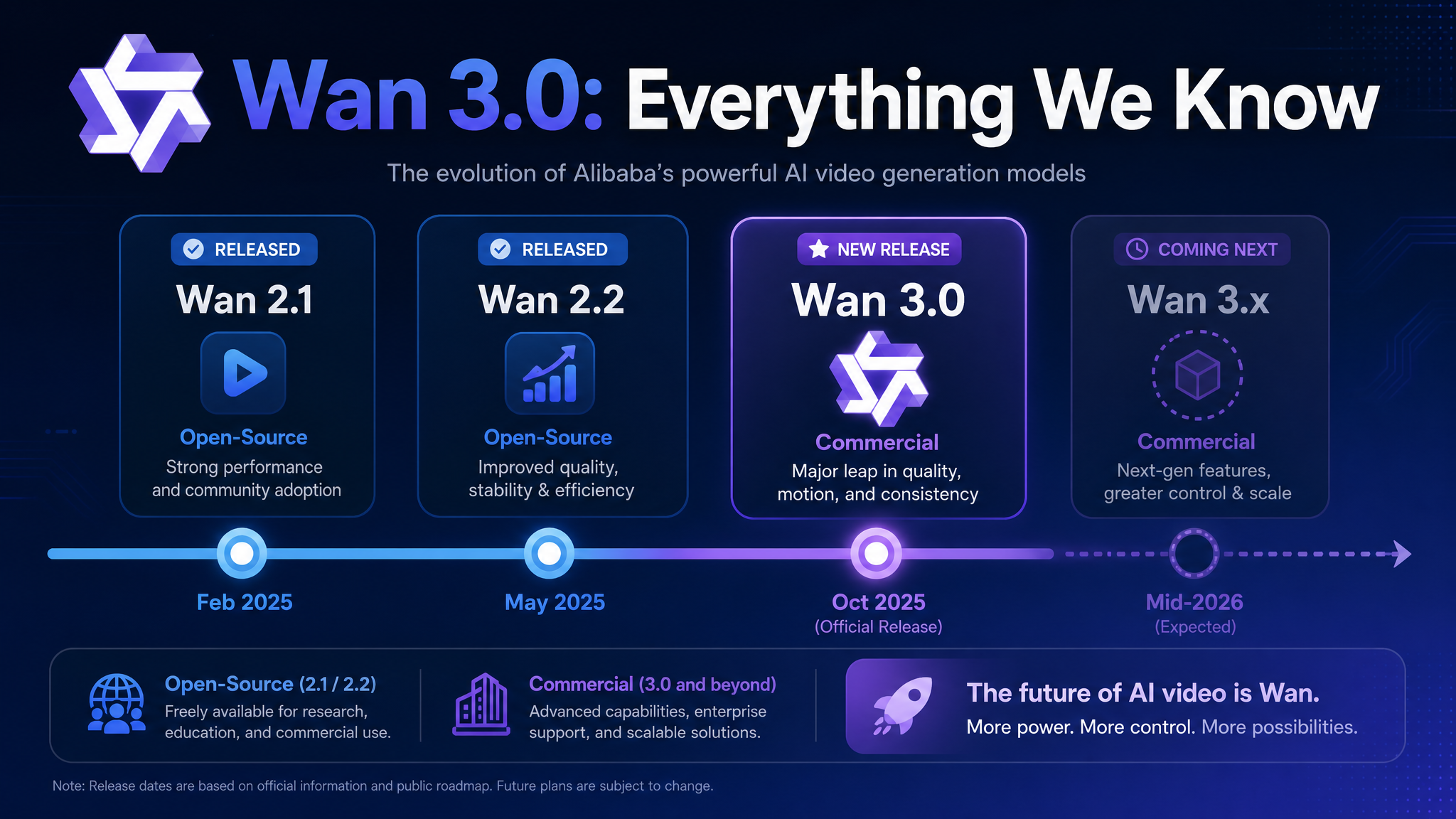
Alibaba pre-announced Wan 3.0 as an Apache 2.0 open-weight release. The community response was not excitement. It was caution.
That reaction is not cynicism. It is pattern recognition — one we have tracked across every Wan release since 2.1.
Wan 2.5 was pre-announced as open. The weights never appeared. Wan 2.6 shipped as a closed commercial API with no open release at all. When Wan 2.7 finally did release select models under Apache 2.0, it took six months of community pressure and a strategic pivot to get there.
So when Alibaba says Wan 3.0 will be open-weight, the question everyone is asking is not "how good will it be?" It is "will the weights actually ship this time?"
This article covers everything currently known about Wan 3.0 — confirmed statements, version history context, the open-source track record, how it compares to Wan 2.7, and what to expect between now and release.
What Is Wan 3.0?
Wan 3.0 is Alibaba's planned next-generation AI video generation model, expected to launch around mid-2026. It would follow Wan 2.7 (released March 2026) as the next major version in the Wan series developed by Alibaba's Tongyi Lab.
What makes Wan 3.0 notable before any technical details have been published: Alibaba has publicly pledged it will be released under the Apache 2.0 license with open weights — a return to its earlier open-source strategy after a period of heavy commercialization.
What is confirmed:
- Alibaba has stated Wan 3.0 will be an Apache 2.0 open-weight release
- The model is positioned as a successor to Wan 2.7
- Expected release window: mid-2026
What is not confirmed:
- No specific model architecture details have been shared
- No capability benchmarks or feature lists have been published
- No exact release date has been set
- No confirmation on which models (base, turbo, image, video) would be included
Everything outside of these two statements — the version number commitment and the license pledge — is community speculation. For an in-depth architectural analysis of the Wan ecosystem signals pointing to Wan 3.0's capabilities, see the independent analysis on Wan 3.0 Huggingface.
The Full Wan Version History: Why the Community Is Cautious
To understand the skepticism around Wan 3.0's open-source pledge, you have to look at the full release chronology.
| Version | Released | License | Key Character |
|---|---|---|---|
| Wan 2.1 | Feb 2025 | Apache 2.0 | Fully open-weight release |
| Wan 2.2 | Jul 2025 | Apache 2.0 | Fully open-weight release |
| Wan 2.5 | Sep 2025 | Commercial API | Pre-announced as open, weights never shipped |
| Wan 2.6 | Dec 2025 | Commercial API | Closed API-only, no open release |
| Wan 2.7 | Mar 2026 | Apache 2.0 (partial) | Select models open, premium features API-only |
| Wan 3.0 | Mid-2026 (expected) | Apache 2.0 (pledged) | Pre-announced open, community waiting to see |
The pattern is clear: baseline models are released open-source, and each premium iteration is kept behind a commercial API. Wan 2.1 and 2.2 were fully open. Wan 2.5 and 2.6 were closed. Wan 2.7 reopened select models under Apache 2.0 — but the highest-value capabilities (instruction editing, multi-subject reference, drama-core generation) remained on the API.
Wan 3.0 being pledged as open is therefore less surprising than it might seem. If the pattern holds, Alibaba would release a capable baseline model under Apache 2.0 while keeping a premium tier — possibly Wan 3.5 or a "Wan 3.0 Pro" — behind the API.
Wan 3.0 vs Wan 2.7: What We Can Reasonably Expect
Without official specs for Wan 3.0, every comparison is speculative. But we can project based on the upgrade pattern between previous Wan generations and the broader AI video landscape in mid-2026.
| Dimension | Wan 2.7 (Current) | Wan 3.0 (Expected) |
|---|---|---|
| Release | March 2026 (live) | Mid-2026 (pre-announced) |
| License | Apache 2.0 (select models) | Apache 2.0 (pledged) |
| Motion control | First/last frame | Likely improved temporal coherence |
| Multi-subject | Up to 5 references | Possibly expanded |
| Resolution | 1080p | Could reach 4K generation |
| Open-weight scope | Selective | Pledged as comprehensive |
| Premium tier | Wan 2.7 API | Likely Wan 3.0 Pro / Wan 3.5 API |
| Architecture | Diffusion-based | Possibly hybrid or next-gen |
The most realistic expectation: Wan 3.0 will deliver meaningful quality improvements — higher resolution, better temporal consistency, stronger instruction following — with at least a subset of models available under Apache 2.0. The commercial API tier will likely offer capabilities the open model does not.
The Open-Source Question: Three Scenarios
There are three plausible outcomes for Wan 3.0's open-source pledge.
Scenario A: Full Commitment (Best Case)
Alibaba ships all Wan 3.0 model weights under Apache 2.0 at or near launch. This would be a genuine return to the Wan 2.1 / 2.2 strategy and a major win for the open-source AI video community.
Likelihood: Low. Alibaba's commercial API revenue from Wan 2.5 and 2.6 was significant. Completely forgoing that revenue stream is not a realistic expectation for a for-profit company.
Scenario B: Selective Open Release (Most Likely)
Alibaba releases baseline Wan 3.0 models (e.g., a 5B-param text-to-video model and a smaller I2V variant) under Apache 2.0, matching the Wan 2.7 pattern. Higher-end capabilities — larger models, premium generation modes, advanced editing — remain on the commercial API.
Likelihood: High. This is the established pattern. It keeps the open-source community engaged while protecting the commercial product.
Scenario C: Partial or Delayed Release (Disappointing)
Alibaba delays the weight release significantly after the API launch, or releases fewer models than expected, or changes the license terms. This would mirror what happened with Wan 2.5.
Likelihood: Moderate. The Wan 2.5 precedent exists, but the community reaction to that was strongly negative. Alibaba is likely aware that repeating the pattern would damage trust further.
What the Community Actually Wants From Wan 3.0
The AI video community has been vocal about what they want from Wan 3.0.
High on the wish list:
- Genuine Apache 2.0 weights at launch, not months later
- 4K resolution or higher
- Improved temporal consistency across longer clips (30+ seconds)
- Better prompt adherence especially for complex scenes
- Continued ComfyUI and local inference support
- Transparent communication about what is open vs API-only
Reasonable, but unconfirmed:
- Wan 3.0 will likely support longer video durations than Wan 2.7's current generation limits
- The open model may use a distilled or pruned architecture to fit on consumer GPUs (similar to Wan 2.7's 14B and 5B model variants)
- A new image generation model aligned with Wan 3.0 is plausible given the Wan 2.7 Image precedent
Should You Wait for Wan 3.0?
Here is a practical decision framework:
| If your situation is... | Then... |
|---|---|
| You need AI video now for active projects | Do not wait. Use Wan 2.7 today, plan to migrate when 3.0 ships |
| You require open-source weights for local deployment | Wan 2.7 already offers Apache 2.0 models. Wait for 3.0 confirmation before building infrastructure |
| You are evaluating which platform to build on | Start with Wan 2.7 workflows. The prompt engineering and pipeline skills transfer directly to 3.0 |
| You only care about maximum quality | Wait for Wan 3.0 reviews and benchmarks to appear before deciding |
| Open-source licensing is your primary concern | Monitor the official release. Do not assume — verify when weights actually drop |
The safest approach: start creating with Wan 2.7 now. The skills you build — prompt design, frame control, reference conditioning, editing workflows — are architecture-agnostic. When Wan 3.0 ships, the transition will be about capability upgrades, not relearning fundamentals.
Rule of thumb: If the weights are not downloadable within 30 days of the official announcement, treat the open-source pledge as aspirational — and adjust your roadmap accordingly.
Quick check: Bookmark the Wan website or follow the Wan GitHub repository. When weights appear there, the open release is real. Until then, assume nothing.
Frequently Asked Questions
When will Wan 3.0 be released?
Alibaba has indicated a mid-2026 release window. No exact date has been published. The most reliable source for updates is the official Wan website and Alibaba Cloud Model Studio announcements.
Will Wan 3.0 really be open source?
Alibaba has publicly pledged it will be released under Apache 2.0. However, given the Wan 2.5 precedent — which was also pre-announced as open but never released — the community remains cautious. The most likely outcome is a selective open release of baseline models, with premium capabilities reserved for the commercial API.
How will Wan 3.0 compare to Wan 2.7?
Without published specs, any comparison is speculative. The upgrade will likely include higher resolution, better temporal coherence, and stronger instruction following. The exact feature set will only be clear when Alibaba publishes the model card.
Will Wan 3.0 work in ComfyUI?
If Alibaba releases open weights under Apache 2.0, the community will almost certainly build ComfyUI nodes for Wan 3.0, just as they did for Wan 2.2 and Wan 2.7. Local inference support depends on the model size and VRAM requirements.
Is Wan 3.0 a replacement for Wan 2.7?
Yes, as a version upgrade. Wan 2.7 will remain usable and available, but Wan 3.0 is positioned as its successor. If you are starting a new project today, Wan 2.7 is the right choice — and you can plan to migrate when 3.0 ships.
What about Wan 3.0 pricing?
No pricing information is available. If the established pattern holds, the open-weight model will be free to use (subject to Apache 2.0 terms), while API access to premium capabilities will be priced similarly to or higher than Wan 2.7 API rates.
Bottom Line
Wan 3.0 is a significant upcoming release in AI video, but as of July 2026, it exists mostly as a promise.
Alibaba has committed to an Apache 2.0 open-weight release. The community is hopeful but cautious. The version history shows a mixed record: sometimes Alibaba delivers open weights, sometimes it does not. The most realistic expectation is a selective open release matching the Wan 2.7 pattern, with premium capabilities on the API.
If you are creating AI video today, do not wait. Wan 2.7 is already production-capable with frame control, multi-subject reference, instruction editing, and Apache 2.0 licensed models.
When Wan 3.0 ships — if the weights actually arrive — it will be an upgrade worth evaluating. Until then, build your workflows, learn the controls, and keep an eye on the official channels.
Start creating with Wan 2.7 today — it is production-capable and available now. For Wan 3.0 updates, bookmark the official page.