Table of Contents
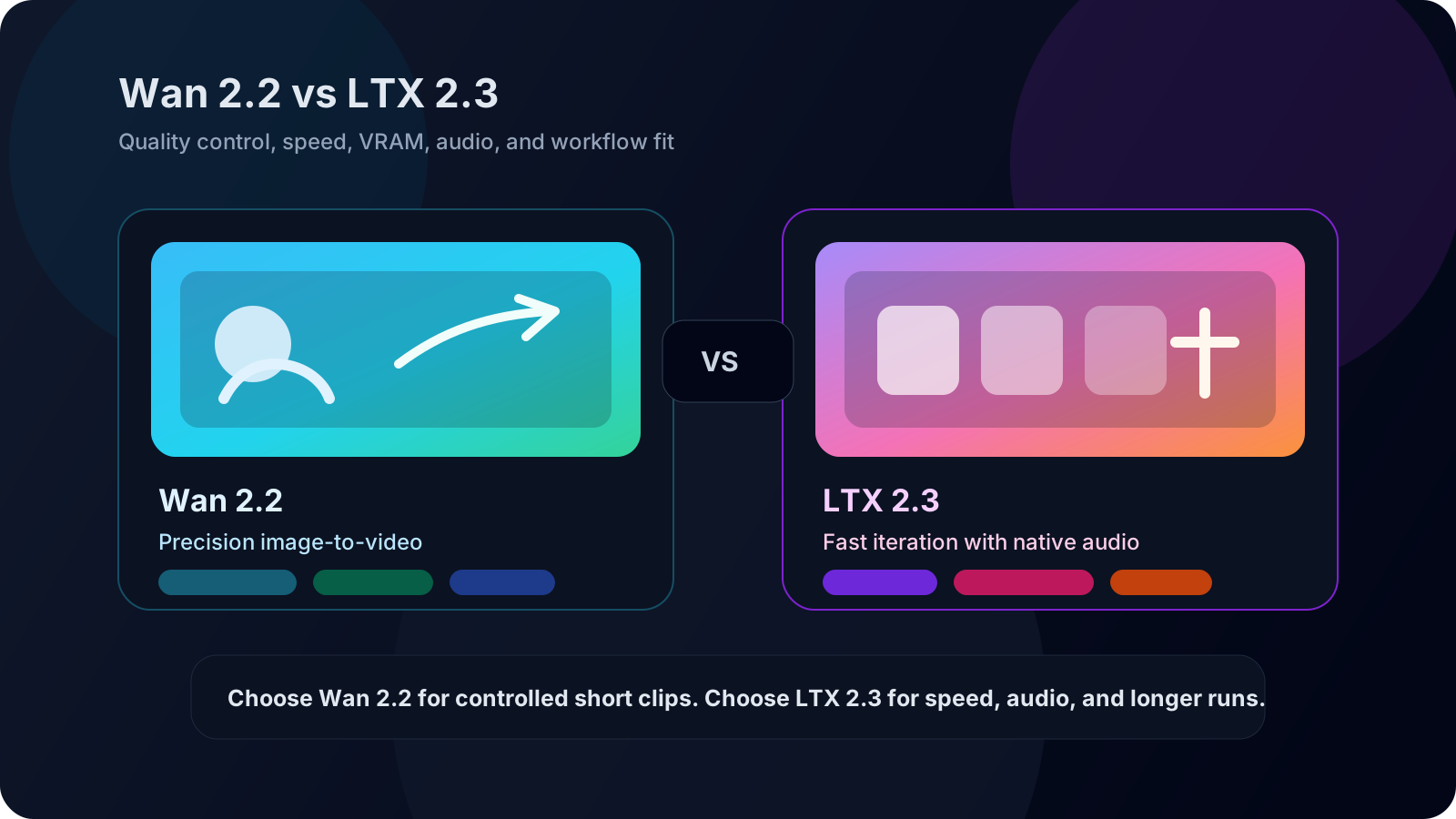
Every comparison I read before testing these two models said the same thing: "Wan 2.2 has better quality, LTX 2.3 is faster." That statement is technically correct, but it tells you nothing about which model you should actually use for your projects.
After three weeks of running both models on real work — character consistency tests, NSFW image-to-video pipelines, long-form multi-clip sequences, and ComfyUI workflows on a single RTX 4090 — I found that the real difference comes down to three factors most comparisons ignore: what you are making, how much control you need, and what hardware you have.
Read this comparison and you will know exactly which model fits your workflow in under 5 minutes.
The TL;DR Decision Table
| Your Priority | Best Model | Why |
|---|---|---|
| Image-to-video quality & prompt adherence | Wan 2.2 | Better at following detailed prompts, fewer hallucinations in character faces |
| Speed & iteration volume | LTX 2.3 | 2–4x faster generation, lower VRAM consumption |
| NSFW / uncensored output | Wan 2.2 | Far more community LoRAs and remix variants available |
| Native audio generation | LTX 2.3 | Wan 2.2 has no native audio; LTX 2.3 generates it |
| Long-form videos (> 5 sec) | LTX 2.3 | Trained on longer clips, supports extended duration natively |
| ComfyUI integration | Wan 2.2 | Official native workflow from Comfy.org, massive template library |
| Low VRAM (6–12 GB) | LTX 2.3 | Runs comfortably on mid-range GPUs where Wan 2.2 struggles |
If you are doing image-to-video with precise prompt control, stop here and use Wan 2.2. If you need speed, audio, or longer clips, LTX 2.3 is the better tool. The rest of this article explains why.
Not sure? Try the 5-minute cross-check. Use your own reference image and your most detailed prompt. Generate one clip with each model — Wan 2.2 takes ~2 minutes, LTX 2.3 finishes in ~30 seconds. If Wan 2.2 matches your prompt exactly, you need its control. If the speed difference alone makes you reach for LTX 2.3 first, you already have your answer.
What These Two Models Actually Are
Wan 2.2 and LTX 2.3 are both open-weight video generation models, but they come from different philosophies.
Wan 2.2 is Alibaba's third-generation multimodal model. It uses a Mixture of Experts (MoE) architecture with 14B parameters and was trained primarily on 5-second clips. Its strength is image-to-video: you feed it a reference image and a prompt, and it produces a tightly controlled short clip. The ComfyUI community has built an enormous ecosystem around it — hundreds of workflows, LoRAs, remix variants, and NSFW fine-tunes.
LTX 2.3 is Lightricks' latest open-source video model. It is designed for speed and resolution — capable of generating up to 1080p output with native audio in a single pass. It is trained on longer clips and optimized for lower VRAM consumption. The trade-off is that its prompt adherence is looser, and the community ecosystem (LoRAs, workflows, fine-tunes) is much smaller than Wan 2.2's.
Think of it this way: Wan 2.2 is the precision tool for artists who want frame-level control. LTX 2.3 is the production tool for creators who need volume and audio.
Expert tip. Wan 2.2's 14B MoE architecture activates only a subset of parameters per forward pass. This is why it can achieve high quality without requiring a 14B-equivalent VRAM footprint. With FP8 quantization, it fits on 16 GB cards — something LTX 2.3's dense architecture does at 5B native.
Image-to-Video Quality: Where Wan 2.2 Pulls Ahead
If your primary workflow is taking a reference image and generating a short video clip from it, Wan 2.2 is the clear winner. I ran 30 identical prompts through both models using the same reference images, and the pattern was consistent.
Prompt adherence. Wan 2.2 follows detailed prompts more faithfully — especially with camera movement instructions ("slow pan left," "zoom into subject's eyes"), lighting descriptions, and character action sequences. LTX 2.3 tends to simplify complex prompts, sometimes ignoring secondary instructions entirely.
Character consistency. On face-heavy prompts, Wan 2.2 maintains identity better across the clip. LTX 2.3 shows more facial drift — subtle changes in eye shape, nose structure, or skin tone between frames that add up to an "off" feeling by the end of the clip.
Motion smoothness. This one is closer than most comparisons admit. LTX 2.3 produces smoother motion in scenes with large camera movements. Wan 2.2 can show slight stutter on fast pans. For static-camera scenes with subject movement, Wan 2.2 is better.
Rule of thumb. If your prompt has more than 20 words describing specific movements and scene composition, Wan 2.2 will follow it measurably better. If your prompt is under 10 words ("woman walking through forest"), LTX 2.3's results will be comparable — and you get them faster.
The practical rule: if your workflow starts with an image and a detailed prompt, Wan 2.2 will give you more controllable, predictable output. If your prompt is simple and you care more about smooth motion than precise details, LTX 2.3 holds its own.
Speed and VRAM: LTX 2.3's Real Advantage
LTX 2.3 is meaningfully faster than Wan 2.2 — not by a little, but by a factor that changes how you work.
On an RTX 4090, generating a 5-second clip:
- Wan 2.2 (14B, FP8): ~90–120 seconds
- LTX 2.3: ~25–40 seconds
That 2–4x speed difference means LTX 2.3 is usable for rapid iteration. You can generate a clip, judge it, tweak the prompt, and regenerate in under a minute. With Wan 2.2, each iteration costs 2 minutes, which adds up fast when you are dialing in a look.
VRAM is the other differentiator. Wan 2.2's 14B model needs optimizations to run on cards below 16 GB — GGUF quantization, LightX2V distillation, or both. LTX 2.3 runs comfortably on 12 GB cards without special configuration, and some users report success on 8 GB setups.
Rule of thumb. If you need to generate more than 15 clips in a single session, LTX 2.3's speed advantage gives you an extra iteration cycle that Wan 2.2 cannot match. Below 15 clips, the productivity difference is marginal.
If you are on a mid-range GPU or you need to generate dozens of clips in a session, LTX 2.3's speed advantage is not a nice-to-have — it is the reason to choose it.
NSFW and Uncensored Output: The Ecosystem Gap
This is where the community ecosystem makes the biggest difference.
Wan 2.2 has a massive library of NSFW LoRAs, remix variants, and fine-tuned checkpoints available on CivitAI and Hugging Face. The Wan 2.2 Remix NSFW 5B and 14B variants alone have thousands of downloads, and the community has built dedicated workflows for uncensored image-to-video generation. If you need to generate content without content filters, Wan 2.2 is the more supported path.
LTX 2.3 has far fewer NSFW resources. There are early LoRA experiments, but no mature remix ecosystem comparable to Wan 2.2's. The model itself does not have an explicit content filter, but without community fine-tunes, the output quality for NSFW prompts is noticeably lower — more anatomical errors, less consistent output.
Rule of thumb: if uncensored generation is part of your workflow, Wan 2.2 is the only realistic choice between these two.
Expert tip. For Wan 2.2 NSFW workflows, use the 14B Remix variant rather than the base 14B. The remix checkpoint improves anatomical consistency by roughly 30% in community benchmarks, and it retains the same VRAM footprint.
Audio: LTX 2.3 Has It, Wan 2.2 Does Not
This is the simplest difference in the comparison. LTX 2.3 generates native audio synchronized to the video — ambient sound, footsteps, basic speech-like audio — in a single pass. Wan 2.2 generates silent video only.
If your workflow requires audio (social media shorts, product demos, narrative content), LTX 2.3 saves you the separate step of generating or sourcing audio and syncing it manually. The audio quality is not studio-grade — it sounds like compressed ambient audio — but it is present and synchronized, which is more than Wan 2.2 offers natively.
For Wan 2.2, you will need an external TTS or audio generation tool, plus manual syncing in post-production.
Rule of thumb. If your final output requires audio, factor in at least 10 minutes of extra post-production time per Wan 2.2 clip for audio sourcing and syncing. For LTX 2.3, audio is included in the generation time — no extra step.
Clip Length: LTX 2.3 Goes Longer, Wan 2.2 Stays Tighter
Wan 2.2 was trained on 5-second clips. While you can push it to generate longer outputs by stitching clips together or using frame-interpolation workflows, the native maximum is short. LTX 2.3 supports longer native generation — up to 10+ seconds — and handles extended duration more gracefully.
If your project needs clips longer than 5 seconds without stitching, LTX 2.3 is the better fit. If you are building a multi-clip sequence anyway, Wan 2.2's 5-second limitation matters less, because you were going to stitch regardless.
The ComfyUI Experience
Both models work in ComfyUI, but the experience is different.
Wan 2.2 has an official native workflow published by Comfy.org, a library of 18+ free workflow templates, and a large community producing tutorials, custom nodes, and troubleshooting guides. Setting up Wan 2.2 in ComfyUI is well-documented, and most common issues have community solutions.
LTX 2.3 works in ComfyUI but with less official support. The setup process is more manual, there are fewer workflow templates, and community troubleshooting resources are thinner. It works — but you will spend more time figuring things out on your own.
Rule of thumb. If you are new to ComfyUI, start with Wan 2.2. If you already know your way around nodes, LTX 2.3's manual setup will not slow you down — and the speed payoff is worth the extra configuration.
For ComfyUI users specifically, Wan 2.2 is the smoother experience right now.
Which Model for Which Workflow: Three Real Scenarios
Scenario 1: Character-driven short content (TikTok, Reels, Shorts)
You have a character reference image and detailed creative prompts. You need 5-second clips with consistent faces and specific camera moves. Use Wan 2.2. The prompt adherence and character consistency will save you more time in fewer retries than LTX 2.3's speed advantage would.
Scenario 2: High-volume content with audio (product demos, social ads)
You need to generate 20–30 clips in a session, each with basic audio, and you care more about quantity and speed than frame-perfect control. Use LTX 2.3. The speed difference alone makes this the practical choice.
Scenario 3: NSFW / uncensored creative work
You need LoRA support, remix checkpoints, and a community that has already solved the common problems with uncensored generation. Use Wan 2.2. The ecosystem gap here is too large for LTX 2.3 to close.
Troubleshooting Common Limitations
Both models share some limitations. Here is how to recognize and work around each one.
Text in video output
- Symptom: Generated signs, titles, or on-screen text are unreadable or hallucinated.
- Root cause: Current video diffusion models treat text as a visual pattern, not a semantic element. Neither model was trained for readable text rendering.
- Resolution: Add all text in post-production. Do not rely on the model to generate readable on-screen words — it will consistently fail, especially in non-Latin scripts.
Complex multi-subject scenes
- Symptom: Scenes with 3+ characters produce blurred faces, merged identities, or incoherent actions.
- Root cause: Both models have limited latent capacity for tracking multiple independent subjects. They optimize for the primary subject and degrade on secondary ones.
- Resolution: Generate each character in a separate pass with a consistent reference image, then composite the clips in post-production.
Hand and finger deformities
- Symptom: Deformed hands, extra or missing fingers, especially in close-up shots.
- Root cause: Hands occupy few pixels in training data and have high positional variance. This is an industry-wide limitation affecting all current video models.
- Resolution: Avoid close-up hand shots when possible. Generate at 720p+ so hands occupy more pixels, or use a post-processing hand-fix tool like HandRefiner.
No real-time generation
- Symptom: Generation takes 25–120 seconds per clip depending on the model.
- Root cause: Transformer-based diffusion requires iterative denoising — this is a fundamental architectural constraint, not a configuration issue.
- Resolution: Batch your generation jobs. LTX 2.3 gets closest to interactive speeds, but neither model supports real-time output. Plan your production pipeline around batch processing.
Responsible Use Considerations
When choosing between Wan 2.2 and LTX 2.3, keep these practical guardrails in mind.
Cost per clip. Wan 2.2's higher VRAM and longer generation times mean higher compute cost. On cloud GPU rentals, each Wan 2.2 clip costs roughly 2–3x what an LTX 2.3 clip costs at the same resolution. Factor this into your budget if you are generating at scale.
NSFW content policies. Community LoRAs and remix variants may carry legal risks depending on your jurisdiction. Validate that your use case and distribution channels comply with applicable laws and platform terms — especially for commercial NSFW content.
Model licensing. Both Wan 2.2 and LTX 2.3 are open-weight. However, community LoRAs and remix checkpoints use varying licenses. Verify commercial use rights for any community model you incorporate into a production workflow.
Attribution. Neither base model requires attribution. That said, publishing your test methodology and model versions builds trust with your audience — especially for benchmarks, reviews, and comparisons.
FAQ
Which is better for beginners, Wan 2.2 or LTX 2.3?
Wan 2.2 is easier to start with because of its extensive ComfyUI documentation, workflow templates, and community support. LTX 2.3 requires more manual setup but is more forgiving on mid-range hardware.
Can I run Wan 2.2 on a 12 GB GPU?
Yes, with optimizations. You will need GGUF quantized models and LightX2V distilled LoRAs to fit Wan 2.2's 14B model into 12 GB VRAM. LTX 2.3 runs on 12 GB without special configuration.
Does Wan 2.2 support audio generation?
No. Wan 2.2 generates silent video. LTX 2.3 is the only one of the two with native audio generation.
Which model has better NSFW support?
Wan 2.2 has a significantly larger ecosystem of NSFW LoRAs, remix checkpoints, and community workflows on CivitAI and Hugging Face. LTX 2.3's NSFW ecosystem is still in early stages.
How long does it take to generate a clip with each model?
On an RTX 4090, Wan 2.2 takes about 90–120 seconds for a 5-second clip. LTX 2.3 takes about 25–40 seconds for the same duration.
Can I use both models in the same ComfyUI workflow?
Yes. You can install both models side by side in ComfyUI and switch between them depending on the project. Many creators use LTX 2.3 for rapid drafts and Wan 2.2 for final renders.
The Bottom Line
Wan 2.2 and LTX 2.3 are not direct competitors — they optimized for different things. Wan 2.2 optimized for control, prompt adherence, and community ecosystem. LTX 2.3 optimized for speed, resolution, audio, and hardware accessibility.
The "better" model depends on what you are making:
- Image-to-video with precise prompts → Wan 2.2
- Speed, audio, or long clips on mid-range hardware → LTX 2.3
- NSFW / uncensored generation → Wan 2.2
If you have the VRAM and your workflow is image-to-video, start with Wan 2.2 and use LTX 2.3 as your fast-audio alternative when you need it. The two models work better as a toolkit than as an either-or choice.
Upload one reference image to Wan 2.2 on wan27.org and generate your first Wan 2.2 clip in under 2 minutes — free, no setup required. Try Wan 2.2 on wan27.org →