Table of Contents
Is Wan 3.0 Open Source? What Actually Shipped, the License, and How to Run It (2026)
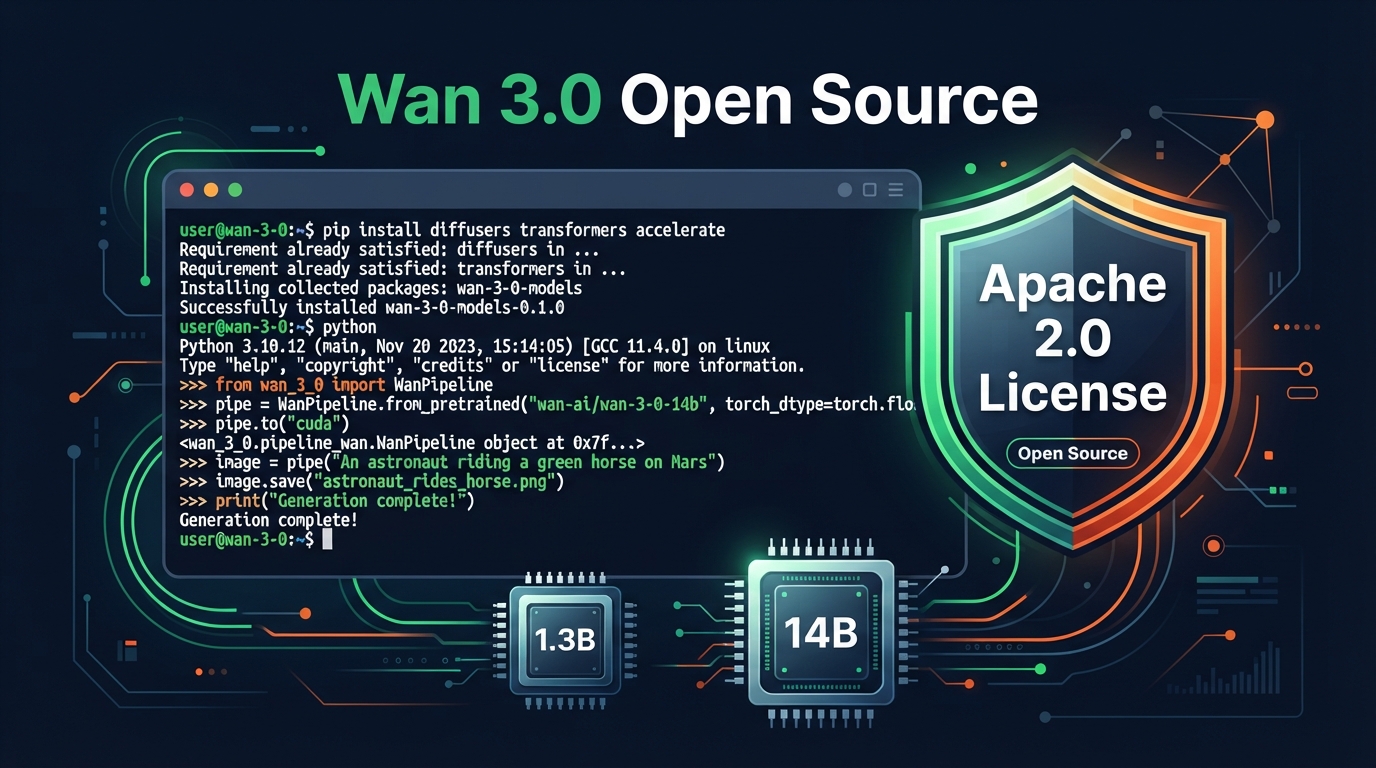
Yes — Wan 3.0 is open-weight under the Apache 2.0 license. Alibaba Tongyi Lab pledged Wan 3.0 as an Apache 2.0 open-weight release, and open-weight checkpoints — a lightweight 1.3B model for consumer hardware and a professional 14B version — were reported released around April 2026. "Open-weight" is not the same as "open source" in the OSI sense: the weights and inference code are public, while the training pipeline and dataset are not. And after Wan 2.5 was promised open and never shipped, the community's real question is "will the weights actually stay available." This guide covers what shipped, what the license lets you do, what GPU you need, and where to download.
The Short Answer: Yes, Wan 3.0 Is Open Source (with One Caveat)
If your question is "can I download Wan 3.0 and run it on my own machine?" — yes. Open-weight releases of the 1.3B consumer model and the 14B professional model were reported by industry trackers in late April 2026, under the same Apache 2.0 license that covered the community-favorite Wan 2.2 (LinkedIn — "Alibaba Releases Wan 3.0 Open-Weight Video Models," Apr 27 2026).
The caveat is vocabulary. What ships is:
- Model weights — public, downloadable
- Inference code and examples — public via the Wan-Video GitHub organization
- Training code and dataset — not published, as with every prior Wan release
For creators and builders, "open source" in the practical sense — run it, fine-tune it, build on it — is already true; reproducing the training run is not. Most people asking "is Wan 3 open source" want the first answer.
What Actually Shipped: The 1.3B and 14B Open-Weight Releases
Wan 3.0's open-source story is not a single model — it shipped as two open-weight checkpoints:
| Model | Target | Hardware class |
|---|---|---|
| Wan 3.0 1.3B | Consumer / hobbyist hardware | ~8GB-class GPUs |
| Wan 3.0 14B | Professional / production work | ~24GB-class GPUs |
The 14B version carries Wan 3.0's headline capabilities: native 4K output, up to 30-second clips, and sound/audio in generated video, plus strong character consistency across shots and multi-shot cinematic output. It supports text-to-video and image-to-video, with reference-to-video and video-edit through the API. Some third-party sites circulate "60B parameter" claims — unconfirmed; the open releases that actually shipped are the 1.3B and 14B checkpoints above.
Timeline note: Alibaba pre-announced the open release around April 2026, with several outlets initially expecting a mid-2026 drop; the weights were reported to have shipped later that same month, in late April 2026 (Flowith's early-2026 take was written before they landed). For the full capability rundown — 4K, 30 seconds, audio, character consistency — see What Is Wan 3.0? Everything We Know.
Wan's Open/Closed History: Why "Pledged Open" Isn't Enough Anymore
Alibaba's Wan family has swung between open and closed strategies version by version:
| Version | Released | License | What actually happened |
|---|---|---|---|
| Wan 2.1 | Feb 2025 | Apache 2.0 | Fully open; source + all models published |
| Wan 2.2 | Jul 2025 | Apache 2.0 | Fully open; community favorite, huge ComfyUI ecosystem |
| Wan 2.5 | Sep 2025 | Commercial API | Pre-announced as open — weights never shipped |
| Wan 2.6 | Dec 2025 | Closed API | API-only, no open release |
| Wan 2.7 | Mar 2026 | Apache 2.0 (partial) | Select models open, premium features API-only |
| Wan 3.0 | 2026 (open weights ~Apr 2026) | Apache 2.0 (pledged + 1.3B/14B weights shipped) | Next-gen: 4K, 30s, sound |
| WanSong / Wan-Dancer / Wan-Streamer | Jul 2026 | Apache 2.0 | Music, dance, and streaming ecosystem models |
Wan 2.5 was announced as open, then went commercial-API; Wan 2.6 was closed entirely; Wan 2.7 took months of community pressure before select models shipped under Apache 2.0. We covered each chapter as it happened — Is Wan 2.5 Open Source?, Is Wan 2.6 Open Source?, Wan 2.7 Open Source: What Is Actually Open. That history is why "pledged open" got a skeptical reception — and why the actual arrival of the weights was the real news, not the pledge.
What Apache 2.0 Actually Lets You Do (Commercial Use Included)
Wan 3.0's open weights are released under Apache 2.0, the same permissive license used by Wan 2.1, 2.2, and the partial 2.7 release. Three things matter:
- Commercial use is allowed. You can use Wan 3.0 outputs in commercial products and services without a separate license fee.
- Modification and redistribution are permitted. You can fine-tune the model, build LoRA adapters, and redistribute your modified weights.
- No share-alike obligation. Unlike GPL-style licenses, Apache 2.0 does not force you to open-source your own modifications or the videos you generate.
The practical takeaway: if you are building a product, a service, or a creative pipeline on Wan 3.0, the license does not get in your way. The same analysis applied to the previous generation: Can You Use Wan 2.7 Commercially? Licensing, Rights, and Practical Rules.
One boundary to keep straight: the open weights are Apache 2.0, but hosted/API-only features (reference-to-video, video edit, premium tiers) sit behind platform terms of service. "Open model, closed premium features" is the pattern Wan established with 2.7.
Running Wan 3.0 Locally: 1.3B vs 14B Hardware
The VRAM question is the biggest one in the community right now — and the reason the 1.3B model matters:
| Hardware | Wan 3.0 1.3B | Wan 3.0 14B |
|---|---|---|
| 8GB GPU (RTX 4060-class) | Yes — intended use case | No |
| 12–16GB GPU (RTX 4070 / 4080) | Yes, comfortably | GGUF/quantized, short clips only |
| 24GB GPU (RTX 3090 / 4090) | Yes, fast | Yes — practical minimum for full quality |
| 24GB+ / A100 class | Yes, instant | Yes, fast — full 4K/30s workflows |
The 1.3B model was released precisely for the 8GB-class crowd — people who could never run a 14B video model locally. It trades clip length and resolution to run on hardware most enthusiasts already own.
The 14B model needs 24GB VRAM or more for comfortable full-quality generation, matching Wan 2.7's demands. Budget roughly 30GB+ of disk per full-precision checkpoint set; the 1.3B is only a few GB. Quantized conversions lower the 14B's VRAM floor, at the usual cost of speed and fidelity.
Where to Download the Weights
Wan 3.0's open weights follow the same channels as 2.2 and 2.7:
- Hugging Face (
Wan-AIorganization) — the primary home for model weights, via the website or thehuggingface_hublibrary. - GitHub (
Wan-Videoorganization) — the inference code, examples, and docs at github.com/Wan-Video. - ModelScope — Alibaba's own platform; often the fastest route in Asia.
Rule of thumb: verify you are on an official Wan-AI / Wan-Video / ModelScope page. Clone sites and SEO-optimized download pages were a persistent problem in the 2.7 era, and the same junk will chase "wan 3.0 weights download" queries.
The Ecosystem Is Open Too: WanSong, Wan-Dancer, and Wan-Streamer
In July 2026, Alibaba shipped a wave of companion models — every one Apache 2.0:
- WanSong — a text-to-music model (~25B parameters)
- Wan-Dancer-14B — music-to-dance generation
- Wan-Streamer — real-time streaming interaction
None carries a "Wan 2.x" label, which is why they are read as part of the Wan 3.0 generation (Hugging Face blog — Wan 3.0 ecosystem signals). The open stack around Wan is broadening from video into music, dance, and live interaction — all commercially usable under the same permissive license.
The Skepticism: Will the Weights Really Stay Open?
The honest section: the community's reaction to Wan 3.0 has been cautious rather than euphoric, and the caution is earned.
Wan 2.5 was pre-announced as open and never shipped; Wan 2.6 shipped closed; Wan 2.7 took sustained community pressure before select weights appeared. So when Alibaba pledged Wan 3.0 as Apache 2.0, threads like r/StableDiffusion's "open-sourcing new Qwen and Wan models" were full of the same question: are we actually getting the weights this time?
The dominant sentiment across r/StableDiffusion and r/comfyui in mid-2026 was skepticism about delivery rather than quality: the question was whether the weights would actually ship, not how good the model would be.
That framing is why the April 2026 release — downloadable 1.3B and 14B checkpoints under Apache 2.0 — was the milestone that converted the pledge into fact.
The enthusiasm is real, though: enthusiasts now recommend Wan 3.0 alongside Seedance 2.0 for open video generation and compare it against Veo 3.1, Kling 3.0, and LTX. Some users who found Wan 2.7 output "plastic"-looking hope Wan 3.0 fixes the aesthetic — currently unconfirmed by widespread testing.
Open Weights vs Hosted: Which Path Should You Take?
| Factor | Open weights (self-host) | Hosted platform |
|---|---|---|
| Upfront cost | GPU or cloud GPU rent | Free credits, then per-generation |
| Hardware needed | 8GB GPU (1.3B) or 24GB+ (14B) | None — runs in the browser |
| Output quality | Same model, capped by GPU | Same model, full 4K/30s |
| Control | Full — modify, fine-tune, automate | Limited to platform features |
Start hosted if you want to see Wan 3.0-quality output before committing to a GPU purchase or a 30GB download. The Wan 3.0 AI video generator offers text-to-video and image-to-video workflows with free credits on signup. Go local if you generate at high volume, need privacy, or plan to fine-tune — the 1.3B model finally makes that viable on modest hardware.
FAQ
Is Wan 3.0 open source?
Yes — open-weight under Apache 2.0. The 1.3B consumer and 14B professional models shipped as open weights around April 2026. Weights and inference code are public; training code and dataset are not.
Can I use Wan 3.0 commercially?
Yes. Apache 2.0 permits commercial use, modification, and redistribution, with no share-alike obligation. Hosted premium features (reference-to-video, video edit, API tiers) follow platform terms of service instead.
What GPU do I need for Wan 3.0?
The 1.3B consumer model runs on an 8GB-class GPU (RTX 4060 or similar). The 14B professional model needs 24GB VRAM or more (RTX 3090/4090 class) for full quality; quantized versions can run on 12–16GB cards for shorter clips.
Is Wan 3.0 free?
The open weights are free to download and self-host — you pay only for your hardware. Hosted platforms charge per generation, though most (including wan-3.io) offer free credits on signup.
Where can I download the Wan 3.0 weights?
From Wan-AI on Hugging Face, the Wan-Video GitHub org, and Alibaba's ModelScope. Avoid third-party download sites.
Is Wan 3.0 better than Wan 2.7?
Wan 3.0 targets capabilities Wan 2.7 lacks — native 4K, 30-second clips, and sound — and the 1.3B model opens local generation on hardware that could never run 2.7. Whether the aesthetics improve on 2.7's "plastic" look is not yet settled.
Bottom Line
Wan 3.0 is the most open the Wan family has been since Wan 2.2 — and this time the pledge converted into actual weights. The 1.3B consumer and 14B professional models are downloadable under Apache 2.0, commercially usable, joined by an Apache 2.0 ecosystem of music, dance, and streaming models. The skepticism is understandable given the 2.5/2.6 era, but the April 2026 release answered the only question that mattered: the weights exist.
Your next move depends on your hardware. Judge the output before investing in local setup: try the hosted workflow on the Wan 3.0 AI video generator — free credits, no GPU required. Developers should read the Wan 3.0 API guide for T2V, I2V, R2V, and VideoEdit endpoints. For the deeper rundown, revisit What Is Wan 3.0? Everything We Know or Wan 2.7 Open Source: What Is Actually Open.