Table of Contents
Yesterday, the AI video generation market had a clear hierarchy. Kling v3 Pro, Seedance 2.0, Runway Gen-4.5, and Luma Ray 3.2 each owned a lane — speed, quality, or features — and you picked your trade-off. No single model did everything. And no major model generated audio natively as part of the video generation pass.
Black Forest Labs just made that hierarchy obsolete.
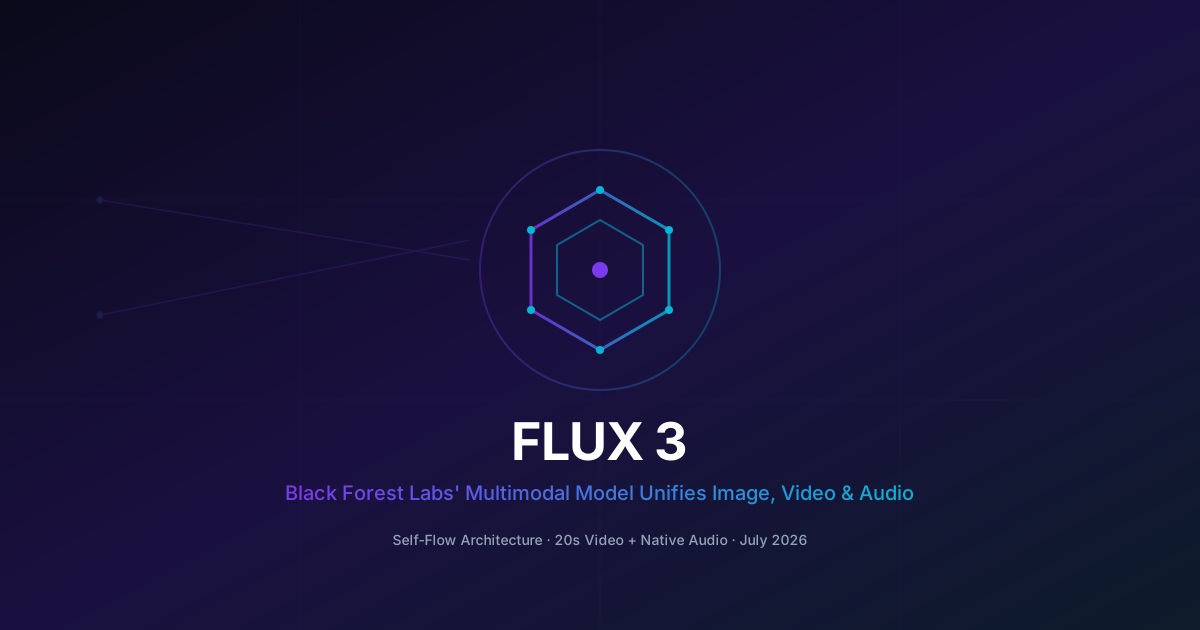
On July 23, 2026, BFL released FLUX 3 — a multimodal foundation model that jointly learns from images, video, and audio within a single unified architecture. It is not three models sharing a brand name. It is one model that generates video with native audio, edits images, renders readable text, and predicts robot actions — all from the same set of weights. FLUX 3 Video is in early access right now at bfl.ai/models/flux-3. FLUX 3 Image and FLUX 3 Action follow in the coming weeks.
All specifications, benchmark data, architecture details, and launch timeline information in this article come directly from Black Forest Labs' official July 23 announcement and technical documentation. No second-hand aggregations or paraphrases — every benchmark number, capability claim, and timeline date is BFL's own published data, flagged accordingly where preliminary or vendor-reported. Competitive comparison data (duration, audio capabilities, typography support for Kling, Seedance, Runway, and Luma) is cross-referenced against each vendor's public documentation as of July 23, 2026.
This article breaks down what FLUX 3 does, how its architecture works, where it beats the competition on published benchmarks, and what the phased launch timeline means for anyone building with AI video and image tools.
What Makes FLUX 3 Different: One Architecture That Learns Images, Video, and Audio Together
Every major AI video model released in 2025 and early 2026 trained on one modality. Text-to-video models learned from video. Text-to-image models learned from images. Audio was bolted on later with separate post-processing pipelines — if it was available at all.
FLUX 3 breaks that pattern at the architectural level.
BFL built FLUX 3 on a unified multimodal flow matching framework built on what they call the Self-Flow approach: images capture spatial structures and composition, video restores temporal dynamics and physics, and audio reveals causal relationships between events and sounds. When all three modalities are learned simultaneously, each one constrains and teaches the others. An image of a coffee cup teaches the model what a cup looks like. Video of a cup falling teaches it how objects move and shatter. Audio of ceramic breaking teaches it what that event sounds like. Trained together, the model learns that a video of a falling cup should generate the sound of ceramic breaking — not just a generic impact noise.
The practical result: FLUX 3 does not need a separate audio model, a separate image upscaler, or a separate text renderer. One model, one architecture, one inference pass. If you prompt for a video of a glass shattering on concrete, FLUX 3 generates the visual impact and the audio of the shatter from the same internal representation — because it learned that glass shattering looks and sounds a certain way together during joint training.
Rule of thumb: In multimodal AI, joint training beats post-hoc stitching. If a model learns audio from a separate dataset and attaches it after video generation, the audio will be plausible but generic. If it learns audio and video together from the same data, the audio is causally linked to what happens on screen. FLUX 3's architectural bet is that the second approach produces outputs that feel fundamentally more coherent — and the benchmark numbers support that bet.
Why Joint Multimodal Training Matters in Practice
This architectural distinction is not academic. Here is what joint multimodal training unlocks that separate models cannot achieve:
- Native audio generation: Audio is generated from the same flow-matching pass as the video frames. No separate diffusion model for sound. No lip-sync post-processing. A single generation call produces a complete audiovisual clip.
- Multilingual dialogue in one scene: Characters can speak different languages within the same video, with lip movements matching the audio — because speech audio and mouth movements were learned from the same training data.
- Strong typography: Text rendering in images and video is not a separate feature bolted onto a video model. It is a natural output of a model that learned spatial structure from images and temporal consistency from video in the same training run.
- Cross-modal editing: Editing an image with FLUX 3 uses the same model that generates video. The model understands spatial edits (what changes in a frame) and temporal consequences (how that change propagates across subsequent frames) simultaneously.
If you have used AI video tools in the past year, you know the workflow: generate video in one tool, add audio in another, fix lip-sync in a third, render text overlays in a fourth. FLUX 3 collapses that pipeline into one step. The architectural bet is straightforward — learn from everything at once, and the mutual constraints teach the model how the world actually works, not just how pixels should look.
Architecture papers are persuasive on paper. What matters in practice is what the model can actually generate. The video module — the first FLUX 3 component shipping to early access — turns the joint-training theory into a set of capabilities that no other model offers in a single inference pass.
FLUX 3 Video: 20-Second Clips With Native Audio and Agentic Multi-Shot Chaining
The video generation module is the first FLUX 3 component shipping — and it ships with capabilities that most competing models either lack entirely or handle through separate audio pipelines.
Text-to-Video and Image-to-Video
FLUX 3 generates up to 20 seconds of video from text prompts or image inputs. The model supports video-to-video and keyframe-to-video modes, meaning you can supply a reference clip and transform it stylistically, or provide specific frame-level guidance for precise shot control. This brings FLUX 3 Video into parity with the input flexibility of the current market leaders in a single model — and ahead once audio is factored in.
Native Audio: The Feature No Competitor Has at Launch
This is the headline difference. FLUX 3 generates audio and video together in one inference pass — not as a post-processing step. A prompt like "a jazz drummer in a dimly lit club, cymbal crashes synchronized with the drummer's motions" produces video where the stick hits the cymbal visually and the crash happens audibly at the same moment. No separate audio track to align. No lip-sync tool to run afterward.
For comparison: Kling v3 Pro and Seedance 2.0 offer video generation but rely on separate audio pipelines. Sora 2 added audio in a subsequent update but does not generate it natively in the same inference pass. Runway Gen-4.5 does not generate audio at all. FLUX 3 is the first major model where "generate a 20-second video with sound" is one operation, not two or three.
Multilingual Dialogue Without Separate Lip-Sync
Characters in FLUX 3 videos can speak different languages within the same scene, with lip movements and audio generated together. This is a direct consequence of the joint training approach: the model does not need to learn lip-sync as a separate alignment problem because speech audio and mouth movements were learned from the same data distribution simultaneously.
Agentic Chaining into Multi-Shot Sequences
FLUX 3 can chain multiple generation calls into coherent multi-shot sequences through agentic reasoning. Instead of generating a single 20-second clip at a time and hoping the next one matches, the model plans transitions between shots, maintains character and scene consistency across them, and stitches the output into a continuous narrative. This capability is particularly relevant for storyboarding, short film production, and advertising workflows where single-shot generation is not enough.
Typography in Video: A Persistent Pain Point, Potentially Solved
Text rendering in AI video has been a persistent weakness across every major model. Letters get garbled, characters morph across frames, and readable on-screen text requires manual compositing in post-production. FLUX 3 claims significant improvement here — a direct result of learning text rendering from image data during joint training. If the claim holds in community testing, this alone eliminates a major production bottleneck that has forced creators to composite text manually for years.
Expert-level pitfall: Native audio generation is the feature that separates FLUX 3 on paper, but the real test is coherence at the tail end of 20-second clips. Most models degrade in temporal consistency during the last 5 to 8 seconds — faces distort, objects drift, motion becomes jittery. If FLUX 3 maintains audio-visual synchronization through the full 20 seconds, it is a genuine generational leap. If it degrades after 10 to 12 seconds — as many video models do — it is an incremental improvement over the status quo with a new audio feature attached. Wait for third-party reviews that test the full 20-second envelope before committing a production pipeline to FLUX 3.
FLUX 3 Image: Coming Soon, With a Track Record to Beat
The image generation module — FLUX 3 Image — is not shipping on day one. BFL says it will enter early access "in the following weeks." But the announcement outlines what to expect based on the unified architecture:
- Text-to-image generation with significantly improved prompt adherence over FLUX.2
- Image editing using the same model: paint in, paint out, style transfer, object replacement — without switching to a separate editing model
- Wide style diversity: photorealism, illustration, 3D render, line art, and more — all from the same model without toggling between specialized variants
- Complex prompt handling: multiple subjects, spatial relationships, attribute binding — the areas where previous FLUX models sometimes struggled relative to Midjourney and Ideogram
- Multi-language text rendering: improved text generation in images, supporting multiple scripts and languages in a single image
BFL positions FLUX 3 Image as a "significant improvement" over FLUX.2. The FLUX.2 series — which includes FLUX.2 Pro, FLUX.2 Dev, and FLUX.2 Schnell — already competes with Midjourney V7 and Ideogram V4 on image quality. An architectural leap from FLUX.2's single-modality training to FLUX 3's joint multimodal training, applied to image generation specifically, could meaningfully shift the competitive landscape.
How FLUX 3 Image compares to the current image generation leaders — Midjourney V7, Nano Banana 2 (Gemini 3.1 Flash Image), and Ideogram V4 — will become clear once the early access benchmarks and community testing land in the coming weeks.
FLUX 3 Action: Robot Prediction, Tested on Real Production Tasks at Audi
The third module is the one nobody expected from an AI media company. FLUX 3 Action is a robot action prediction system built on the same unified multimodal backbone that generates video and images.
The logic: the unified architecture already models physical dynamics from video training data. It understands how objects move, collide, deform, and interact with each other — because it had to learn those dynamics to generate coherent video. Applying that understanding to robot control — predicting what action a robot arm should take next to achieve a goal — is a natural extension of the same capabilities. The model does not need to learn physics separately for video and for robotics; the physics learned from video transfers directly.
BFL is working with Mimic Robotics as its first partner. Mimic operates in the industrial robotics space, and FLUX 3 Action has already been tested on real production tasks at Audi — one of the world's largest automotive manufacturers. The involvement of a major industrial partner at launch signals that this is not a research prototype being marketed as a product. It is a production deployment.
FLUX 3 Action is available "via selected research and commercial partners" — not through the same early access program as the video and image modules. This is enterprise-only for now, with Mimic Robotics as the first deployment partner.
The broader significance: if BFL's unified architecture successfully transfers from media generation to physical action prediction, it validates the core claim that joint multimodal training creates a genuinely general world model — not just a better image generator with a separate audio pipeline attached after the fact. A model that generates video, images, audio, and robot actions from the same weights is not a media model. It is a world simulator.
Architectural ambition is one thing. Measured performance against the current market is another. Here is how FLUX 3 Video performed in BFL's preliminary human preference evaluations — the first public data point on whether the unified architecture translates to results users can see.
FLUX 3 Benchmarks: Preliminary Human Preference Results
BFL published preliminary human preference benchmarks for FLUX 3 Video, using 10-second 720p text-to-video clips as the testing standard. The methodology is straightforward: show evaluators FLUX 3 output side by side with a competitor, ask which they prefer, and report the win rate.
| Competitor | FLUX 3 Preference Win Rate |
|---|---|
| Luma Ray 3.2 | 93% preferred FLUX 3 |
| Runway Gen-4.5 | 77% preferred FLUX 3 |
| Grok Imagine Video | 69% preferred FLUX 3 |
| Kling v3 Pro | 60% preferred FLUX 3 |
| Seedance 2.0 | 52% preferred FLUX 3 |
| Gemini Omni Flash | 52% preferred FLUX 3 |
The numbers that matter most: 60% over Kling v3 Pro and 77% over Runway Gen-4.5. Kling v3 Pro and Runway Gen-4.5 are the current production workhorses for professional AI video. A 60%+ preference rate against both is substantial. The narrower 52% margins against Seedance 2.0 and Gemini Omni Flash, however, suggest those models are close competitors — not distant second-place finishers. The Seedance 2.0 result in particular is a data point to watch, given that Seedance 2.5 — a significantly upgraded model with 30-second 4K generation and 50 multimodal reference inputs — is launching now.
Validation note: These are vendor-published preliminary benchmarks on a specific clip type (10 seconds, 720p, text-to-video). Independent third-party evaluations on longer clips, higher resolutions, and more diverse prompt categories will determine whether these numbers hold. For the full 20-second 1080p+ generation that FLUX 3 claims to support, community benchmarks are still pending. Treat these as directional — FLUX 3 is competitive with the top of the field — not as a definitive ranking by exact percentage points.
Expert-level pitfall: Human preference benchmarks with margins under 5 percentage points — like the 52% results against Seedance 2.0 and Gemini Omni Flash — are statistically fragile. A 2–3 point difference on a single evaluation batch of 100–200 judgments is typically within the noise floor. When you see a 52% win rate, the correct interpretation is "roughly tied," not "slightly better." Models that appear to edge ahead on narrow margins in vendor-published evaluations often flip rankings when independent tests apply different prompt distributions. Wait for evaluations that break results down by prompt category — action, dialogue, landscape, abstract — before drawing conclusions from single-digit preference gaps. A model that wins on "scenic landscape" but loses on "complex action sequence" tells you more than one aggregate win-rate number.
FLUX 3 vs the Competition: Capability Comparison
Here is how FLUX 3 Video stacks up against the current market on the dimensions that matter in production:
| Model | Creator | Max Duration | Native Audio | Image-to-Video | Agentic Chaining | Typography |
|---|---|---|---|---|---|---|
| FLUX 3 | Black Forest Labs | 20 seconds | Yes (joint generation) | Yes | Yes | Strong (claimed) |
| Kling v3 Pro | Kuaishou | ~10 seconds | No (separate pipeline) | Yes | No | Moderate |
| Seedance 2.0 | ByteDance | 30 seconds | No (separate pipeline) | Yes | No | Moderate |
| Runway Gen-4.5 | Runway | ~10–15 seconds | No | Yes | No | Weak |
| Luma Ray 3.2 | Luma AI | ~5–10 seconds | No | Limited | No | Weak |
| Grok Imagine Video | xAI | Varies | No | Limited | No | Unknown |
The pattern is clear: FLUX 3's competitive advantage is not in raw duration — Seedance 2.0 beats it on that dimension with 30 seconds — but in the breadth of capabilities within a single model. Native audio, agentic chaining, and strong typography are each missing from most competitors. Having all three in one model, with competitive benchmark scores, is the current differentiator.
If Seedance 2.5 ships native audio in its consumer launch, the gap narrows. If Runway Gen-4.5 adds audio in a mid-cycle update, the gap narrows further. FLUX 3's window of differentiation is real, but it is not permanent.
Which Model to Pick: A Decision Guide for Production Pipelines
If you need to commit to a model for a production pipeline today, here is the practical decision framework — organized by what matters most to your workflow:
- Choose FLUX 3 Video if native audio is non-negotiable. No other major model generates sound and visuals from the same inference pass. The 20-second duration and agentic chaining make it the strongest option for short-form ads, social content, and explainer videos that need integrated audio without a separate post-production step.
- Choose Seedance 2.5 if you need maximum generation length (30 seconds) and reference-image flexibility (50 multimodal inputs). Commercial and music video workflows where raw duration matters will lean toward Seedance on this dimension alone.
- Choose Kling v3 Pro if you need a production-grade API with proven uptime and a large existing community. API reliability, rate limits, and ecosystem maturity trump benchmark scores when you are generating thousands of clips per day.
- Choose Runway Gen-4.5 if your workflow lives inside a creative suite with editing, compositing, and collaboration tools. Runway's integrated environment saves more time than a standalone model with a marginally higher benchmark score.
Rule of thumb: Pick the model for the pipeline you are plugging into, not the benchmark number. A model that integrates natively into your existing workflow — whether that is a ComfyUI node, an API endpoint, or a full creative suite — saves more production hours than a 5% quality lead on a preference chart. The model you can actually ship with is worth more than the model with the higher win rate.
FLUX 3 Launch Timeline
FLUX 3 is not shipping all at once. BFL is rolling out modules in phases across Q3 2026:
| Module | Status | Availability | Target Users |
|---|---|---|---|
| FLUX 3 Video | Early access now | bfl.ai/models/flux-3 | General users, creators, studios |
| FLUX 3 Image | EAP coming "in following weeks" | bfl.ai | Photographers, designers, marketers |
| FLUX 3 Action | Selected partners only | Mimic Robotics, Audi | Industrial robotics, manufacturing |
| FLUX 3 Dev | Coming later | Open-weight multimodal backbone | Developers, researchers, self-hosters |
FLUX 3 Dev is the wildcard. BFL committed to releasing an open-weight version of the multimodal backbone "later" — for both content creation and action prediction. If this materializes with a permissive license, it would be the first open-weight multimodal model that jointly generates video, image, and audio from a single architecture. Both FLUX.1 Dev and FLUX.2 Dev were released as promised, suggesting BFL follows through on open-weight commitments, but no timeline has been confirmed.
A phased launch with an unknown Dev release date raises an obvious question: does the team behind this timeline have the track record to deliver? The answer matters because FLUX 3's roadmap depends on BFL executing across three modules, an open-weight release, and enterprise partnerships — all within a single quarter.
Who Is Behind FLUX 3 — and Why Their Claims Carry Weight
Black Forest Labs is a Germany-based AI research company founded by the core team behind Stable Diffusion at Stability AI. They shipped the FLUX.1 series in 2024 and the FLUX.2 series in 2025, establishing a reputation for high-quality media generation models with a consistent pattern of open-weight releases alongside commercial products.
Key credibility signals:
- ISO 27001:2022 and SOC 2 Type II certified — enterprise-grade security and data handling standards. This matters for commercial and enterprise users evaluating FLUX 3 for production pipelines.
- Martin Scorsese is listed as an advisor, signaling investment in cinematic-quality generation rather than short social-media clips.
- FLUX.1 and FLUX.2 have been independently benchmarked, widely adopted, and integrated into major creative tools, including ComfyUI, Replicate, and fal.ai. The FLUX 3 claims come from a team with a track record of shipping models that perform — not a first-time entrant making ambitious promises.
BFL's established release pattern — commercial Pro model, followed by open-weight Dev and speed-optimized Schnell variants — means the ecosystem around FLUX 3 Dev (ComfyUI workflows, LoRA adapters, community fine-tunes) will determine its long-term adoption as much as the early benchmark scores. If the Dev release includes the multimodal backbone with native audio, it opens a new category of open-weight model that currently does not exist.
Frequently Asked Questions
What is FLUX 3?
FLUX 3 is Black Forest Labs' multimodal foundation model that jointly generates video, images, and audio from a single unified architecture. It was released on July 23, 2026, as the successor to the FLUX.1 and FLUX.2 model families, with the video module entering early access immediately.
What makes FLUX 3 different from other AI video models?
The defining difference is native audio generation. FLUX 3 generates video and audio together in one inference pass, with audio sourced from the same flow-matching framework that produces the video frames. No other major AI video model — not Kling v3 Pro, Seedance 2.0, Runway Gen-4.5, or Luma Ray 3.2 — generates audio natively within the same architecture. They all rely on separate audio models or post-processing pipelines.
Is FLUX 3 available now?
FLUX 3 Video is available in early access at bfl.ai/models/flux-3. FLUX 3 Image will enter early access in the following weeks. FLUX 3 Action is available through selected enterprise partners. FLUX 3 Dev — the open-weight multimodal backbone — is coming later with no confirmed release date.
How long are FLUX 3 videos?
Up to 20 seconds per generation. This is longer than Kling v3 Pro (~10 seconds), Runway Gen-4.5 (~10–15 seconds), and Luma Ray 3.2 (~5–10 seconds), but shorter than Seedance 2.0 and Seedance 2.5, which generate up to 30 seconds.
Does FLUX 3 support image-to-video?
Yes. FLUX 3 Video supports text-to-video, image-to-video, video-to-video, and keyframe-to-video modes — covering the full set of input modalities that professional video workflows require.
Can FLUX 3 generate text in images and videos?
Yes. FLUX 3 claims significant improvement in typography — rendering readable text in multiple languages and scripts within generated images and videos. This is a direct result of learning text rendering from image data during the joint multimodal training.
How does FLUX 3 compare to Seedance 2.0 and Seedance 2.5?
In BFL's preliminary human preference benchmarks using 10-second 720p clips, evaluators preferred FLUX 3 over Seedance 2.0 with a narrow 52% margin — the closest matchup among all competitors tested. Seedance 2.5, launched in June 2026, adds 30-second 4K generation and 50 multimodal reference inputs. For a detailed breakdown of Seedance 2.5's capabilities and pricing, see our full guide.
Will FLUX 3 be open source?
FLUX 3 Dev — the open-weight multimodal backbone — will be released later, according to BFL's announcement. BFL has a track record of delivering open-weight releases: FLUX.1 Dev and FLUX.2 Dev were both released publicly. No specific license or release date has been confirmed for FLUX 3 Dev.
What is FLUX 3 Action?
FLUX 3 Action applies the same unified multimodal architecture to robot action prediction. Trained jointly with video data, the model predicts physical actions for robotic systems. It is being tested with Mimic Robotics on real production tasks at Audi's manufacturing facilities.
Is FLUX 3 better than the Wan 2.7 model?
They target different use cases. Wan 2.7 is optimized for video generation with frame-level control, reference-to-video input, and ComfyUI-native workflows — it anchors an open-source-adjacent creator ecosystem. FLUX 3 adds native audio and unified multimodal training across video, image, and audio. If your workflow depends on ComfyUI, LoRA fine-tuning, and open-weight models, Wan 2.7 remains the most practical choice today. If you need integrated video + audio + image generation with joint training — and can operate in BFL's early access environment — FLUX 3 is the model to evaluate.
What FLUX 3 Changes — and What It Does Not
FLUX 3's release on July 23, 2026 marks a genuine architectural shift in AI media generation: the first major model that generates video, image, and audio from a single set of weights trained jointly on all three modalities. The benchmark numbers place it at or near the top of the field in human preference evaluations, with a decisive lead over Runway Gen-4.5 and Kling v3 Pro on published data. The native audio generation is a capability no competitor currently matches. The open-weight commitment — if delivered — would make joint multimodal training accessible to developers and researchers who have been limited to single-modality models since the field began.
What FLUX 3 does not change: the AI video market remains deeply competitive and fast-moving. Seedance 2.5 is launching with 30-second 4K generation and 50 multimodal reference inputs. Kling v3 Pro has an established user base and production-grade API infrastructure. Runway Gen-4.5 is integrated into a full creative suite with editing, compositing, and collaboration tools. FLUX 3 opens a new front with unified multimodal training and native audio, but winning that front requires more than benchmark wins — it requires ecosystem adoption, API reliability, pricing transparency, and community tooling.
The next two months will determine whether FLUX 3 becomes the new default model for multimodal generation or an impressive technical achievement that the market races past while BFL rolls out the remaining modules. The video module ships first. The image module follows. The Dev release — the one that could reshape the open-weight landscape — comes last. The order matters.
What to do next — a 3-step validation sequence:
1. Same prompt, three models. Write one text-to-video prompt and run it through FLUX 3, Seedance 2.5, and your current production model. Compare frame by frame at the 5-second, 10-second, and final-3-second marks of each clip. A brief first-impression scroll says nothing — frame-level comparison does.
2. The end-of-clip audio sync test. In FLUX 3, use a prompt with a distinct, time-anchored sound event at the 15+ second mark (e.g., "a glass shatters on concrete at second 17"). Check whether the audio stays synchronized through the full 20 seconds. Most video models degrade in temporal consistency during the last 5 to 8 seconds. FLUX 3 must be tested at its claimed duration ceiling, not at a safe 10-second sweet spot.
3. Typography beyond the headline. Generate a video with multi-line text — a title plus a subtitle or a sentence of body copy — at the 15+ second mark. AI video models notoriously lose text fidelity past 10 seconds; letters smear, characters swap, words become unreadable blobs. This is a pass/fail test for any production workflow that relies on in-frame text.
Try FLUX 3 Video at bfl.ai/models/flux-3 today. Pay special attention to audio-video synchronization beyond the 10-second mark and text rendering accuracy in complex typography. Those two dimensions are where FLUX 3's architectural claims will either prove out in practice or fall short under real-world conditions.
This article was published on July 23, 2026, based on Black Forest Labs' official FLUX 3 announcement and published preliminary benchmark data. It will be updated as FLUX 3 Image launches, independent third-party benchmarks are published, and FLUX 3 Dev release details become available.
Explore more at wan27.org: