Table of Contents
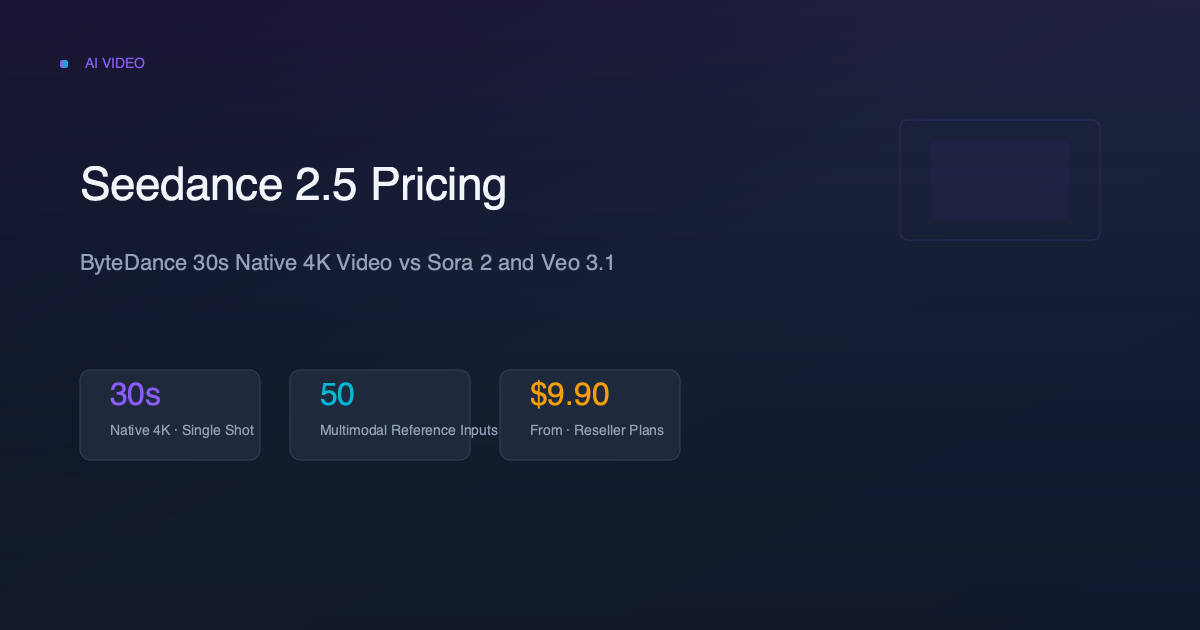
ByteDance dropped Seedance 2.5 at the Volcano Engine FORCE Conference in Beijing on June 23, 2026, and the specs immediately reset expectations for what a consumer AI video model can do: native 30-second single-segment 4K video generation with no stitching, extendable to 3 minutes, up to 50 multimodal reference inputs, 3D white-box pre-visualization, frame-level local editing, and unified audio-video generation with 10+ language lip-sync — all powered by a new Sparse DiT architecture that reportedly delivers ~20% better prompt adherence than Seedance 2.0.
The model is in enterprise beta now, with a consumer launch slated for July 2026. ByteDance has not published official pricing. That silence has created a pricing vacuum — and a growing ecosystem of third-party resellers, APIs, and platform integrations that are already taking money for access. Here is every pricing data point available, how the model earns its cost, and where Seedance 2.5 sits in a market dominated by Sora 2 at $20/month and Veo 3.1 at $19.99/month.
What Seedance 2.5 Actually Delivers — and Why Pricing Matters
Before comparing dollar amounts, you need to understand what tier of compute you are buying. Seedance 2.5 is not a minor iteration. It is a generational leap over Seedance 2.0 in five dimensions, each of which carries a real inference cost.
Native 30-Second 4K Single-Segment Generation
Most AI video models generate short clips — Sora 2 typically produces shorter durations under 20 seconds, and Veo 3.1 operates in a similar range. Seedance 2.5 generates a full 30 seconds of 4K video as a single continuous segment. No stitching, no temporal blending artifacts, no visible seam between two shorter clips glued together. This alone multiplies the compute requirement: a single 30-second 4K generation at 24 FPS means 720 distinct frames, each at 3840×2160 resolution, generated coherently from one inference pass. For context, extending the model to a full 3-minute output — as ByteDance claims is possible — would push the frame count past 4,000.
Up to 50 Multimodal Reference Inputs
Seedance 2.5 accepts images, video clips, audio files, text descriptions, and 3D white models as reference inputs — up to 50 simultaneously. Competitors typically accept a handful of image references. The jump to 50 multimodal inputs is not just a flexibility feature; it is a context-window problem. The model must attend to vastly more conditioning tokens than any competing architecture, which increases both memory usage and per-generation latency.
3D White-Box Pre-Visualization
This is one of the most underappreciated features in the announcement. Users can import blockout models from Maya, Blender, or other 3D tools into Seedance 2.5 to control camera movement, scene composition, and spatial relationships before generation. The model respects these 3D guides during inference — meaning the output video follows a director's blocking, not a statistical guess at camera motion. For professional video pipelines, this is the difference between a tool that generates "something pretty" and a tool that generates "the shot I actually storyboarded."
Frame-Level Local Editing
Instead of regenerating an entire video to change one element, Seedance 2.5 supports local editing at the frame level. Replace a background, swap a prop, adjust lighting on a specific frame — without disturbing the rest of the clip. This feature matters for pricing because it reduces re-generation waste. On a model that charges per generation, being able to fix one detail rather than re-render 30 seconds of 4K has direct cost implications.
Unified Audio-Video Generation
Seedance 2.5 operates in a single latent space that handles both visual and audio generation. This means lip-sync, foley effects, and dialogue are generated alongside the video, not patched on afterward with a separate audio model. The model supports 10+ languages for lip-sync. For creators producing multi-language content, this eliminates the cost and latency of a separate audio pipeline.
The Architecture Behind the Cost: Sparse DiT
Seedance 2.5 uses a Sparse Diffusion Transformer (DiT) architecture. DiT models have been the backbone of high-quality video generation since Sora's original release, but the "sparse" variant indicates ByteDance is using a mixture-of-experts-style routing within the diffusion transformer — activating only a subset of parameters per generation step. This is architecturally expensive to train (you need more total parameters to route among) but potentially cheaper at inference than a dense model of equivalent quality. Whether that cost saving flows to the consumer is the open question that official pricing will answer.
Third-Party Reseller Pricing: What You Pay Today
With no official ByteDance pricing, third-party platforms have stepped in. Three resellers dominate the current landscape, and their plans reveal both the demand for Seedance 2.5 and the uncertainty about what the model truly costs to run.
Seedance.tv
Seedance.tv is the most prominent reseller, offering three annual billing tiers. All prices below reflect annual billing with a reported 30% discount versus monthly equivalents.
| Tier | Price (Annual) | Credits | Est. Videos | Resolution Cap | Duration Cap |
|---|---|---|---|---|---|
| Mini | $28/mo | 400 | ~40 | 1080p | 10 seconds |
| Standard | $56/mo | 1,600 | ~160 | 1080p | 10 seconds |
| Plus | $112/mo | 4,800 | ~480 | 1080p | 10 seconds |
The credit-to-video ratio sits at roughly 10 credits per video based on advertised estimates, though actual consumption varies with resolution, duration, and reference input count. Notably, Seedance.tv caps output at 1080p and 10 seconds — well below the model's native 30-second 4K ceiling. This suggests the platform is pricing conservatively, offering access to the model architecture while reserving full-quality generation for a future premium tier or official ByteDance pricing.
Seedance25ai.net
Seedance25ai.net positions itself as the budget option, undercutting Seedance.tv significantly. All prices are annual billing with approximately 50% off monthly equivalents.
| Tier | Price (Annual) | Credits |
|---|---|---|
| Starter | $9.90/mo | 1,200 |
| Plus | $14.90/mo | 2,000 |
| Enterprise | $39.90/mo | 5,600 |
At $9.90/month for 1,200 credits, Seedance25ai.net offers a dramatically lower entry point than Seedance.tv's $28/month Mini tier — and with triple the credits. However, the same caveats apply: resolution and duration caps are not publicly specified at full 4K 30-second levels, and the platform's credit consumption model likely scales cost by output quality.
Renoise — Multi-Model Platform
Renoise takes a different approach: Seedance 2.5 is one model among many on its platform, bundled alongside competing AI video generators. Its credit pricing reflects the multi-model premium.
| Tier | Price | Credits |
|---|---|---|
| Starter | $20/mo | 1,200 |
| Standard | $60/mo | 3,600 |
| Advanced | $200/mo | 14,000 |
Renoise's pricing is useful as a benchmark because it forces Seedance 2.5 to compete directly against other models on the same platform. If Seedance 2.5 consumed dramatically more compute per generation than alternatives, Renoise would either charge more credits per Seedance generation or raise its prices. The fact that it sits in the standard credit bracket suggests the model's inference cost is competitive at scale — even if ByteDance has not published the raw numbers.
The Unofficial Reseller Spread: What It Tells Us
The $9.90 to $200/month range across three resellers is not random noise. It reveals three things about the market:
-
Compute cost uncertainty: Without official pricing, resellers are guessing at the model's true inference cost. Seedance25ai.net's aggressive pricing suggests either tight margins or an assumption that most users will generate short, low-resolution clips. Renoise's $200/month Advanced tier suggests the opposite — that power users doing 4K 30-second multi-reference generations will consume credits fast.
-
Quality-tier segmentation is coming: Every reseller enforces resolution and duration caps below the model's ceiling. The full 30-second 4K experience with 50 reference inputs and 3D pre-viz is not yet available at any published price. When ByteDance does release official pricing, expect a tier that unlocks the full feature set at a premium.
-
The market is fragmented and opportunistic: Three different platforms with three different pricing models and no standardization in credit-to-video ratios. This is the classic sign of a market waiting for the official anchor price — once ByteDance publishes its numbers, reseller pricing will converge or collapse.
Estimated Official ByteDance Pricing
Dreamina: The Consumer Gateway
Dreamina, ByteDance's own AI creative platform, is the most likely channel for consumer access. Based on Seedance 2.0 patterns, pricing is estimated to land between $15/month and $70/month depending on the generation tier. Dreamina has historically offered a credit-based system where users purchase monthly quotas with rollover options, and the platform serves as ByteDance's primary consumer-facing creative suite — integrating image generation, video generation, editing, and eventually 3D pre-viz tools.
The $15–70/month estimate aligns with ByteDance's broader strategy: make the entry point cheap enough to onboard millions of Douyin/TikTok creators, then upsell professional tiers to studios and agencies. If Seedance 2.5's consumer launch in July follows this pattern, expect a free tier with limited generations (likely watermarked, 720p, short duration), a creator tier around $15–25/month, and a professional tier at $50–70/month with 4K output and priority queue access.
Volcano Engine API Pricing
For developers and enterprises, Seedance 2.0 was priced at approximately ¥1 RMB per second of generated video on Volcano Engine, ByteDance's cloud platform. At current exchange rates, that is roughly $0.14 per second.
For Seedance 2.5, the per-second cost will almost certainly be higher. The model's 4K output, 50-reference-input capacity, and unified audio-video generation represent a step-function increase in compute. A reasonable baseline estimate would place Seedance 2.5 API pricing at ¥1.5–3.0 RMB per second ($0.21–0.42), though enterprise contracts will likely negotiate volume discounts below published rates.
Here is what the math looks like for a typical workload:
| Generation Spec | Seconds | Est. Low (¥1.5/s) | Est. High (¥3.0/s) |
|---|---|---|---|
| 5s 1080p clip | 5 | ¥7.50 ($1.05) | ¥15.00 ($2.10) |
| 10s 1080p clip | 10 | ¥15.00 ($2.10) | ¥30.00 ($4.20) |
| 15s 4K clip | 15 | ¥22.50 ($3.15) | ¥45.00 ($6.30) |
| 30s 4K clip | 30 | ¥45.00 ($6.30) | ¥90.00 ($12.60) |
A single 30-second 4K generation at the high estimate costs roughly $12.60 in raw API compute. That puts into perspective why resellers cap output at 1080p and 10 seconds — the full-quality inference is genuinely expensive.
Enterprise Beta and the $2 Billion Question
ByteDance reported $2 billion in annual recurring revenue for Seedance enterprise. That figure, disclosed around the FORCE Conference, signals that Seedance is not a research project or a loss leader — it is a material revenue line for ByteDance's cloud division. Enterprise pricing is almost certainly custom-negotiated, involving committed spend agreements, dedicated GPU allocation, data residency guarantees, and SLAs around generation latency and uptime.
For context, $2 billion ARR places Seedance enterprise revenue in the same order of magnitude as OpenAI's reported API revenue ($3–5 billion range as of mid-2026, per various analyst estimates). ByteDance is competing at the same financial scale as the largest AI labs — and its pricing decisions will reflect that ambition.
Competitor Pricing: Sora 2, Veo 3.1, and the Market Anchor
To evaluate whether Seedance 2.5 pricing is competitive, you need to look at the two models that define the current market price for AI video generation: Sora 2 and Veo 3.1.
Sora 2 (OpenAI) — $20/month
Sora 2 is bundled with ChatGPT Plus at $20/month (and ChatGPT Pro at $200/month with higher generation quotas). The $20 tier comes with monthly generation limits — OpenAI does not publish exact quotas, but community testing suggests roughly 50 priority generations per month at the Plus tier, with relaxed mode available for additional generations at lower priority.
Sora 2's strengths include strong text rendering, consistent character tracking across cuts, and integration with ChatGPT's prompt refinement. Its weaknesses relative to Seedance 2.5 are clear: shorter single-shot duration (typically under 20 seconds in practice), fewer reference inputs (Sora 2 supports image references but not the 50-input multimodal mix), no 3D pre-viz workflow, no frame-level local editing, and no native audio generation — Sora generates silent video.
Veo 3.1 (Google DeepMind) — $19.99/month
Veo 3.1 is accessible through Google AI Pro at $19.99/month, with higher quotas available through Google Cloud's Vertex AI for enterprise customers. Veo 3.1 supports 1080p output, strong visual fidelity, and Google's proprietary video understanding models for prompt interpretation. It integrates with Google's ecosystem (YouTube, Google Drive, Vertex AI pipelines).
Veo 3.1 is closest to Seedance 2.5 in philosophy — both target professional video pipelines with API access — but Veo 3.1 does not match Seedance 2.5 on duration (30s native), reference input count (50), 3D pre-viz, or frame-level editing. Veo's advantage is Google Cloud integration and established enterprise relationships.
The Price-Performance Matrix
| Feature | Seedance 2.5 | Sora 2 | Veo 3.1 |
|---|---|---|---|
| Consumer Price (Est.) | $15–70/mo | $20/mo | $19.99/mo |
| Max Native Duration | 30 seconds | ~20 seconds | ~20 seconds |
| Max Resolution | 4K | 1080p | 1080p |
| Reference Inputs | Up to 50 (multimodal) | Limited image | Limited image |
| 3D Pre-Viz | Yes (Maya/Blender) | No | No |
| Frame-Level Editing | Yes | No | No |
| Native Audio | Yes (lip-sync + foley) | No (silent) | No |
| Audio Lip-Sync Languages | 10+ | N/A | N/A |
| Extendable Duration | Up to 3 minutes | Limited | Limited |
Seedance 2.5 dominates the spec sheet. The only question is whether ByteDance will price it as a premium product that commands a premium — or as a volume play designed to capture market share before OpenAI and Google can close the feature gap.
Pricing by Use Case: Who Should Pay What
Pricing only makes sense when mapped to actual workflows. Here is how Seedance 2.5 costs break down by user type.
The Solo Creator
For a solo creator producing short-form content (TikTok, Instagram Reels, YouTube Shorts), the Sweet Spot is the estimated $15–25/month Dreamina creator tier or Seedance25ai.net's $9.90/month Starter plan. At these price points, a creator generating 30–50 short clips per month spends roughly $0.20–0.50 per video. For comparison, hiring a freelance video editor for 50 short clips would cost $500–2,000/month. The ROI math is straightforward.
The key variable is whether the free tier — if ByteDance offers one — provides enough quality and duration for social media content. If the free tier is limited to 5 seconds at 720p with a watermark, most creators will upgrade to the paid tier immediately.
The Indie Filmmaker or Agency
For filmmakers and agencies using Seedance 2.5 in a professional pipeline — pre-visualization, concept trailers, client pitches — the $50–70/month professional tier or API access makes sense. The 3D white-box pre-viz feature alone justifies the cost: importing a blockout from Blender and generating a 30-second 4K camera-motion-accurate render in minutes replaces days of traditional 3D rendering.
At $0.21–0.42 per second on the API, a 3-minute extended generation (180 seconds) costs $37.80–75.60. That is the price of a single high-quality render — but the output is a complete, editable, audio-synced video. In a professional context where a single VFX shot can cost $500–5,000, Seedance 2.5 at $38–76 for 3 minutes is not expensive — it is transformative.
The Enterprise
For enterprises with committed API spend, the calculation shifts to total cost of ownership. A studio generating 100 hours of AI-assisted video per month at the high API estimate of ¥3.0/second would spend roughly ¥1,080,000 RMB (~$151,200) monthly. At enterprise volume discounts — which ByteDance almost certainly offers given the $2 billion ARR figure — the effective rate could drop to ¥1.0–1.5/second, bringing the monthly bill to $50,000–75,000.
That is a six-figure annual AI spend, but for a studio that previously spent millions on traditional VFX, the economics still favor AI-assisted pipelines. The question is not whether Seedance 2.5 is cheaper than traditional VFX — it always will be — but whether it is cheaper than Sora 2's enterprise API, Veo 3.1's Vertex AI pricing, or Runway's Gen-4 enterprise plans. Without published enterprise pricing from any of these vendors, that comparison remains speculative.
The Hobbyist Exploring AI Video
For someone who wants to experiment with AI video generation without committing to a subscription, free browser-based tools and limited-tier offerings provide a useful on-ramp. Most platforms offer trial credits or watermarked outputs that let users explore AI video generation concepts before deciding whether a paid Seedance 2.5 subscription is worth it.
The Integration Ecosystem and Its Pricing Impact
Pricing does not exist in isolation — it reflects the distribution channels and platform integrations that ByteDance controls.
CapCut Integration (Confirmed July 4, 2026)
CapCut, ByteDance's video editing app with over 500 million monthly active users, confirmed Seedance 2.5 integration on July 4. This is the single most important pricing signal. CapCut operates a freemium model: basic editing tools are free, with a Pro subscription unlocking premium effects, transitions, and AI features.
If Seedance 2.5 generation becomes a CapCut Pro feature, the effective price of Seedance 2.5 drops to the cost of CapCut Pro — roughly $7.99/month in most markets. That would make Seedance 2.5 the cheapest frontier AI video model by an order of magnitude. If instead CapCut charges per-generation on top of the Pro subscription, the model remains more expensive but benefits from CapCut's massive distribution.
Either way, the CapCut integration fundamentally changes the pricing equation. Five hundred million users with one-click access to 30-second 4K AI video generation is a distribution moat that neither OpenAI nor Google can match. Sora 2 requires a ChatGPT Plus subscription and lives in a separate app; Veo 3.1 requires navigating Google AI Pro or Vertex AI. Seedance 2.5, inside CapCut, sits directly inside the editing workflow of the world's most popular video app.
Doubao (豆包)
Doubao, ByteDance's consumer AI assistant app with over 100 million monthly active users in China, integrates Seedance 2.0 and is expected to add Seedance 2.5. Doubao's monetization model is not yet fully established, but if Seedance generation becomes a premium feature within Doubao's subscription, it adds another mass-market pricing vector that competitors lack.
Volcano Engine API
The Volcano Engine API is the enterprise play. It targets developers building custom video pipelines, and its per-second pricing model rewards high-volume users with negotiated discounts. This is the channel where Seedance 2.5's $2 billion ARR is primarily generated — enterprise contracts with committed spend, not consumer subscriptions.
The Unresolved Pricing Questions
Several factors could significantly shift the pricing landscape between now and the consumer launch.
Free Tier or No Free Tier?
ByteDance has not announced whether Seedance 2.5 will offer a free tier. Seedance 2.0 did not have an official free tier at launch, though Dreamina offered limited free credits. A free tier — even watermarked 720p at 5 seconds — would be a powerful funnel into paid subscriptions. Without one, ByteDance cedes the low end of the market to third-party resellers and competing free tools.
Credit Rollover and Expiration
The credit-based model used by resellers raises the question of whether official pricing will follow the same pattern and, critically, whether credits expire. Monthly credit expiration — common in AI image generation tools like Midjourney — penalizes sporadic users and inflates the effective per-generation cost. If ByteDance offers annual credit pools with no monthly expiration, it would differentiate favorably from competitors.
Geographic Pricing
ByteDance operates primarily in China, and its pricing historically reflects Chinese market economics. Whether Seedance 2.5 international pricing will mirror domestic pricing or carry a premium is unknown. Douyin/TikTok creator economics differ significantly between markets — a ¥50 RMB/month plan ($7) that works for a Chinese creator may be priced at $25/month internationally, not because of compute cost but because of willingness to pay.
Resolution and Duration Tiering
Every reseller imposes caps below the model's ceiling. The question is whether official ByteDance pricing will do the same. A likely scenario: a base consumer tier at $15–25/month for 1080p up to 10–15 seconds, a creator tier at $30–50/month for 4K up to 20 seconds, and a professional tier at $70+/month for full 4K 30-second output with 50 reference inputs and 3D pre-viz. This would align with industry practice — Midjourney, Runway, and Pika all tier by resolution and feature set.
Market Implications: What Seedance 2.5 Pricing Means for the AI Video Industry
If ByteDance prices Seedance 2.5 aggressively — at or below Sora 2's $20/month — the AI video market will shift on three axes.
Price Compression at the Consumer Tier
Sora 2 at $20/month and Veo 3.1 at $19.99/month have established a de facto $20 consumer price anchor for frontier AI video. If Seedance 2.5 enters at $15/month with superior specs (30s 4K vs. 20s 1080p), it resets the value expectation. OpenAI and Google would face pressure to either match the price, increase generation quotas, or accelerate Sora 3 / Veo 4 to close the feature gap. None of those responses are cheap.
Enterprise API Competition
The $2 billion ARR figure signals that Seedance enterprise is not a sideshow — it is a primary revenue driver. If ByteDance prices the Seedance 2.5 API competitively (¥1.5–3.0/second, or $0.21–0.42/second), it puts pressure on OpenAI's Sora API (pricing undisclosed but estimated higher) and Google's Vertex AI Veo pricing. Enterprise video pipelines are high-volume, and a 20–30% per-second cost difference at scale translates to hundreds of thousands of dollars annually.
The CapCut Distribution Moat
The CapCut integration changes the competitive dynamic from "which model is better" to "which model is already inside your editing workflow." Five hundred million CapCut users do not need to seek out Seedance 2.5 — it will be a button inside the app they already use. Sora 2 requires opening a separate website. This distribution advantage could make Seedance 2.5 the default AI video generator for a generation of creators, regardless of whether a marginally better model ships six months later from a competitor.
Bottom Line: What Seedance 2.5 Pricing Means for You
Seedance 2.5 pricing, even without official numbers, tells a clear story. ByteDance has built the most technically ambitious consumer AI video model on the market — 30-second native 4K, 50 reference inputs, 3D pre-viz, frame-level editing, unified audio — and is preparing to distribute it through the world's most popular video editing app. The third-party reseller market has already priced access from $9.90 to $200/month, revealing both intense demand and genuine uncertainty about the model's inference cost.
When ByteDance publishes official pricing in July 2026, the number to watch is the consumer entry point. If it lands at $15–20/month, Seedance 2.5 becomes the default recommendation for anyone buying AI video generation — more capable than Sora 2 or Veo 3.1 at a comparable or lower price. If it lands at $30–50/month, it competes as a premium professional tool that justifies its premium with genuinely better output. If it lands above $70/month, it cedes the consumer market to OpenAI and Google while dominating the professional tier where the $2 billion ARR already lives.
For now, the smart move is to watch the July launch, compare the official pricing against your actual usage pattern, and calculate whether Seedance 2.5's feature advantage translates to cost savings in your specific workflow. The model is real, the specs are record-setting, and the distribution is unmatched. The only missing piece is the price tag — and that piece drops within weeks.