Table of Contents
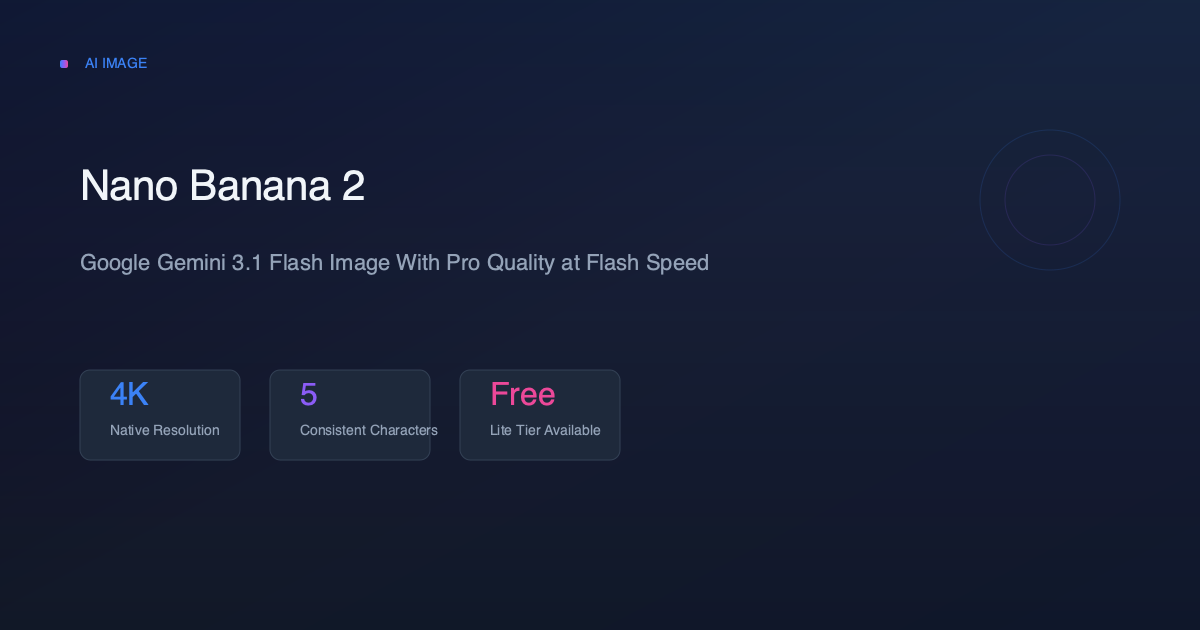
The AI image generation landscape just shifted. On February 26, 2026, Google DeepMind dropped Nano Banana 2 — officially named Gemini 3.1 Flash Image — and it is not another incremental update. It is the model that finally collapses the trade-off between quality and speed that has defined this space since DALL-E 2 first appeared.
If you were building images with AI in 2025, you knew the deal. You could have fast generations with decent results, or you could wait for studio-grade output. You could have character consistency, or you could have speed. You could have good text rendering, or you could have multi-turn editing. Pick one. Nano Banana 2 says: pick all of them.
This is the third entry in the Nano Banana family, and it lands between — and in some ways above — both its predecessors. The original Nano Banana v1 launched in August 2025 and went viral, generating millions of images in its first weeks. Nano Banana Pro landed in November 2025, pushing fidelity and detail to studio-quality levels but trading away some of that Flash-tier responsiveness. Nano Banana 2 merges both paths: Pro-level image quality wrapped in Flash-generation speed, priced at Flash-tier costs.
The timing is not accidental. In the six months since Nano Banana v1, the AI image generation market saw Midjourney ship V7 with personalization modes, Ideogram push its text-rendering lead further, and a wave of specialized models carve out niches in photorealism and artistic style transfer. Google's response is to embed image generation so deeply into its ecosystem that the competition's standalone apps start to look like feature requests waiting for Google to ship them natively.
What Nano Banana 2 Actually Does: The Full Feature Breakdown
Resolution and Aspect Ratios: From 512px to 4K
Nano Banana 2 generates images at resolutions from 512 pixels all the way up to 4K. It supports multiple aspect ratios — square, portrait, landscape, widescreen — and includes a dedicated upscale function that takes any image to 2K or 4K in seconds. This is not just "make it bigger." The upscaler preserves sharpness, color fidelity, and detail. A 512px thumbnail can become production-ready print material without leaving the same workflow.
The practical implication is that one model now serves the entire resolution chain. You do not need to generate in one tool and upscale in another. You do not need to export, reimport, or switch models. That sounds like a workflow footnote. In practice, it eliminates the single biggest friction point in AI image production — the resolution jumps between ideation, mockup, and final asset.
Character Consistency: Up to 5 Characters, Up to 14 Objects Across Multi-Turn Workflows
This is the headline feature for anyone building narratives, comics, storyboards, brand assets, or game art. Nano Banana 2 can maintain visual consistency across up to five distinct characters — and the fidelity of up to fourteen objects — within a single multi-turn conversation.
What this means: you prompt for a character in scene one, and in scene two (a different setting, different pose, different lighting), the model recognizes that character and preserves their facial structure, clothing details, hair, and build. This is not a "describe the character again every time" workaround. The model holds the character in its conversational context and applies that understanding across subsequent generations.
The same applies to objects. A branded coffee cup, a specific car model, a designed piece of furniture — generate it once, and Nano Banana 2 can reproduce it in new contexts, new angles, new lighting, with the same identifying details.
The ceiling here matters. Five characters and fourteen objects is the stated upper limit. Below that threshold, the system is designed for reliability. Above it, results become less predictable. The rule of thumb: if your scene has fewer than five unique characters and fewer than fourteen tracked objects, Nano Banana 2 should handle consistency without degradation.
Text Rendering: Legible Words, Not Gibberish Glyphs
AI image generators have historically been terrible at rendering text. Letters warped, words became phonetic approximations, and anything longer than a few characters dissolved into alien script. That era is ending.
Nano Banana 2 renders clean, legible text directly into images. Greeting cards with actual messages. Marketing mockups with real headlines. Posters where the title is not a hallucinated approximation of the prompt. The model supports font variation, style variation, and size variation — all controllable through natural language.
In the official demo materials, Nano Banana 2 produces birthday cards with perfectly kerned typography, event posters with multi-line text in multiple colors, and signage where every character is readable. The text is generated as part of the image, not layered on top in post-processing. This makes it usable for end-to-end creative workflows where the text and image need to feel like one designed composition, not an edit.
Advanced Image Editing: Multi-Input and Inpainting-Style Edits
Nano Banana 2 is not just a generator. It is an editor. You can upload multiple images as input — reference images, style references, elements to combine — and the model will reason across them to produce a coherent output.
The editing capabilities include:
- Inpainting-style edits: mask a region and describe what should replace it; the model fills the gap with context-aware generation that matches the surrounding image.
- Background removal and replacement: isolate subjects and swap environments while preserving the subject's details.
- Style transfer with reference images: upload a reference image and the model adapts its output style accordingly.
- Localization: take an image with English text and translate it to Hindi, German, Spanish, Japanese — preserving the visual style, font feel, and composition. The DeepMind demos show a wildlife sign transformed from English to Hindi to German with the illustrated sign style intact.
- Environmental changes: transform the setting of a photo — the Mumbai coastline becomes the Tokyo skyline, with the subject and composition preserved.
Real-World Knowledge and Web Search Integration
Because Nano Banana 2 is built on Gemini's architecture, it inherits access to real-world knowledge and real-time web search. This is a qualitative leap that standalone image models cannot match.
When you prompt for "Bletchley Park Mansion in Synthetic Cubism style," the model can first search for visual references of the actual building, then render it in the requested style. When you ask for an infographic about "how the water cycle works," it draws on scientific knowledge to get the stages, terminology, and visual logic correct. When you need a diagram about "different types of flour and their protein content," it knows the actual protein ranges for all-purpose, bread, cake, and whole wheat flours.
This means the model generates images that follow real-world logic, not just statistical pattern matching. A cross-section of the Earth shows the crust, mantle, outer core, and inner core in correct proportion and with accurate labels. A cloud-type infographic correctly distinguishes cumulus, stratus, and cirrus by altitude, shape, and formation mechanism.
The gap between "AI art" and "AI-assembled factual infographic" is closing, and web search integration is the mechanism.
Speed and the Flash Architecture
The "Flash" in Gemini 3.1 Flash Image is not branding fluff. Flash models in Google's ecosystem are designed for high-throughput, low-latency inference. The practical experience: you type a prompt, and the image appears fast enough that it feels like a conversation, not a batch job.
For developers building products on top of the API, this means image generation can be part of a real-time interaction loop — generate, review, refine, regenerate — without the user staring at a loading spinner. For casual users in the Gemini app, it means the same chat interface that answers questions can also produce rich visual content without mode-switching or waiting.
The Nano Banana Model Family: A Complete Lineup
Nano Banana 2 is not the only model in the family. Google DeepMind now offers a three-tier image generation lineup, each targeting a different use case:
| Model | Technical Name | Positioning | Best For |
|---|---|---|---|
| Nano Banana Pro | Gemini 3 Pro Image | Studio-quality precision and control | High-end creative work, print production, brand assets |
| Nano Banana 2 | Gemini 3.1 Flash Image | Pro-level quality at Flash speed | Daily creative work, rapid iteration, content production |
| Nano Banana 2 Lite | Gemini 3.1 Flash-Lite Image | Fastest, most efficient, lowest cost | High-volume generation, prototyping, casual use |
The Lite tier deserves special attention. Nano Banana 2 Lite is positioned as the free tier with unlimited generations — a strategic move that makes Google's image generation the most accessible entry point in the market. Midjourney starts at $10/month for limited generations. DALL-E requires a ChatGPT Plus subscription. Ideogram has a free tier with daily limits. Nano Banana 2 Lite offers unlimited, no-cost generation, backed by Google's infrastructure.
This is a land-grab play, and it works because Google's compute scale makes the unit economics viable at a level competitors cannot match.
Where You Can Use Nano Banana 2: Distribution That No Competitor Can Match
The single biggest strategic advantage of Nano Banana 2 is not in the model architecture. It is in the distribution channels.
Consumer Access
Nano Banana 2 is the default image model across:
- Gemini App: Available in Fast, Thinking, and Pro modes — users generate images the same way they chat, with the model reasoning about what you want before rendering it.
- Google Search AI Mode: When users search with AI Mode enabled, the results can include AI-generated images created on the fly by Nano Banana 2.
- Google Lens: Visual search now has a generation engine behind it, blurring the line between finding images and creating them.
- Google Flow: Google's video editor integrates Nano Banana 2 for asset generation within video projects.
Developer Access
- Gemini API: The standard REST API for integrating Nano Banana 2 into any application. Available through Google AI Studio with a generous free tier.
- Gemini CLI: Command-line access for developers who want to script image generation into automated workflows.
- Vertex AI: Enterprise-grade deployment with Google Cloud's security, scaling, and governance.
- Google AI Studio: The web interface for prototyping, prompt engineering, and testing before moving to production.
- Antigravity: Google's agentic development platform, where Nano Banana 2 can be called by AI agents as a tool.
Third-Party Platforms
Nano Banana 2 is available through ImagineArt and OpenArt, both of which have integrated it into their creative suites. On OpenArt, it appears alongside models like Seedream 5.0 Pro and Gemini Omni Flash. On ImagineArt, it powers generation and editing workflows.
The combined reach — Gemini app, Google Search, Google Lens, plus third-party creative platforms — gives Nano Banana 2 a distribution surface area that Midjourney (Discord-only, then web app), Ideogram (standalone web app), and DALL-E (browser-only, ChatGPT-only) cannot approach.
Safety, Watermarking, and Content Credentials
Every image generated by Nano Banana 2 carries two provenance markers:
- SynthID watermark: Google DeepMind's imperceptible digital watermark embedded at the pixel level, detectable by automated tools but invisible to the human eye.
- C2PA Content Credentials: The Coalition for Content Provenance and Authenticity standard, which attaches cryptographically signed metadata about the image's origin — including that it was generated by AI, when, and by which model.
This dual-layer approach means Nano Banana 2 outputs are traceable through both technical detection (SynthID) and open-standard metadata (C2PA). For platforms, publishers, and regulators concerned about AI-generated content provenance, this is the most robust watermarking stack available in any commercial image generator.
Real-World Applications: What People Are Actually Doing With Nano Banana 2
Interior Design and Architecture: Sketch-to-4K-3D Rendering
One of the most compelling use cases emerging in early adoption is interior design rendering. Users upload rough sketches with approximate dimensions, and Nano Banana 2 produces photorealistic 4K renders with accurate spatial proportions.
The model's real-world knowledge layer means it understands room layouts, furniture scale, lighting physics, and material properties. You can specify "a mid-century modern living room, 12' x 16', with a west-facing window at golden hour" and the rendering will respect those parameters — not just the aesthetic, but the spatial logic.
This workflow compresses what used to be a multi-day process (sketch → 3D model → texture → render → iterate) into minutes (sketch → prompt → refine → final 4K render). Interior designers, architects, and real estate stagers are among the earliest professional adopters.
Product Photography and E-Commerce
Generate product shots in any environment, with any lighting, from any angle — without a physical studio, camera, or product sample. Upload a reference image of the product, describe the setting, and Nano Banana 2 places it in context with consistent lighting, shadows, and reflections.
For e-commerce businesses, this means a single product image can become a full catalog of lifestyle shots, detail views, and contextual photography. The character and object consistency features mean the product stays recognizable across every image in the set.
Character Art and Visual Storytelling
The character consistency feature (up to five characters, up to fourteen objects) is purpose-built for visual storytellers. Comic artists, game developers, storyboard artists, and brand designers can maintain a cast of characters across scenes, settings, and actions without the drift that plagued earlier models.
A game studio can concept a character, generate that character in multiple poses and environments, and then maintain that exact character in marketing materials — all from the same model, without Photoshop compositing or manual cleanup.
Virtual Try-On and Fashion
Upload a garment image and a model reference, and Nano Banana 2 renders the garment on the model with realistic draping, fit, and fabric behavior. This is a significant step toward virtual try-on experiences that do not require specialized 3D body scanning or physics simulation.
Greeting Cards, Posters, and Designed Communications
The text rendering capabilities open up a category that AI image generators have historically failed at: designed communications. Birthday cards with actual messages. Event posters with correct dates and headlines. Marketing mockups with brand copy. All generated as cohesive compositions where text and image feel like one design.
The localization feature extends this to multilingual audiences. A card designed in English can be instantly translated to Spanish, Hindi, Japanese, or German — keeping the same visual style, font feel, and composition.
How Nano Banana 2 Compares to the Competition
Nano Banana 2 vs Midjourney V7
Midjourney V7 excels at aesthetic quality and has a deeper set of style personalization features. Its community-driven creative ecosystem — prompt sharing, style references, community ratings — is unmatched. But Midjourney is a standalone tool. To use it, you must go to Discord or the Midjourney web app. You cannot generate an image mid-conversation in Google Search. You cannot call it from a Gemini API agent. You cannot use it to create infographics with real-world knowledge backing.
Nano Banana 2 trades some of Midjourney's aesthetic frontier for ecosystem integration, speed, and factual grounding. If you need the most beautiful possible image, Midjourney may still win. If you need an image that is beautiful, fast, text-accurate, factually grounded, and available across every surface Google touches, Nano Banana 2 is in a category of one.
Nano Banana 2 vs Ideogram 3.0
Ideogram built its reputation on text rendering accuracy — it was the first model to reliably generate images with readable, correctly spelled words. Nano Banana 2 has closed that gap and added features Ideogram does not have: character consistency, real-world knowledge integration, web search, multi-input editing, and localization.
Ideogram remains a strong choice for pure text-in-image use cases, but Nano Banana 2 offers a superset of capabilities while matching or approaching Ideogram's text rendering quality.
Nano Banana 2 vs DALL-E (GPT-5 with Image)
OpenAI integrated DALL-E into ChatGPT, giving it a similar "generation in conversation" advantage. But DALL-E's resolution ceiling, editing capabilities, and consistency features lag behind where Nano Banana 2 is today. OpenAI's integration depth into its own ecosystem is shallower — there is no equivalent to Google Search AI Mode integration, Google Lens, or the unlimited free tier of Nano Banana 2 Lite.
Nano Banana 2 vs Specialized Models
Specialized image models — those focused on photorealism, anime, architecture, or specific art styles — still have an edge in their narrow domains. A model purpose-built for photorealistic portraits may still outperform Nano Banana 2 on that specific axis. But the gap between specialized models and general-purpose models is narrowing with each generation, and Nano Banana 2's breadth (generation + editing + text + consistency + knowledge + localization) makes the "do I need a specialized tool?" question harder to answer.
Pricing and Access Tiers
| Tier | Model | Cost | Access |
|---|---|---|---|
| Free | Nano Banana 2 Lite | Unlimited generations | Gemini app, AI Studio free tier |
| Standard | Nano Banana 2 | Gemini Advanced subscription ($19.99/month) or API pay-per-use | Gemini app (Advanced), Gemini API, AI Studio |
| Enterprise | Nano Banana 2 / Nano Banana Pro | Vertex AI pricing (compute-based) | Vertex AI, Gemini Enterprise Agent Platform |
The unlimited Lite tier is the strategic differentiator. No other major AI image generator offers completely unlimited free generations at this quality level. Google is effectively subsidizing image generation to build user habits and platform lock-in, and at Google's infrastructure scale, that math works.
What Changed From Nano Banana v1 and Pro
Understanding Nano Banana 2 requires understanding what the previous models could and could not do:
Nano Banana v1 (August 2025): Went viral. Millions of images in weeks. Fast generation, fun results, decent quality. The breakthrough was accessibility — image generation inside the Gemini chat app, no separate tool required. Limitations: inconsistent text, limited editing, no character consistency, middling resolution.
Nano Banana Pro (November 2025): Addressed the quality complaints. Higher fidelity, better detail, more control. But the generation speed was slower — this was a Pro model, not a Flash model. You traded speed for quality. Good for final assets, bad for rapid iteration.
Nano Banana 2 (February 2026): Takes Pro-level quality and delivers it at Flash speed. Adds character consistency (up to 5 characters, 14 objects). Adds advanced text rendering. Adds multi-input editing. Adds web search integration. Adds localization. Adds 4K upscaling. Keeps the unlimited free tier (via Lite). The message from Google DeepMind is clear: the v1→Pro→v2 progression was not a linear upgrade path; it was a deliberate convergence toward one model that does everything well enough to be the default choice.
The Bigger Picture: Why This Is Google's Most Important Image Model Launch
Nano Banana 2 matters beyond the spec sheet for three reasons.
First, it marks the moment Google stopped treating image generation as a standalone feature and started treating it as a modality of the Gemini platform — the same way text, code, audio, and video are modalities. You do not "switch to the image generator." You ask Gemini for something, and if an image is the right response, you get an image. This is the multimodal promise of Gemini, and Nano Banana 2 is the image modality that makes it credible.
Second, the distribution strategy is a moat. Midjourney can build a better image model. Ideogram can improve text rendering. OpenAI can integrate DALL-E deeper into ChatGPT. But none of them can put their image generator inside Google Search, Google Lens, the Gemini app (pre-installed on Android), and Google Flow — while also offering an unlimited free tier. That combination of reach and zero-cost access is unique to Google.
Third, the safety infrastructure (SynthID + C2PA) positions Nano Banana 2 as the "safe choice" for platforms, publishers, and enterprises that need AI image generation with auditable provenance. As regulation around AI-generated content tightens — the EU AI Act, various US state laws, platform content policies — having built-in watermarking and content credentials becomes a competitive advantage, not a compliance checkbox.
FAQ: Nano Banana 2
Is Nano Banana 2 really free?
Nano Banana 2 Lite is free with unlimited generations. Full Nano Banana 2 (Flash-level quality with all features) requires a Gemini Advanced subscription ($19.99/month) or API credits. The Lite tier is genuinely unlimited — no daily caps, no credit system — but may have queue prioritization below paid tiers during peak usage.
How does Nano Banana 2 compare to Midjourney?
Midjourney has an edge in pure aesthetic quality and style personalization. Nano Banana 2 has the edge in speed, text rendering, character consistency, real-world knowledge, editing capabilities, ecosystem integration, and price (via the free Lite tier). If you need the most beautiful image, Midjourney may still lead. If you need images that are fast, accurate, and integrated into your existing Google workflows, Nano Banana 2 is the stronger choice.
Can Nano Banana 2 generate images with accurate text?
Yes. Text rendering is one of the headline improvements over v1. The model can generate greeting cards, posters, marketing mockups, and signage with legible, correctly spelled, well-kerned text. It can also localize existing images by translating text into other languages while preserving the visual style.
How many characters can Nano Banana 2 keep consistent?
Up to five characters across multiple turns in a single workflow. The model can also maintain consistency for up to fourteen objects. Beyond these limits, consistency becomes less reliable.
What resolutions does Nano Banana 2 support?
From 512px to 4K. Multiple aspect ratios are supported (square, portrait, landscape, widescreen). There is a dedicated upscale function that can take any generated image to 2K or 4K in seconds.
Does Nano Banana 2 work in the Gemini API?
Yes. The model is available as gemini-3.1-flash-image-preview through the Gemini API, Google AI Studio, and Vertex AI. Developers can integrate image generation into their applications with standard REST calls.
Are Nano Banana 2 images watermarked?
Yes. All outputs include both SynthID digital watermarking (imperceptible, detectable by automated tools) and C2PA Content Credentials (cryptographically signed metadata about the image's AI origin).
What is the difference between Nano Banana 2 and Nano Banana Pro?
Nano Banana Pro (Gemini 3 Pro Image) offers the highest possible quality and control, targeting studio-grade creative work. Nano Banana 2 (Gemini 3.1 Flash Image) delivers near-Pro quality at Flash generation speed and lower cost. Pro is for final production assets where quality is the only priority. Nano Banana 2 is for everything else.
Can I edit existing images with Nano Banana 2?
Yes. Nano Banana 2 supports multi-input editing — upload one or more reference images alongside your prompt. You can inpaint (edit specific regions), remove and replace backgrounds, transfer styles, and localize text. It is a generator and an editor in one model.
Where can I try Nano Banana 2?
- Gemini app (gemini.google.com)
- Google AI Studio (aistudio.google.com)
- Via the Gemini API (ai.google.dev)
- On ImagineArt and OpenArt platforms
- In Google Search with AI Mode enabled
Does Google have other image generation tools?
Yes. Google's image generation portfolio includes Imagen (their dedicated text-to-image model, now largely superseded by the Nano Banana family), Veo for video generation, and the Nano Banana family (Pro, 2, and 2 Lite) which is the primary image generation stack going forward.
What happens to the original Nano Banana v1?
Nano Banana v1 is effectively replaced by Nano Banana 2 Lite for free users and Nano Banana 2 for paid users. Both successors outperform v1 on every axis — quality, speed, features, and resolution. v1 will likely be deprecated as the transition completes.
The Bottom Line
Nano Banana 2 is not the best AI image generator at any single thing. It does not have Midjourney's aesthetic peak. It does not have Ideogram's text-rendering depth. It does not have DALL-E's integration into ChatGPT's brand recognition.
What it has is the combination that matters most for adoption: Pro-grade quality, Flash-tier speed, unlimited free access, the deepest ecosystem integration in the industry, and a safety infrastructure that enterprises and platforms can trust. That combination is what makes a model the default — and Google DeepMind has built Nano Banana 2 to be exactly that.
If you are anywhere in the Google ecosystem — which, for billions of people, is wherever they are online — Nano Banana 2 is already your image generator. You just might not have opened it yet.