Table of Contents
Back in April, DeepSeek V4 Preview shipped under an MIT license — impressive, but every discussion looped back to the same question: when is the actual release coming? On July 19, that question got its answer. And it's not just a faster model — it's a pricing shock that forces every API-dependent team to rethink their cost assumptions.
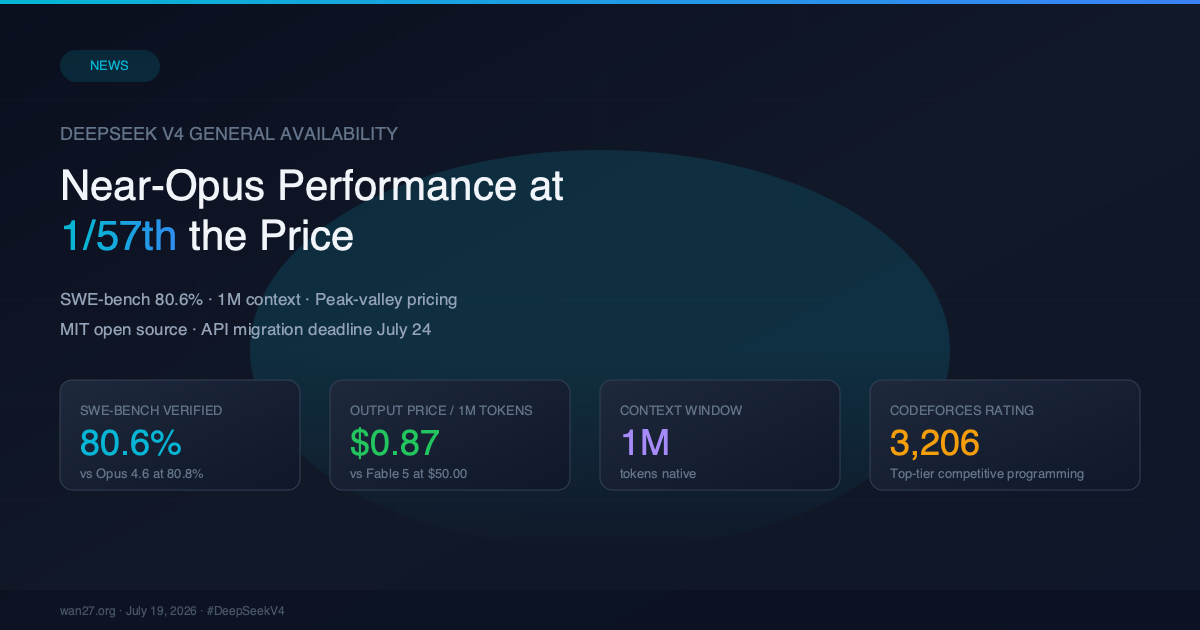
On July 19, DeepSeek V4 GA (General Availability) began rolling out to users. Early testers report overall performance approaching Opus 4.8, coding capabilities closing in on GPT-5.6 Sol, and pricing that undercuts Fable 5 by a staggering 57x. If you use the DeepSeek API — or just evaluate models for production — this article covers what changed, what the benchmarks say, and what you need to do before July 24.
From Preview to GA: the three-month timeline
| Date | Event |
|---|---|
| April 24, 2026 | V4 Preview goes live — Pro (1.6T / 49B active) and Flash (284B / 13B) open-sourced under MIT |
| June 29, 2026 | DeepSeek announces the official version is targeting mid-July |
| July 14, 2026 | Grayscale testing begins; select users get early access |
| July 19, 2026 | GA rollout begins |
| July 24, 2026 | Legacy endpoints deepseek-chat and deepseek-reasoner shut down |
The core architecture — parameter counts, context window, MoE structure — hasn't changed between Preview and GA. What has changed is reasoning quality, agentic capability, and pricing strategy.
What GA improves over Preview
Reasoning and coding: from "solid" to "frontier-adjacent"
The GA release delivers measurable gains across key benchmarks:
| Benchmark | V4 Pro GA | Opus 4.8 | GPT-5.6 Sol | Fable 5 |
|---|---|---|---|---|
| SWE-bench Verified | 80.6% | ~87.6% | — | — |
| LiveCodeBench | 93.5% | — | — | — |
| Codeforces Elo | 3,206 | — | — | — |
| GPQA Diamond | 90.1% | — | — | — |
| Humanity's Last Exam | 48.2% | — | — | — |
| MMLU-Pro | 87.5% | — | — | — |
| HMMT 2026 Feb (math) | 95.2% | — | beats K2.6 and Gemini-3.1-Pro |
Note: SWE-bench Verified 80.6% sits just behind Opus 4.6's 80.8%. For coding tasks, V4 Pro is now the strongest open-weight model available by a clear margin.
Early testers also report significant improvements in:
- Agentic capability — stronger performance on MCPAtlas Public and BrowseComp agent benchmarks
- 3D generation — multiple testers demonstrate V4 GA producing playable 3D game HTML directly
- SVG output — noticeably better structure and detail on complex vector graphics
- Chain-of-thought style — CoT is more concise and readable, summarizing reasoning steps in natural language instead of dumping raw code
Peak-valley billing: AI's first time-of-day pricing
The most talked-about change isn't performance — it's pricing.
DeepSeek introduces peak-valley billing, a first for AI model APIs:
| Period | Time (Beijing) |
|---|---|
| Peak | 9:00–12:00, 14:00–18:00 daily |
| Off-peak | All other hours |
Peak rates are exactly 2x off-peak rates.
V4 Pro pricing (per million tokens)
| Item | Off-peak | Peak |
|---|---|---|
| Output | $0.87 | $1.74 |
| Input (cache miss) | $0.435 | — |
| Input (cache hit) | $0.0036 | — |
V4 Flash pricing (per million tokens)
| Item | Off-peak | Peak |
|---|---|---|
| Output | $0.28 | $0.56 |
| Input (cache miss) | $0.14 | — |
| Input (cache hit) | $0.0028 | — |
To put this in perspective:
| Model | Output price per 1M tokens |
|---|---|
| DeepSeek V4 Flash | $0.28 (off-peak) |
| DeepSeek V4 Pro | $0.87 (off-peak) |
| Kimi K3 | $15 |
| GPT-5.6 Sol | $30 |
| Anthropic Fable 5 | $50 |
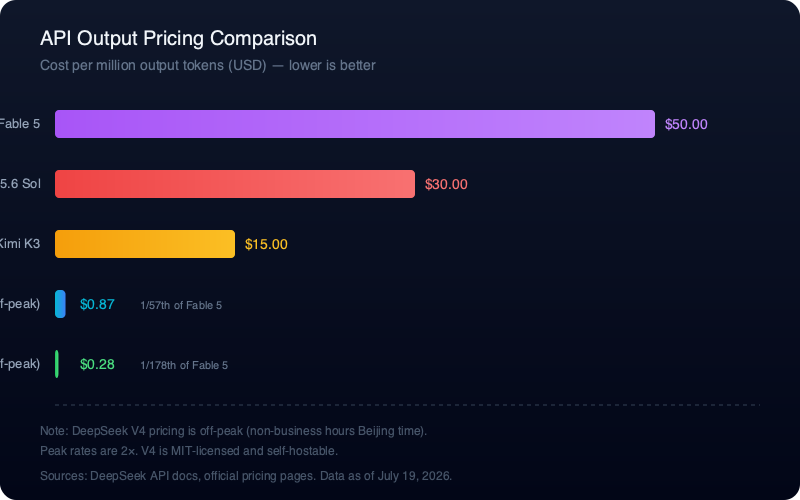
V4 Pro's off-peak output price is 1/57th of Fable 5 and 1/34th of GPT-5.6 Sol. Factor in the MIT license — which lets anyone self-host — and the cost gap becomes even harder for closed-source rivals to justify.
Practical tip: Schedule batch inference and non-real-time tasks outside Beijing peak hours (9–12 and 14–18). This alone can cut your API bill in half.
If all this sounds impressive but you're not sure whether you're already on the GA version, there is a dead-simple way to check.
How to tell if you're on GA: check the CoT
A quirk spotted by the community: the GA version's chain-of-thought uses a different first-person style.
- GA version: CoT starts with "I'm" / "I'll"
- Preview version: CoT starts with "Let me"
It's a quick check. If your API responses show the new CoT style, you're likely already on GA.
Why V4 is this cheap: the architecture in 30 seconds
DeepSeek V4 Pro has 1.6 trillion total parameters but activates only 49B per token — the MoE promise: the model is massive, but each token only pays for a fraction of it.
The cost-control stack:
- Hybrid attention (CSA + HCA) — at 1M context, single-token inference FLOPs drop to 27% of V3.2, and KV cache to 10%
- FP4 + FP8 mixed precision — expert parameters run at FP4, most others at FP8
- Prefix caching — repeated inputs are dramatically cheaper; cache-hit input is just $0.0036/M
- Open ecosystem — the MIT license lets the entire community optimize and deploy
This isn't "a small model sold cheap." It's "a large model engineered to be cheap."
Migration alert: July 24 deadline for legacy API users
If you're currently calling the DeepSeek API, mark this date:
After July 24, 2026, deepseek-chat and deepseek-reasoner will stop working.
The migration is straightforward:
| Old model name | New model name |
|---|---|
deepseek-chat (non-thinking) | deepseek-v4-flash |
deepseek-reasoner (thinking) | deepseek-v4-flash (thinking mode) |
| — | deepseek-v4-pro (for heavy reasoning tasks) |
Keep your base_url the same. Just update the model field in your API calls. One important detail: during the Preview phase, deepseek-reasoner mapped to V4 Flash, not V4 Pro. If you need heavier reasoning, switch explicitly to deepseek-v4-pro.
Heads-up: V4 has built-in content moderation. Roughly 45% of tested code generation prompts are refused. If your use case involves sensitive content, keep Claude or GPT-5.6 as a fallback.
Beyond the migration logistics, a different kind of conversation has been running alongside the GA rollout — one about where V4's performance actually comes from.
The distillation controversy: is V4 GA "original"?
As grayscale testing expanded, so did a debate on X.
Independent researcher @synthwavedd published an investigation claiming that under specific conditions — complex code tasks combined with knowledge queries — DeepSeek V4 returns outputs that are "virtually identical" to Fable 5. When input included questions known to trigger Claude's safety classifiers, output quality tanked — interpreted as the request routing to Fable 5 and falling back after hitting a classifier.
DeepSeek has not publicly responded. Multiple testers note that V4 GA's CoT style is indeed much closer to Claude's, and that DeepSeek has been adjusting its routing system during the rollout period.
The honest take: Distillation claims are not new in AI — they've followed every major open release this year. Regardless of the truth, V4 GA's benchmark scores (80.6% SWE-bench, 3,206 Codeforces) are objectively verifiable. For developers, the most practical approach is the same as always: test on your own workload and let results — not positioning — drive your decision.
Where V4 GA fits in July 2026's crowded field
This month has been a non-stop parade of model releases:
| Model | Released | Positioning | Price level |
|---|---|---|---|
| DeepSeek V4 GA | July 19 | Open-weight price leader | $0.28–$1.74/M output |
| Kimi K3 | July 14 | Open-weight flagship, 2.5T params | ~$15/M output |
| GPT-5.6 Sol | Mid-July | Closed-source flagship | $30/M output |
| Fable 5 | Early July | Closed-source flagship | $50/M output |
| GLM-5.2 | Early July | Open-weight flagship | — |
V4 GA's differentiation is clear: open-weight pricing with near-closed-source performance. If you're willing to self-host or use a third-party deploy, no other model at this tier comes close on pure cost per token.
Rule of thumb: If your task requires more than ~2,000 tokens of reasoning before generating an answer, start with V4 Pro — it's built for depth. For high-throughput generation where latency matters more than reasoning (chat, classification, simple code completion), V4 Flash delivers near-Pro quality at one-third the cost. And if neither justifies self-hosting, the API at off-peak rates still beats every closed-source alternative on price.
But the gap isn't uniform:
- Long-context retrieval still trails Opus 4.8
- Specialized software engineering — Fable 5 remains ahead
- Complex agent tasks need more iteration rounds than Fable 5
- 94% hallucination rate on AA-Omniscience — the model rarely abstains when it doesn't know the answer
What to watch in the coming weeks
- Independent benchmarks — Chatbot Arena and Artificial Analysis results will confirm or refute the performance claims from early testers
- Opus 5 launch — if Opus 5 ships by end of July as rumored, "near-Opus 4.8" gets redefined quickly
- Community ecosystem — the MIT license enables fine-tuning, quantization, and optimized deployments; expect community variants within weeks
- Distillation follow-up — more evidence could shift developer trust and adoption decisions
Frequently asked questions
What's the difference between V4 GA and Preview? The GA version improves reasoning quality, agentic capability, and 3D/SVG generation, and introduces peak-valley billing. Architecture parameters remain the same (Pro 1.6T/49B, Flash 284B/13B).
Is the price higher than Preview? GA introduces peak-valley billing. Off-peak rates are roughly in line with Preview pricing; peak rates are 2x. If you avoid peak hours, the cost increase is minimal.
I'm still using deepseek-chat. What do I need to do?
Switch your model field to deepseek-v4-flash or deepseek-v4-pro before July 24. Your base_url stays the same.
Which should I use: V4 Pro or V4 Flash? Pro for heavy reasoning (complex coding, math, agent tasks). Flash for low-latency, high-value tasks (conversation, simple coding, content generation).
Is V4 GA open source? Yes — both Pro and Flash are MIT-licensed. Weights are available on Hugging Face.
Can I use V4 GA commercially? The MIT license permits commercial use, including self-hosting and integration into commercial products. If using the official API, DeepSeek's terms of service apply.
Core summary
If there is one takeaway from this launch, it is this: the gap between open-weight and closed-source models just narrowed to a sliver — and the price gap all but vanished.
- Performance: SWE-bench 80.6%, Codeforces 3,206 Elo — the strongest open-weight coding model available, approaching Opus 4.8 territory.
- Price: $0.87/M output off-peak (Pro), $0.28/M (Flash) — for comparable coding tasks, 1/57th of Fable 5's API cost.
- Action: Update your API model field before July 24, and evaluate whether Pro's reasoning depth justifies the premium over Flash.
The single smallest next step: open your API integration code, change model from deepseek-chat to deepseek-v4-flash, and check your CoT style. If it starts with "I'm" instead of "Let me", you are already on GA. For the official migration guide, see DeepSeek's changelog.