Table of Contents
The most-watched page in the FLUX 3 rollout isn't a demo, a pricing table, or a benchmark leaderboard. It's the Black Forest Labs organization page on Hugging Face, sitting untouched while the rest of the launch has moved at full speed.
On July 23, 2026, Black Forest Labs (BFL) announced FLUX 3, its multimodal "omni" foundation model — a single network that generates image, video, audio, and action prediction. Tucked into the announcement was the promise that matters most to the open-model community: an open-weight multimodal backbone called FLUX 3 Dev, one of the four launch capabilities alongside FLUX 3 Video, FLUX 3 Image, and FLUX 3 Action. What the announcement did not include was a release date, a license, a parameter count, or a Hugging Face repository.
That gap between "confirmed" and "available" is why the conversation has moved to Hugging Face. Every open-weight FLUX model has landed on BFL's HF org so far, and the community's question — repeated across launch threads and model-hub comments — is simple: when does the FLUX 3 Dev repo drop? Here's what the track record says, what a FLUX 3 Dev release would actually mean for the Hugging Face ecosystem, and what to watch while we wait.
What FLUX 3 actually is
FLUX 3 is not a FLUX.2 successor in the usual sense. It is BFL's attempt at a "real world model": one multimodal architecture trained jointly across video, images, and audio, with action prediction as a fourth capability — positioned as a step toward a "backbone of visual intelligence" rather than another image generator. The model is built on Self-Flow, BFL's research approach for aligning multimodal generation and understanding in the same architecture. The launch plan splits FLUX 3 into four lanes:
- FLUX 3 Video — video and audio generation/editing through APIs and private weight access (early access open now via application at bfl.ai/models/flux-3; up to 20 seconds per generation with native audio: dialogue, SFX, music).
- FLUX 3 Image — image synthesis and editing through APIs and private weight access, early access "in the following weeks."
- FLUX 3 Action — action prediction, natively and through a dynamics-aware video backbone for fine-tuned action models, with partner mimic robotics (FLUX-mimic) tested at Audi.
- FLUX 3 Dev — open-weight access to a multimodal backbone for content creation (video, audio, and image) and action prediction.
Three of the four lanes are API-first, gated, or partner-only. FLUX 3 Dev is the only lane explicitly promised to ship as open weights — which is precisely why Hugging Face is the natural landing zone.
BFL's track record on Hugging Face: the pattern
If you want to predict where FLUX 3 Dev lands and what it looks like, the best evidence isn't the FLUX 3 announcement — it's the history of BFL's Hugging Face organization page. The pattern is consistent: flagship weights go to API and private access, a dev-tier model goes open on HF, and the license is a non-commercial open-weights license rather than a permissive open-source one.
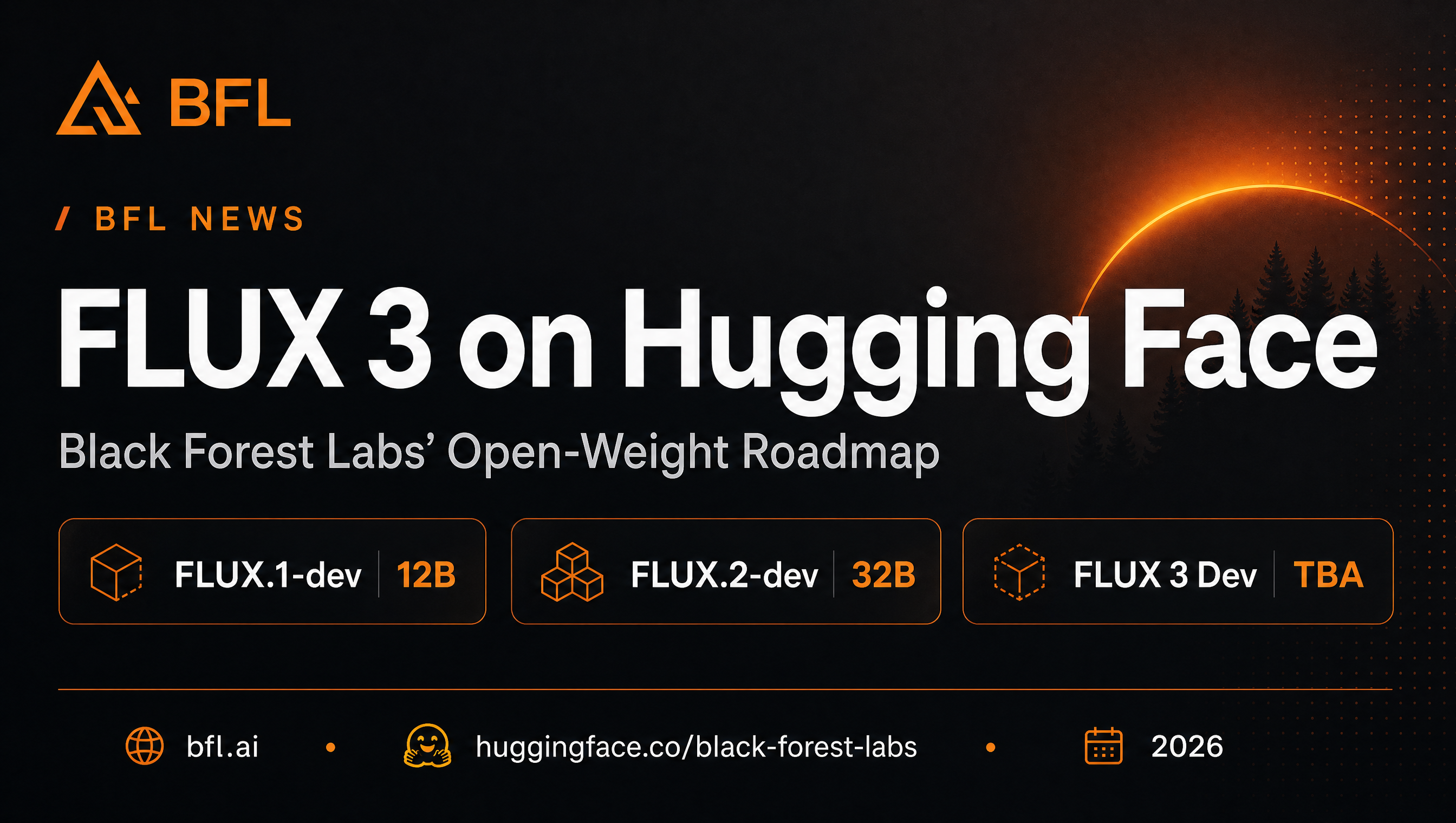
| Model | Parameters | Hugging Face timeline | License / terms |
|---|---|---|---|
| FLUX.1-dev | 12B (text-to-image) | Open weights released Jan 2026 | Open weights; research-oriented license era, generated outputs for personal use |
| FLUX.2-dev | 32B (text-to-image) | Announced Nov 25, 2025; HF weights released April 2026 | Research/non-commercial open-weights license |
| FLUX.1 Kontext (dev variant) | Image editing line | Dev variant on Hugging Face | Open weights (dev tier) |
| FLUX 3 Dev | Not disclosed | No date, no repo yet | No license terms published |
The FLUX.2-dev case is the cleanest template: announced November 25, 2025; "approved the release of the FLUX.2 Pro model via API and the release of the open-weight FLUX.2 [dev]" months later; weights on Hugging Face in April 2026 under a research/non-commercial open-weights license. Same architecture as the flagship, heavier restrictions than Apache/MIT-style open source, fully self-hostable.
BFL's own website treats Hugging Face as the official open-weights home: the Open Weights section links to the Licensing page and to the black-forest-labs HF org. For the community, that makes the org page the single best "is it out yet" signal for FLUX 3 Dev — and so far it has stayed quiet.
What FLUX 3 Dev on Hugging Face would mean for the ecosystem
The FLUX 3 Dev promise is not just "another model card." If it follows the FLUX.1-dev and FLUX.2-dev pattern — and everything BFL has said suggests it will — an open-weight multimodal backbone on Hugging Face reshapes three corners of the ecosystem at once.
1. Fine-tunes and LoRAs move from image-only to multimodal
FLUX.1-dev and FLUX.2-dev created a cottage industry of community fine-tunes: character LoRAs, style adapters, and specialized image models hosted by the thousands on HF. FLUX 3 Dev is different because it is multimodal — one backbone handling video, audio, and image. In theory, a single adapter could transfer across modalities: a style LoRA that changes a character in a still image could also change that character in generated video with audio. Nobody has built that yet because no open multimodal backbone of this scale exists on HF — the first FLUX 3 Dev fine-tunes will be the test of whether "one adapter, all modalities" actually works.
2. ComfyUI-style workflows get a local video backbone
The FLUX line has become a staple of node-based image workflows, with dev-tier checkpoints slotting into ComfyUI-style pipelines for local generation. FLUX 3 Dev extends that muscle memory to video and audio — the practical difference between FLUX 3 Video (API-gated early access) and FLUX 3 Dev (open weights) is that the Dev tier makes low-latency, local, self-hosted video generation possible for people who build on open models. r/StableDiffusion's launch-thread consensus agrees: BFL "will also release faster and open-weight versions of FLUX 3 later this year. Open weights make secure, low-latency local deployment possible."
3. Action prediction becomes a public research target
FLUX 3 Dev is the only launch lane that explicitly covers action prediction in open form. Today, FLUX 3 Action is partner-gated: the robotics work with mimic robotics (FLUX-mimic) has been tested at Audi, and action models are built on FLUX 3's video backbone as a "dynamics-aware foundation." Open weights would hand that foundation to researchers who are not BFL partners — robotics labs, simulation groups, anyone wanting to fine-tune action models outside the partner pipeline. That's a research release with physical-AI implications, not just a content-creation release.
The watchlist: three unknowns that decide everything
What the FLUX 3 Dev release actually looks like comes down to three unannounced details, and the community is watching all three.
Date. BFL has said FLUX 3 Dev is coming "later this year," and that is the only timeline on the record; as of this writing the black-forest-labs org hosts no FLUX 3 repository. The FLUX.2-dev precedent — announced November 2025, weights on HF in April 2026 — suggests a gap of several months between flagship and dev release, but that's a pattern, not a promise.
License. This detail separates "open weights" from "open source," and it matters enormously for commercial users. BFL has never shipped FLUX under a permissive open-source license: FLUX.2-dev came with a research/non-commercial open-weights license, and BFL's licensing page describes two paths — Non-Commercial License Terms and Self-Hosted Commercial License Terms. If FLUX 3 Dev follows suit, local use for research and personal projects is free while commercial self-hosting requires a separate license. Until the model card is live, no one outside BFL knows whether FLUX 3 Dev relaxes or repeats that structure.
Size. The detail that has the community most skeptical is parameter count — or rather, the likely impossibility of a small one. A multimodal backbone covering video, audio, image, and action prediction is, by construction, a very large network. Reddit's "flux 3 open source" discussion puts it bluntly: the multimodal parameter count will likely be huge, and "the number of parameters alone will make it impossible to be a small model." In practical terms, local inference on consumer hardware is questionable at release — a 12B image model fits on a decent GPU, but a 32B+ multimodal backbone with video/audio heads is a different class of requirement. Until BFL publishes the size, architecture, and inference specs, "local FLUX 3" is a hope, not a spec.
There's a fourth item on the watchlist with nothing to do with the Dev release: API pricing. FLUX 3's public API arrives "in the following weeks," and pricing has not been published. For most users, the API is the actual product — FLUX 3 Video early access is already open via application — and Dev weights only become a serious alternative if API pricing pushes self-hosting over the line.
What's still unconfirmed (and why that's normal)
The FLUX 3 Hugging Face story is mostly anticipation right now, so it's worth separating what we know from what we're waiting on. Confirmed: FLUX 3 exists as an omni model; FLUX 3 Dev is part of the official launch plan; BFL's open-weight tradition lives on HF; the model is built on Self-Flow. Unannounced: FLUX 3 Dev's release date, license terms, parameter count, hardware requirements, and any Hugging Face repository — plus API pricing, full video specs (native resolution, frame rate), and FLUX 3's own parameter count. Vendor-reported preference evals (FLUX 3 Video preferred over Grok Imagine Video in up to 69% of comparisons, Kling v3 Pro 60%, Seedance 2.0 52%, Runway Gen-4.5 77%, on 10-second 720p text-to-video clips with audio) are preliminary, self-reported, and "expected to improve"; no formal independent benchmarks exist yet.
That's not a red flag — it's how every FLUX generation has shipped. FLUX.2-dev was announced months before its weights appeared. The gap between "confirmed" and "on Hugging Face" is a feature of the rollout; the open question is how long it is.
FAQ
When will FLUX 3 Dev be released on Hugging Face? No date has been announced; BFL has only said open-weight versions of FLUX 3 come "later this year." The black-forest-labs org hosts no FLUX 3 repository yet, so the org page remains the place to watch.
Is FLUX 3 Dev open source? Unannounced. BFL's history is open weights, not open source: FLUX.2-dev shipped under a research/non-commercial open-weights license, with separate non-commercial and self-hosted commercial terms on BFL's licensing page. Whether FLUX 3 Dev repeats that structure is unknown until the model card publishes.
How big will FLUX 3 Dev be? Unknown. BFL has disclosed no parameter count for FLUX 3 Dev or FLUX 3 itself. The community expects a video/audio/image backbone to be very large — likely too large for comfortable consumer-hardware inference — but that's inference from the architecture, not a published spec.
What can you do with FLUX 3 Dev once it's on Hugging Face? If it follows the FLUX.1-dev and FLUX.2-dev pattern: download and self-host the weights, fine-tune them, and build workflows around them. The multimodal difference is that one backbone covers video, audio, and image generation plus action prediction — the first open multimodal backbone at this scale.
How do I get access to FLUX 3 now? FLUX 3 Video early access is open via application at bfl.ai/models/flux-3 (up to 20 seconds per generation, native audio included). FLUX 3 Image early access follows "in the following weeks"; the public API arrives "in the following weeks" with pricing unpublished.
Bottom line
FLUX 3's Hugging Face story is the rare kind of launch where the most interesting artifact is the one that doesn't exist yet. The launch plan commits to an open-weight multimodal FLUX 3 Dev backbone; BFL's track record — FLUX.1-dev at 12B, FLUX.2-dev at 32B, both on HF — makes the destination obvious; the only real question is when, under what license, and at what size the repo appears. The FLUX.2-dev timeline suggests patience measured in months, not days.
For anyone planning around FLUX 3 — whether you're building fine-tunes, local video pipelines, or just deciding between API access and self-hosting — the practical move is to track the BFL blog for roadmap announcements, the licensing page for commercial terms, and the black-forest-labs Hugging Face org for the repo itself. When the org page updates, the wait is over.
In the meantime, keep the bigger picture in mind: FLUX 3 is entering a crowded multimodal lane against Seedance 2.5, Veo 3.1, Kling 3.0, and Sora 2 — almost all of them closed API-only. If FLUX 3 Dev lands on Hugging Face with usable weights and a workable license, it becomes the only open-weight entry in that field, and the ecosystem that grew up around FLUX.1-dev and FLUX.2-dev will have a reason to build all over again.
Follow Black Forest Labs on Hugging Face to catch the FLUX 3 Dev release the moment it drops, and read the official FLUX 3 announcement and the FLUX.2-dev model card for the license pattern to expect. For video generation workflows and tooling built on open models, check back at wan27.org as FLUX 3 Dev tooling emerges.