Table of Contents
On July 31, 2026, the AI video market got a double launch: two flagship models from two of the biggest Chinese AI labs shipped on the exact same day. ByteDance released Seedance 2.5 through Jimeng (即梦), and MiniMax shipped H3 — the model behind Hailuo 3.0 — through Hailuo's platform. For anyone deciding which model to build on, the timing is either a coincidence or a declaration of war — and it determines how you should read both products.
Here is the problem the launches create: both models are brand-new, closed, platform-based, and neither has been through independent benchmarking at scale yet. Vendor demos look impressive; real-world quality is still unproven. So a spec sheet is the only objective ground to stand on — and the spec sheets could not be more different. Seedance 2.5 is aimed at long-form, reference-heavy, studio-grade production. MiniMax H3 is aimed at fast, affordable, short-form creative. This article walks through the July 31 event as a market signal, compares the two models spec by spec, and then looks at what each launch says about where AI video is heading in the second half of 2026.
July 31 Was a Market Event, Not Just a Release Date
Two same-day launches rarely happen by accident. On July 31, 2026:
- Seedance 2.5 launched on Jimeng, with its API scheduled to open on August 7, 2026 — a publicly announced timeline.
- MiniMax H3 launched the same day, but its API is live right now, including an EvoLink route that comes with 10 free credits.
The availability gap is the first real difference between the two products: Seedance 2.5's consumer front door opened July 31, but developers wait a week for the API, while H3's API was usable the day of the announcement. For teams that want to ship immediately, that asymmetry matters more than any benchmark.
Both launches also share a stance on openness: neither model is open-weight. Seedance 2.5 is closed and platform-based (Dreamina/Jimeng). MiniMax H3 is also closed and platform-based (Hailuo), and no open-weight release has been announced — MiniMax did release weights for its earlier M3 model, so an H3 open release is possible, but it is speculation until confirmed.
Because both models are new, treat every quality claim in this article — including the ones from the vendors — as a hypothesis to test on your own prompts, not a conclusion.
The Head-to-Head Spec Sheet
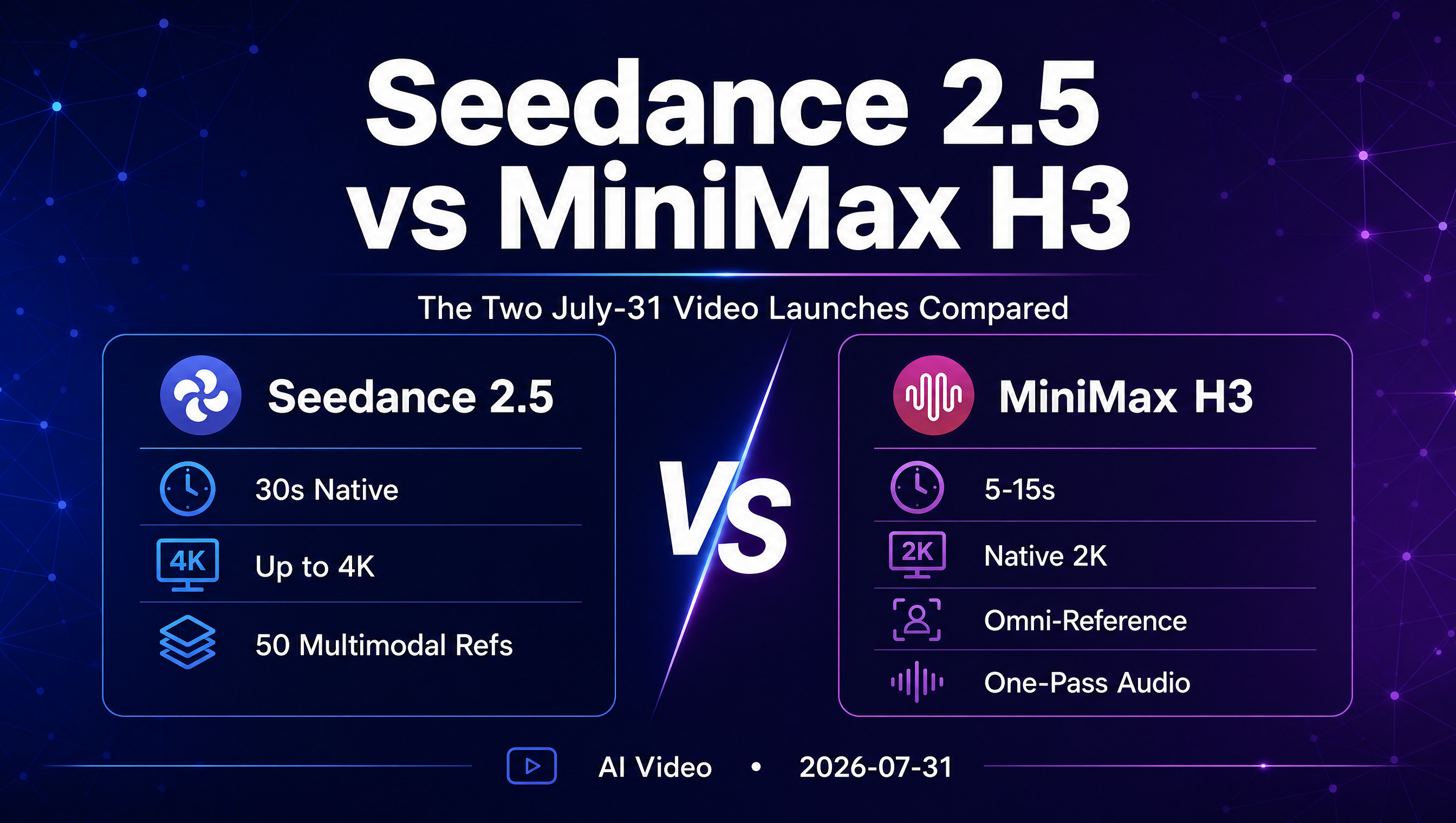
This table is the whole argument in one place. Every number below is drawn from the models' July 31 launch materials and the same-day comparison coverage from EvoLink and OrcaRouter.
| Axis | Seedance 2.5 | MiniMax H3 (Hailuo 3.0) |
|---|---|---|
| Launch | July 31 on Jimeng; API opens August 7 | July 31; API live now |
| Max single clip | 30 seconds native, extendable to ~3 minutes (long-video mode) | 5–15 seconds, extendable to ~30 seconds |
| Resolution | Up to 4K | Native 2K at 24fps |
| Reference inputs | Up to 50 multimodal (images, video, audio, text, 3D whitebox models, greenscreen plates) | Omni-reference: up to 9 images + 3 video clips + 3 audio clips (audio cannot be the only reference type) |
| Audio | Unified audio-video generation: lip-sync in 10+ languages, foley, dialogue in one pass | One-pass synchronized audio: dialogue + SFX + ambience, stereo |
| Editing | Interactive region/frame-level editing with per-second timestamp control | Instruction-based editing |
| Integration | Maya/Blender plugins (3D white-box pre-visualization), confirmed CapCut integration | Fast, accessible API on the Hailuo platform |
| Pricing | Not published; consumer estimate $15–70/mo, API estimate ~$0.21–0.42/s (see caveats below) | Reported ~$0.13/s (check live pricing); EvoLink route live with 10 free credits |
| Open weights | Closed | Closed; open release unconfirmed |
The table reads like two different product categories, because they are. Now let's unpack each row.
Duration and Resolution: Two Different Jobs
The clearest philosophical split is clip length. Seedance 2.5 generates a native 30-second single segment at up to 4K — meaning one continuous shot with no stitching — and can be extended to roughly three minutes in its long-video mode. MiniMax H3 produces clips of 5 to 15 seconds at native 2K and 24fps, extendable to about 30 seconds.
Those numbers define the intended use. Thirty seconds of continuous 4K is a scene: a dialogue exchange, a product hero shot, a cinematic establishing moment. Five to fifteen seconds of 2K is a hook: a social cut, an ad transition, a thumbnail moment. If your deliverable is a 30- to 60-second finished video, Seedance 2.5's native segment means you are not stitching clips together. If your deliverable is a 10-second vertical ad, H3's native range matches the format without paying for compute you do not need.
Reference Systems: 50 Multimodal Inputs vs Omni-Reference
Seedance 2.5 accepts up to 50 multimodal reference inputs — images, video clips, audio, text, 3D white-box models, and greenscreen plates. That last pair is the giveaway that ByteDance is courting actual production pipelines: 3D white-box pre-visualization lets a director block camera movement in Maya or Blender and have the generation respect that blocking, while greenscreen plates slot into compositing workflows.
MiniMax H3's omni-reference system is smaller in raw count but unusually broad in kind: up to 9 images, 3 video clips, and 3 audio clips. One constraint worth knowing: audio cannot be the only reference type — H3 needs at least one visual anchor. For character consistency, product shots, or reference-led sequences where you hold a look across clips, H3's 9+3+3 budget is designed exactly for that.
The reference systems are not competitors; they are different doors into the same problem. Seedance 2.5 assumes you are working like a studio — storyboards, blocking, plates. H3 assumes you are working like a creator — a few reference frames and a vibe.
Audio Is the New Battleground
Both models treat audio as a first-class output rather than an afterthought, which is the clearest sign of where the category is going.
Seedance 2.5 generates audio and video in a single unified pass: lip-sync across 10+ languages, foley, and dialogue are produced together with the visuals. MiniMax H3 also generates synchronized audio in one pass — dialogue, sound effects, and ambience — and outputs stereo.
The practical difference is workflow. With Seedance 2.5, a multilingual lip-sync scene comes out of a single generation instead of a separate dubbing pipeline. With H3, you get a complete short-form package — picture plus sound — in one generation, which is exactly what a fast social-ad workflow wants. Neither approach is "better"; both remove a step that used to require a second tool.
Editing and Integration: Studio Pipeline vs Fast Iteration
Seedance 2.5's editing story is built for surgical revision: interactive region-level (frame-level) editing with per-second timestamp control. You change one element in one region without regenerating the whole take. Its integration story is equally studio-oriented: Maya and Blender plugins for 3D pre-visualization, plus a confirmed CapCut integration (announced July 4, 2026). ByteDance also disclosed that its Seedance enterprise business reported $2 billion in annual recurring revenue around the Volcano Engine FORCE Conference on June 23, 2026 — a reminder that behind the consumer app is an enterprise-scale operation.
MiniMax H3's editing is instruction-based: you describe the change and the model applies it. The emphasis is iteration speed, not surgical precision — consistent with its positioning around quick social and ad creative, product transitions with first/last-frame keyframes, and focused reference-led shots.
Pricing Transparency Is the Sharpest Contrast
Here the two companies diverge completely.
Seedance 2.5 has no official price. ByteDance has not published consumer or API pricing. Everything in the market right now is an estimate or a reseller number, so treat these as directional:
- Consumer tier estimates for Dreamina run roughly $15–70/month.
- Volcano Engine API pricing is estimated at about ¥1.5–3.0 RMB per second ($0.21–0.42/s), extrapolated from Seedance 2.0's ¥1/s baseline.
- Third-party resellers sell access from $9.90 to $200/month with resolution and duration caps (Seedance.tv caps output at 1080p/10s; seedance25ai.net starts at $9.90/month; Renoise offers a multi-model platform).
MiniMax H3 has a reported price and a live route. aireiter's coverage reports roughly $0.13/second, and the EvoLink API route is live with 10 free credits — check live pricing before committing, since per-second rates move. Multiple access points are already selling H3.
For a team budgeting a production, that difference is decisive: you can cost out an H3 workload today, but only estimate a Seedance 2.5 one. That is a fact of the July 31 launches, not a criticism.
What Each Launch Signals for H2 2026
Read together, the two launches describe a market splitting into two lanes.
Seedance 2.5 is the long-form, studio-production lane. Native 30-second 4K segments, 3D white-box pre-visualization with Maya/Blender plugins, greenscreen plates, region-level editing, and a confirmed CapCut integration add up to a model that wants to sit inside a professional pipeline — anything where the deliverable is a finished scene rather than a feed clip. The $2B ARR disclosure says ByteDance believes the money is in enterprises and professionals.
MiniMax H3 is the fast, short-form accessibility lane. 5–15 second clips, 2K output, omni-reference with a modest input budget, one-pass stereo audio, instruction-based editing, and a published per-second price target anyone who needs a constant stream of short video at a cost that makes experimentation cheap.
The bet underneath both launches is that audio-synchronized, reference-controlled generation becomes the default expectation in H2 2026. Neither model lets you bolt sound on afterward as a necessary step; both treat it as part of the generation. The differentiator going forward will not be "can it make video" — it will be "can it make the video you specifically need, at the length, resolution, and price your workflow demands."
Which Should You Pick?
There is no objective winner yet — both models are days old and independent benchmarks are still accumulating. Test on your own prompts before you commit either way. But the spec sheets give you a clear rule of thumb:
- Choose Seedance 2.5 if your work is long-form and reference-heavy: continuous 30-second scenes, 4K delivery, 3D pre-visualization, greenscreen work, multilingual lip-sync, or integration with Maya/Blender/CapCut. Budget for pricing uncertainty until ByteDance publishes official rates.
- Choose MiniMax H3 if you want to ship now at a known cost: 5–15 second social hooks, product transitions with first/last-frame keyframes, focused reference-led shots, one-pass audio, and an API that is live today with 10 free credits on EvoLink.
- Choose both if your pipeline has both kinds of work — a common pattern is H3 for volume short-form and Seedance 2.5 for hero scenes, once its API opens on August 7.
FAQ
Which is better, Seedance 2.5 or MiniMax H3? There is no answer yet. Both launched July 31, 2026, both are closed models, and independent benchmarks are still accumulating. The models target different jobs — long-form studio production (Seedance 2.5) versus fast short-form accessibility (H3). Run your own prompts on both and judge by your use case.
How much does Seedance 2.5 cost? Official pricing is not published. Estimates put the Dreamina consumer tier at roughly $15–70/month and Volcano Engine API at ~$0.21–0.42/second (based on Seedance 2.0's ¥1/s baseline). Third-party resellers range from $9.90 to $200/month with resolution and duration caps.
How much does MiniMax H3 cost? Coverage reports roughly $0.13/second, and the EvoLink API route is live with 10 free credits. Per-second rates move, so check live pricing before scaling.
When does the Seedance 2.5 API open? August 7, 2026, per the announced schedule. MiniMax H3's API was live on launch day, July 31.
Is MiniMax H3 open source? No open-weight release has been announced. H3 is closed and platform-based (Hailuo). MiniMax released weights for its earlier M3 model, so an H3 open release is possible — but that is speculation until confirmed.
Can Seedance 2.5 do lip-sync? Yes — its unified audio-video generation includes lip-sync in 10+ languages, plus foley and dialogue, produced in a single pass. H3 generates synchronized dialogue, SFX, and ambience in one pass, in stereo.
The Bottom Line
July 31, 2026, will be remembered as the day AI video split in two. Seedance 2.5 and MiniMax H3 shipped the same day with opposite philosophies: one pushing toward 30-second 4K studio scenes with 3D pre-visualization and surgical editing, the other toward affordable 5–15 second clips with omni-references and one-pass audio at a published price. Neither has proven itself in the wild yet, and both deserve a test run on your own prompts before you pick a side. But the direction of travel is unmistakable — audio-synchronized, reference-controlled video is now table stakes, and the fight for H2 2026 is about which workflow you belong to.
For more on the pricing side of this launch, see our breakdown of Seedance 2.5 pricing across official tiers and resellers, or compare against Vidu S1 for another angle on the 2026 video generation landscape.