Table of Contents
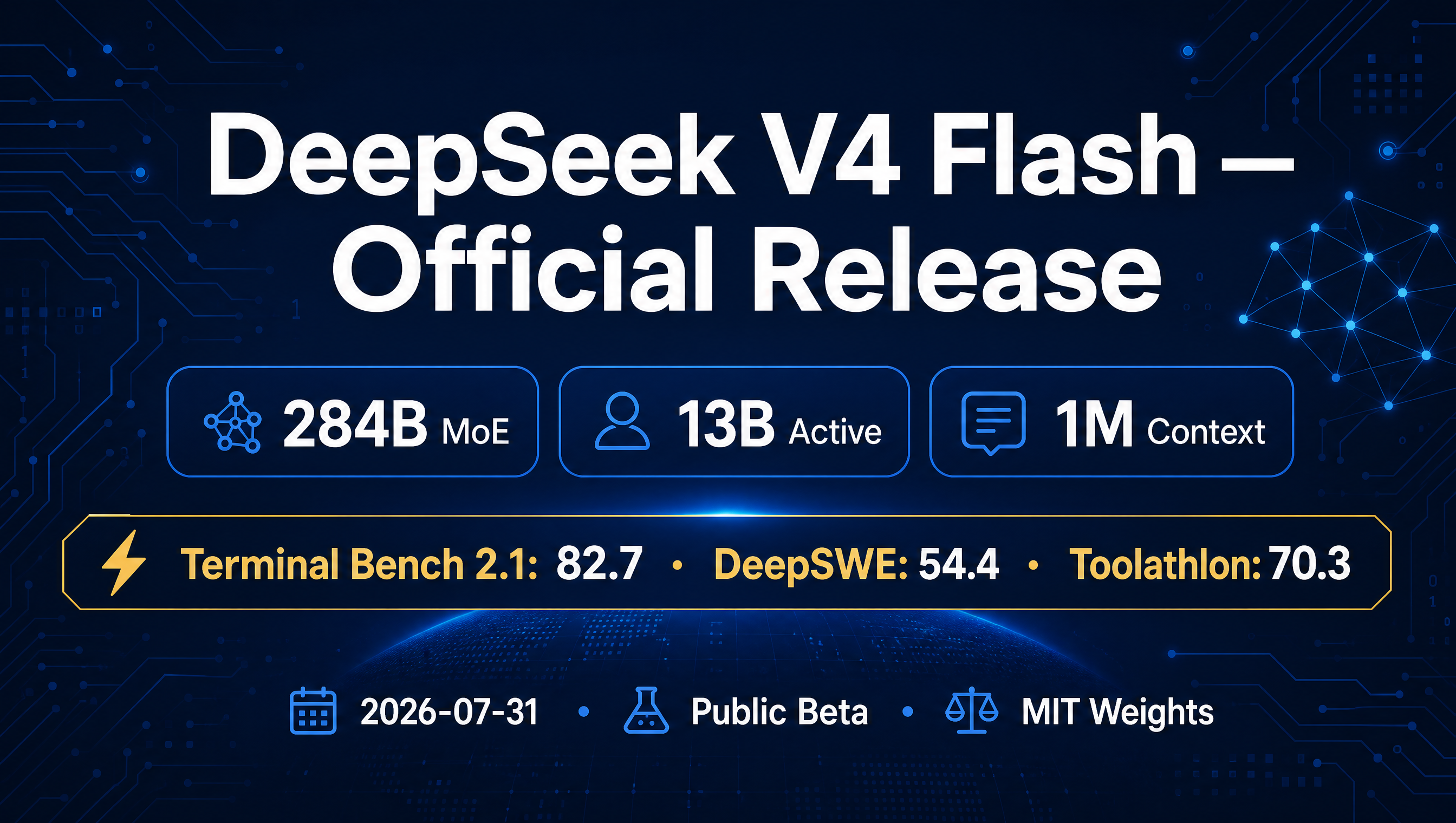
The model behind your deepseek-v4-flash API calls changed on July 31, 2026 — same name, same architecture, same price, and dramatically different agent benchmark scores. DeepSeek's official API changelog, dated July 31, 2026, announces that the official release of the DeepSeek-V4-Flash API is now live in public beta under the build name DeepSeek-V4-Flash-0731. The headline is not a new parameter count — it is an agent capability jump so large that DeepSeek says the new build's results "far exceed" V4-Pro-Preview, the bigger model in the same family.
If you have been building on the preview since April, the change is mostly invisible: the API calling method is unchanged (set the model name to deepseek-v4-flash), and the model keeps the exact same architecture and size as DeepSeek-V4-Flash-Preview. It was only re-post-trained. But what changed underneath is why this matters: the 0731 build posts Terminal Bench 2.1 at 82.7, DeepSWE at 54.4, and Cybergym at 76.7, natively supports the Responses API format, and is specifically adapted for Codex. For developers running agent loops, that shifts what a $0.28-per-million-output-token model can be trusted to do autonomously.
This article covers what the official release actually changes, the benchmark numbers behind the jump, the architecture and serving economics behind them, where the build sits in the July 2026 open-weight landscape, and what to expect next.
The News: DeepSeek-V4-Flash-0731 Is Officially in Public Beta
The source of record is DeepSeek's API changelog, updated July 31, 2026. Per the announcement, the official release of the DeepSeek-V4-Flash API is now in public beta and the calling method is unchanged: set the model name to deepseek-v4-flash exactly as during the preview.
Three facts from the changelog define what kind of release this is:
- It is a retrained build, not a new architecture. DeepSeek-V4-Flash-0731 keeps the same model architecture and size as DeepSeek-V4-Flash-Preview. The upgrade is re-post-training — new weights on the same skeleton, which is why API integration is a drop-in change.
- The agent numbers are the story. DeepSeek describes the enhanced agent capabilities as benchmark results "far exceeding" V4-Pro-Preview, the flagship-scale model in the V4 family.
- It is API-scoped. Only the V4-Flash API was upgraded. The V4-Pro API and the APP/WEB models are unchanged, and DeepSeek states that the official release of DeepSeek-V4-Pro will follow soon.
The changelog also adds two developer-facing features beyond the April preview: the official V4-Flash natively supports the Responses API format, and the build is specifically adapted for Codex. Both point one way — DeepSeek is tuning this release for long-running, tool-using agents, not single-shot chat.
The Agent Benchmark Jump in the 0731 Build
The benchmark table in the changelog is the hook. DeepSeek published nine agent-focused scores for DeepSeek-V4-Flash-0731, run with the DeepSeek Harness in minimal mode, max effort, top_p=0.95, temperature=1.0:
| Benchmark | DeepSeek-V4-Flash-0731 |
|---|---|
| Terminal Bench 2.1 | 82.7 |
| Cybergym | 76.7 |
| Toolathlon (verified) | 70.3 |
| DSBench-FullStack (internal) | 68.7 |
| DSBench-Hard (internal) | 59.6 |
| DeepSWE | 54.4 |
| NL2Repo | 54.2 |
| Agent Last Exam | 25.2 |
| Automation Bench (Public) | 25.1 |
Two are DeepSeek's internal sets — DSBench-FullStack (68.7) for full-stack development and DSBench-Hard (59.6) for hard coding-agent problems — so treat those two as directional: they have not been independently reproduced yet. The rest are public benchmarks covering terminal use, repository construction, software engineering, tool use, and automation.
For scale: the April preview's terminal score was Terminal-Bench 2.0 at 56.9%; the 0731 build posts 82.7 on the newer Terminal Bench 2.1. The versions differ, so this is directional evidence rather than a like-for-like delta — but the direction is consistent across every category. Scores were produced with the DeepSeek Harness in minimal mode; the harness ships publicly soon, so third parties can reproduce the runs.
Against the preview's broader coding picture — SWE-bench Verified 79.0%, LiveCodeBench 91.6%, Codeforces rating 3052 — the 0731 release closes the gap between "great at code generation" and "trustworthy at autonomous execution." The first gets you good completions; the second gets you an agent you can point at a repo or pipeline and walk away from.
What the Official Release Actually Changes for Developers
If you are already calling deepseek-v4-flash, the practical change list is short — and that is the point. The changelog's migration burden is essentially zero:
- Model name unchanged. Keep sending
deepseek-v4-flash. If you were still on the retired legacy aliases, that is the one migration you must make:deepseek-chatanddeepseek-reasonerwere retired on July 24, 2026, and calls must now usedeepseek-v4-flashordeepseek-v4-pro. - Responses API support is native. The official V4-Flash natively supports the Responses API format, which simplifies building agentic loops that chain tool calls, file access, and multi-turn state without shimming a chat-completions endpoint.
- Codex-ready out of the box. The build is specifically adapted for Codex — long-horizon, tool-using agent harnesses are the intended workload.
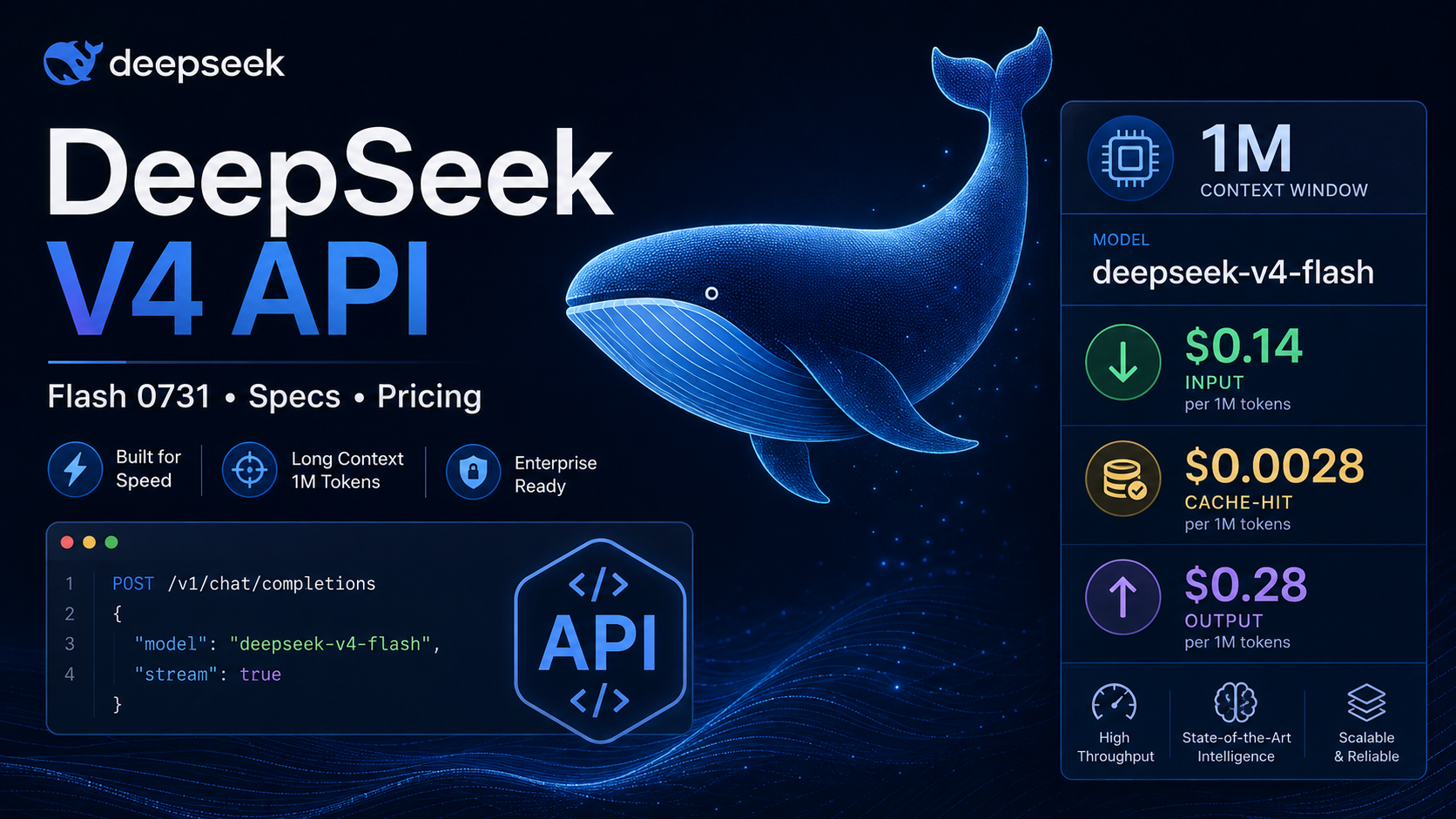
- Pricing is unchanged. The preview rates remain the public numbers: $0.14 per million input tokens (cache miss), $0.028 (cache hit), and $0.28 per million output tokens. OpenRouter lists $0.09 in / $0.18 out — aggregator pricing, not DeepSeek's own rate card.
- Thinking modes still available. Both Thinking and Non-Thinking modes remain supported, with reasoning efforts
highandxhigh(xhigh = max reasoning) available via the OpenAI-compatible endpoint athttps://api.deepseek.com. - Only V4-Flash moved. The V4-Pro API and APP/WEB models are untouched, so V4-Pro-pinned systems see no change until its official release lands.
One thing to watch: DeepSeek has announced peak-hour surge pricing tied to Beijing business hours (UTC+8), but no percentage or start date is published as of late July and it is not active. Flag it in your cost model and move on.
Why the Jump Happened: Architecture, Context, and Serving Economics
The 0731 build's gains come from re-post-training, but the reason the model can afford to be an agent workhorse is the V4-Flash architecture shipped in April. The preview announcement (April 24, 2026) introduced V4-Flash at 284B total parameters with 13B activated — a sparse MoE design whose entire purpose is cheap, high-throughput serving.
Three numbers from the preview technical reporting frame the economics:
- 1M-token context by default (up from V3.2's 128K), with max output of 65,536 tokens. An agent can hold a full codebase, a full script, or a full production brief in context without chunking.
- New hybrid attention — Compressed Sparse Attention (CSA) plus Heavily Compressed Attention (HCA), extending DeepSeek Sparse Attention (DSA) from V3.2-Exp (technical analysis). The stated goal is serving cost, not headline evals: versus V3.2 at 1M context, KV cache drops to roughly 10%, inference FLOPs to roughly 27% per token, and cost-to-serve is roughly 10x cheaper.
- Measured throughput around 60+ tokens/sec for V4-Flash (Lightning AI measurements) — fast enough for interactive agent loops and, at $0.28/M output, cheap enough for hundreds of revision cycles.
Both V4-Flash and V4-Pro shipped as MIT-licensed open weights — see the model card for specs — which turns pricing into a deployment question. Community positioning has V4-Flash as "runnable at home": it fits on 2x NVIDIA DGX Spark (GB10) at full context, with deployments documented on NVIDIA forums — a differentiator against Kimi K3 (2.8T open-weight) and GLM 5.2, which need heavier hardware. For teams with data-handling constraints, that means the $0.28/M model can run on-prem, without routing prompts to a third-party API.
What the 0731 Build Means for the Open-Weight Agent Race
The headline numbers land in a category that, until now, belonged almost exclusively to closed frontier flagships. A model with 13B active parameters posting 82.7 on Terminal Bench 2.1, 76.7 on Cybergym, and 70.3 on verified Toolathlon is a different kind of open-weight release: not a coding-completion model, but an agent that can be pointed at real work.
The pricing arithmetic makes that capability broadly reachable. At the preview rates — $0.14 per million input tokens (cache miss), $0.028 (cache hit), $0.28 per million output — an agent loop that sends the same system prompt and tool definitions on every turn turns the repeated context into near-free cache hits. Compare the output rate to Claude Opus 4.6's $25 per million output tokens: V4-Flash's preview coding scores (SWE-bench Verified 79.0%, LiveCodeBench 91.6%) were already within range of the flagships, and the 0731 agent scores now exceed V4-Pro-Preview's own measurements.
Weights matter as much as price. Both V4 models ship under the MIT license, which converts the price-per-token question into a deployment question: fine-tuning, distillation, and private hosting are all permitted. On the hardware side, community deployments document V4-Flash running at full 1M context on 2x NVIDIA DGX Spark (GB10) — an explicitly local configuration that competes against heavier open-weight rivals like Kimi K3 (2.8T) and GLM 5.2.
That is the position DeepSeek is defending in the busiest open-weights month of 2026. Kimi K3 took the Frontend Code Arena crown on July 16; GLM 5.2 and Qwen3.8-Max (2.4T, open-weight planned) shipped within the same window, alongside GPT-5.6 and Claude Opus 4.6-4.8. DeepSeek's answer is not a bigger parameter count — it is a smaller, cheaper, locally runnable model whose 0731 build now leads on the agent benchmarks that matter for autonomous work.
DeepSeek V4 Flash in the July 2026 Model Landscape
The 0731 release lands in the most crowded open-weights month of 2026. Kimi K3 (Moonshot AI, 2.8T open-weight, launched July 16) took #1 on Frontend Code Arena; GLM 5.2 (Z.ai) and Qwen3.8-Max (Alibaba, 2.4T, open-weight planned) shipped alongside GPT-5.6 and Claude Opus 4.6-4.8. DeepSeek's positioning is explicit: price/performance, not parameter count. V4-Flash at 284B/13B active is a fraction of Kimi K3's 2.8T, yet the preview showed 79.0% SWE-bench Verified, and the 0731 build's agent scores now exceed those of V4-Pro-Preview — whose own preview measurement was 80.6% SWE-bench Verified versus Claude Opus 4.6's 80.8%, a 0.2-point gap at roughly one-seventh the output price.
The GA timing was no surprise: leaked build IDs deepseek-v4-flash-202605 and deepseek-v4-pro-202606 surfaced July 4 via @teortaxesTex, and the community expected a WAIC-timed reveal. July 31 confirms the Flash side; V4-Pro's official release remains open.
What Happens Next
Three things are worth watching in the coming weeks:
- The official V4-Pro release — DeepSeek says it "will follow soon"; expect the same treatment: re-post-trained build, agent benchmarks, Responses API support.
- The DeepSeek Harness public release — the minimal-mode harness used for the 0731 runs ships soon, letting third parties verify the agent scores.
- Surge pricing activation — the announced peak-hour surcharge tied to Beijing business hours (UTC+8) still has no percentage or start date; watch the changelog before committing high-volume workloads.
For the image-input rumor, the position stays the same until DeepSeek speaks: unconfirmed, and absent from the changelog.
FAQ
What does the DeepSeek V4 Flash API cost? The preview rates remain public: $0.14 per million input tokens (cache miss), $0.028 (cache hit), and $0.28 per million output tokens. OpenRouter lists $0.09 in / $0.18 out — aggregator pricing. No new pricing came with the 0731 release.
Is DeepSeek V4 Flash open source? Yes. V4-Flash (284B total, 13B active) and V4-Pro (1.6T total, 49B active) are MIT-licensed open weights. Community deployments document V4-Flash running at full context on 2x NVIDIA DGX Spark (GB10).
What is the difference between DeepSeek V4 Flash and V4 Pro? V4-Flash is the smaller model (284B/13B active) built for cheap, high-throughput serving; V4-Pro is flagship scale (1.6T/49B active). The 0731 V4-Flash build's agent results now "far exceed" V4-Pro-Preview, whose official release is expected soon; the V4-Pro API is unchanged for now.
What happened to deepseek-chat and deepseek-reasoner?
Both legacy aliases were retired on July 24, 2026. Calls must now use deepseek-v4-flash or deepseek-v4-pro.
Does DeepSeek V4 Flash support image input? Unconfirmed. Community speculation exists, but DeepSeek has not confirmed it and the official changelog does not mention it. Do not build around it.
Start Building on the 0731 Build
The release is live in public beta today, the migration is a no-op for existing deepseek-v4-flash users, and the agent numbers become verifiable when the DeepSeek Harness ships. The highest-signal move is not to wait for more coverage — it is to stress-test the build against your own agent loops, with the changelog as reference.