Table of Contents
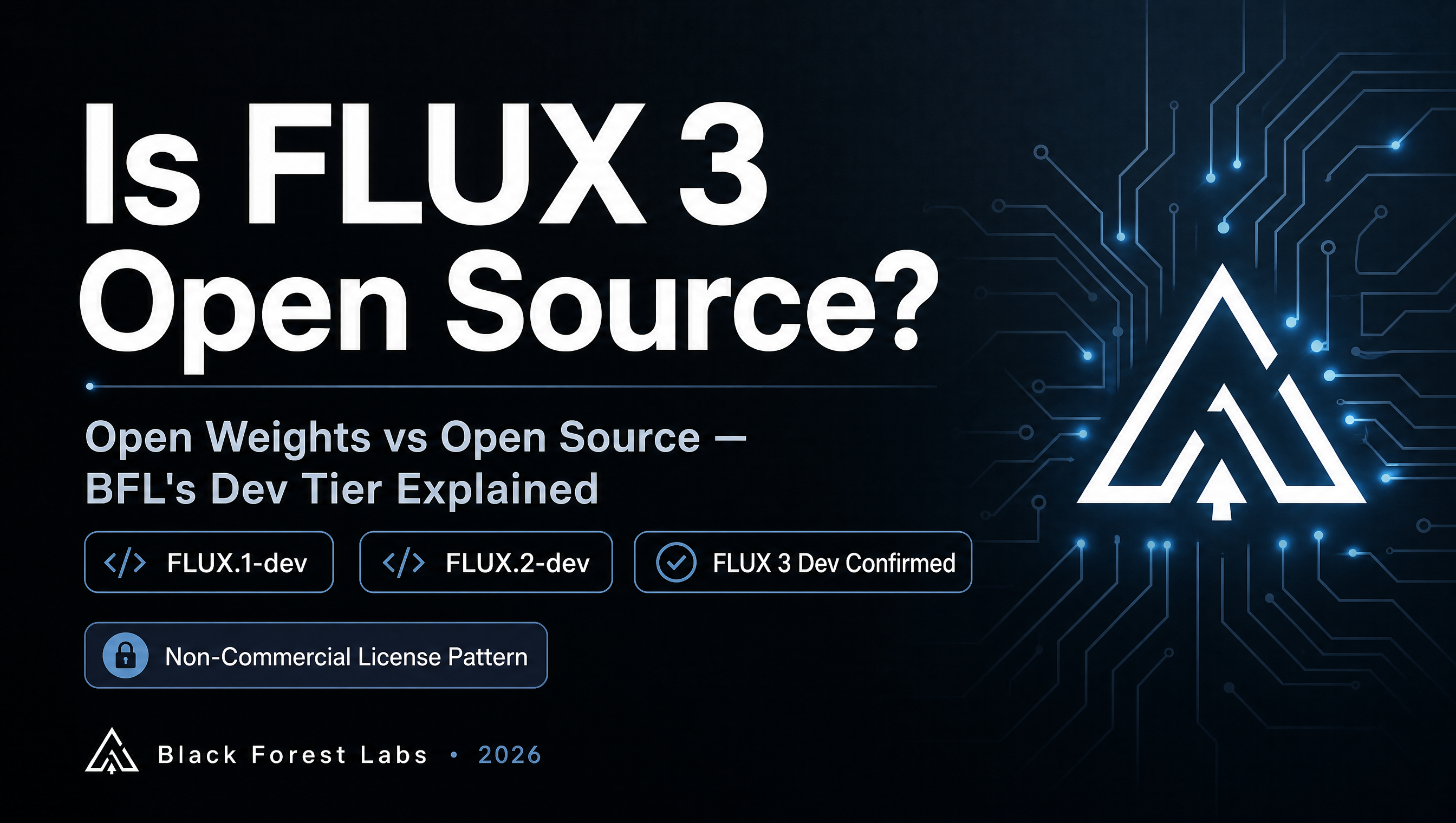
The short answer, as of July 31, 2026: FLUX 3 is not open source, and it is not even open-weights yet — but an open-weights FLUX 3 Dev release is officially confirmed in Black Forest Labs' launch plan. When Black Forest Labs (BFL) announced FLUX 3 on July 23, 2026 (official announcement), it framed the model as a multimodal "omni" foundation network — one architecture generating video, audio, image, and action prediction. The fourth item in its four-part launch plan was unambiguous: "Open-weight access to a multimodal backbone, for content creation (video, audio and image) and action prediction. (FLUX 3 Dev)." What the announcement did not include is the part everyone is actually asking about: no release date, no license terms, no parameter count, and no Hugging Face repository.
That gap between "confirmed" and "shipped" is exactly why "is FLUX 3 open source?" is the wrong question — and also the right one. The term being conflated here is open weights, which is what BFL has shipped for two generations and what it promises again for FLUX 3 Dev. This article unpacks the distinction, walks through BFL's Dev-tier track record, separates what is confirmed from what is speculation about FLUX 3 Dev, and looks at what open weights would actually change for the AI video ecosystem.
The Short Answer: Confirmed, But Undated
Three facts define the current state:
- FLUX 3 Dev is confirmed as an open-weight release. It is item four in the official launch plan, described as "open-weight access to a multimodal backbone" covering content creation (video, audio, image) and action prediction.
- Nothing else about it is public. As of this writing there is no announced release date, no published license, no disclosed parameter count, and no Hugging Face repository for FLUX 3 Dev.
- Until weights exist, the model is only reachable through gated early access. FLUX 3 Video is in early access via an application/request flow on BFL's model page, with up to 20 seconds per generation including native audio. FLUX 3 Image follows "in the following weeks," per the announcement. Neither path allows independent evaluation or fine-tuning — those require weights.
So the honest headline is not "FLUX 3 goes open source." It is: BFL has promised open weights, on a track record of delivering them, with the details still unannounced.
Open Weights vs. Open Source: Why the Distinction Matters
The confusion starts with vocabulary. In the AI community, "open source" now gets used for everything from MIT-licensed code to "the weights are downloadable." Those are very different things — the difference determines what you can legally do with the model: run it commercially, fine-tune it, or redistribute it.
| Dimension | Permissive OSS (e.g., Apache 2.0, MIT) | BFL open-weights Dev tier (track record) |
|---|---|---|
| Model weights published | Yes | Yes — FLUX.1-dev, FLUX.2-dev on Hugging Face |
| Source code / training recipe | Typically included | No — training pipeline stays proprietary |
| License style | Permissive, commercial use allowed | Research / non-commercial (FLUX.2-dev terms) |
| Commercial use path | Included in license | Separate Self-Hosted Commercial License |
| Community fine-tuning | Unrestricted by license | Research use under Dev terms |
BFL has never shipped a permissive-license model. Its Dev releases are open-weights releases under non-commercial-oriented licenses — the fact that you can download 32 billion parameters and run them on your own GPU is real openness, but it is not open source in the OSI sense, and calling it that sets the wrong expectation for commercial users.
BFL's Dev-Tier Tradition: Two Generations of Open Weights
The community assumes FLUX 3 Dev will land on Hugging Face because BFL has done this twice in a row. The pattern is consistent: a proprietary flagship served through an API, plus a smaller or otherwise gated "Dev" variant with downloadable weights.
| Release | Model | Weights | License | Status |
|---|---|---|---|---|
| FLUX.1-dev | 12B text-to-image | On Hugging Face since January 2026 | Personal / non-commercial-oriented research | Released |
| FLUX.2-dev | 32B text-to-image | Announced Nov 25, 2025; HF weights April 2026 | Research / non-commercial open-weights | Released |
| FLUX 3 Dev | Multimodal backbone (video, audio, image, action) | Not on Hugging Face yet | Not announced | Confirmed in launch plan, no date |
FLUX.2-dev is the clearest precedent: announced November 25, 2025, with the open-weight FLUX.2-dev approved alongside the Pro API, and weights on Hugging Face by April 2026 under a research/non-commercial open-weights license. BFL's Hugging Face org page is the established home for these releases, and BFL's own website links its Open Weights section to both the licensing page and that org page.
The launch-week discussion on r/StableDiffusion captured the expectation precisely: commenters reported that BFL "will also release faster and open-weight versions of FLUX 3 later this year," and that "open weights make secure, low-latency local deployment possible." Note the word faster: the Dev-tier promise has historically been speed and accessibility, not raw capability parity with the API flagship.
What Is Actually Confirmed About FLUX 3 Dev
Let's separate the grounded from the assumed, because this is where most coverage goes wrong:
Confirmed. FLUX 3 Dev exists as a launch-plan item: open-weight access to the multimodal backbone, explicitly covering content creation — video, audio, and image — plus action prediction. That last part is distinctive. The launch plan also includes action prediction through research/commercial partners beginning with mimic robotics (the FLUX-mimic video-action model tested at Audi), so the open-weight backbone is positioned not just for content tools but for physical AI research.
Not confirmed. Release date. License terms. Parameter count. Hardware requirements. Whether the Dev weights will be a full multimodal model or a subset. Whether it ships on Hugging Face (highly likely given precedent, but still not announced). Any of these could change the ecosystem calculus dramatically — a 32B text-to-image Dev model and a multimodal Dev model are different deployment problems, as the community has been quick to point out.
Explicitly not published for FLUX 3 generally. Pricing, parameter count, and full video specifications (native resolution, frame rate) were absent from the announcement. There are also no formal independent benchmarks yet — the preference numbers BFL reported (preferred over Kling v3 Pro in 60% of comparisons, over Grok Imagine Video up to 69%) are vendor-reported, preliminary, and explicitly "expected to improve." Treat them as directional.
What Open Weights Would Change for the AI Video Ecosystem
If FLUX 3 Dev ships, the biggest change is not that a new model exists — it's that a multimodal model joins the open-weights club, and the video ecosystem has been waiting for exactly that. Most of the current frontier video models sit behind closed APIs: Seedance 2.5 (ByteDance), Veo 3.1 (Google), Kling 3.0 (Kuaishou), and Sora 2 (OpenAI) are all API- or product-gated. BFL's open-weights Dev tradition is its genuine differentiator in that crowded lane, and a FLUX 3 Dev release would be the first multimodal open-weights option among today's frontier video models.
Three things change in practice:
Local deployment. Open weights make self-hosted inference possible — no API dependency, no per-token cost, no data leaving your infrastructure. The Reddit framing of "secure, low-latency local deployment" is the concrete promise: studios with data-handling constraints, researchers, and hobbyists get a private runway. But the caveat is hardware. The community's dominant concern on the "flux 3 open source" thread is blunt: a multimodal model's parameter count is likely enormous, and as one commenter put it, "the number of parameters alone will make it impossible to be a small model." Local inference on consumer hardware is questionable until BFL discloses size and requirements — which it has not.
Fine-tuning. Weights are the precondition for any independent adaptation: custom LoRAs, domain-specific video styles, character consistency tuned on your own footage. Until weights exist, none of that is possible; the only access is the gated API early access. Fine-tuning is also where the license question bites — under the FLUX.2-dev precedent, research/non-commercial terms allow experimentation but not productized derivatives without a commercial license.
Independent evaluation. With no weights and no formal independent benchmarks, every claim about FLUX 3 quality currently rests on BFL's preliminary preference evals. Weights would let third parties run their own head-to-heads against Seedance, Veo, Kling, and Sora — which is exactly the validation the hype cycle is missing.
What Won't Change: The Dual-Licensing Reality
Even in the best case, "open weights" will not mean "free for everything." BFL's licensing structure — Non-Commercial License Terms and Self-Hosted Commercial License Terms — is the dual path it has used for open-weight models: a free research/non-commercial tier for the community, and a paid self-hosted commercial tier for businesses that want to deploy the weights in products. FLUX 3 Dev, if it follows precedent, inherits that structure rather than escaping it.
That has practical consequences. A solo researcher fine-tuning FLUX 3 Dev for a paper: fine under non-commercial terms. A startup serving customer videos on its own GPUs: that is self-hosted commercial territory. The open-weights promise is real — you can run the thing — but the license still governs what you can do with the thing, and for any commercial deployment you should plan for the paid path from day one.
The other thing that will not change is the scam landscape. If you see a "flux-3.com"-style consumer site offering FLUX 3 access, it is not affiliated with BFL — independent analysis has flagged exactly this pattern. Weights or no weights, the official distribution points are BFL's site, its API, and its Hugging Face org.
What to Watch Next
Three signals will tell you whether the open-weights promise is real and what it will cost:
- The FLUX 3 Dev announcement — license terms, parameter count, and hardware requirements. Size and license matter more than the date: they determine whether local inference is a desktop reality or a datacenter privilege.
- API pricing — unpublished as of late July. The Dev tier's non-commercial license only matters if the commercial path is priced sanely.
- Independent benchmarks — the first third-party evaluations of FLUX 3 Video against Seedance, Veo, Kling, and Sora, once early access results spread.
FAQ
Is FLUX 3 open source? No — not yet, and probably never in the permissive-license sense. FLUX 3 is currently only available through gated early access (video) and an upcoming API (image "in the following weeks"). An open-weight FLUX 3 Dev release is confirmed in BFL's launch plan but has no announced date, license, or parameter count. BFL's Dev-tier history is open weights under non-commercial research licenses, not open source.
Will FLUX 3 be on Hugging Face? Almost certainly, based on precedent, but it is not announced. FLUX.1-dev and FLUX.2-dev both live on BFL's Hugging Face org, and BFL links its Open Weights section to that org. The exact release timing for FLUX 3 Dev has not been published.
When is the FLUX 3 Dev release date? Not announced. BFL statements and community reporting point to "later this year," but that is an expectation, not a commitment. Watch the official announcement for license terms and hardware requirements alongside the date.
Can I run FLUX 3 locally on consumer hardware? Unknown. BFL has not disclosed FLUX 3's parameter count or hardware requirements. The community's working assumption is that a multimodal model will be too large for typical consumer hardware — "the number of parameters alone will make it impossible to be a small model" — but until BFL publishes specs, treat local deployment as an open question.
Can I use FLUX 3 commercially? FLUX 3 itself is API early access today; commercial terms will come with pricing, which is unpublished. For the open-weights Dev tier, BFL's established path is dual licensing — Non-Commercial License Terms for research, Self-Hosted Commercial License Terms for commercial self-deployment.
The Bottom Line
FLUX 3 open source is a category error; FLUX 3 open weights is a confirmed promise with unannounced terms. The launch plan names FLUX 3 Dev explicitly, the track record says it will land on Hugging Face, and the community expects it "later this year." But the release date, license, and size — the three facts that determine whether this changes the video ecosystem or just headlines — are still unpublished. Until they land, the honest position is: expect open weights, plan for dual licensing, and don't buy local-deployment claims based on anything other than BFL's own specs.
While you wait, you don't need a FLUX 3 Dev release date to feel what open-weights video generation is like today. Generate your first Wan 2.7 clip on wan27.org — the platform runs text-to-video and image-to-video workflows directly in your browser, so you can benchmark your expectations against what open models deliver now rather than what FLUX 3 Dev promises for later.