Table of Contents
Two months ago at Google I/O 2026, Google unveiled Gemini 3.5 Flash and promised the Pro version would arrive in June. That deadline came and went.
Developers who adopted 3.5 Flash for production workflows started running into the same friction: the model was verbose. It burned tokens on reasoning chains that did not always improve output quality, and in multi-step agentic workflows, those extra tokens compounded into real latency and real cost. Customers asked for the same intelligence with less waste.
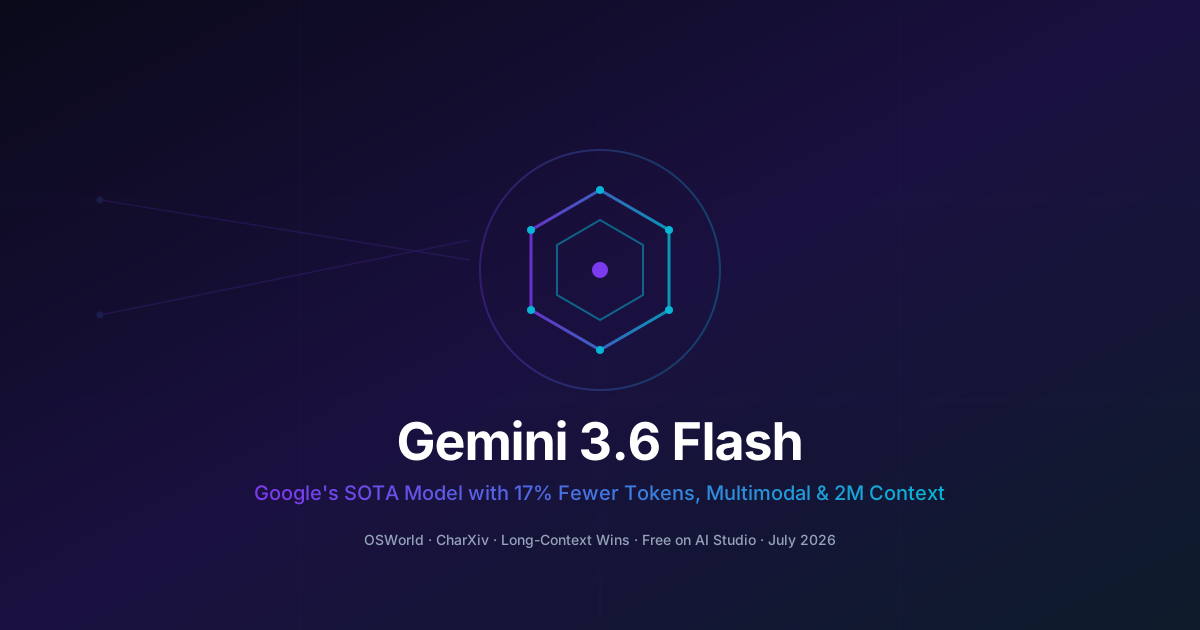
On July 21, Google shipped the answer — and it was not what most people expected. Instead of delivering 3.5 Pro (still testing with partners), the company released Gemini 3.6 Flash, a mid-generation upgrade that outperforms 3.5 Flash on every major benchmark while consuming fewer tokens and costing less per output.
This article is based on Google's official July 21 announcement, the DeepMind model page, and third-party evaluations from Artificial Analysis and Datacurve. By the end, you will know exactly what 3.6 Flash improves, how it compares to GPT-5.6 and Grok 4.5, where to access it, and what the Gemini 4 tease means for the roadmap.
What Happened: The July 21 Launch
Google dropped three announcements on July 21, 2026:
- Gemini 3.6 Flash — a direct upgrade to 3.5 Flash with better token efficiency and lower pricing
- Gemini 3.5 Flash-Lite — a faster, ultra-low-cost model for high-throughput production
- Gemini 3.5 Flash Cyber — a specialized model for code vulnerability detection, exclusive to governments and trusted partners
The headline, though, is Gemini 3.6 Flash. It is the workhorse model that most developers interact with daily — and the improvements are substantial enough to make it a drop-in replacement worth switching for.
Alongside the launch, Google revealed that 3.5 Pro is in partner testing and that Gemini 4's pre-training run has begun — described as "our most ambitious pre-training run yet."
What Changed: Gemini 3.6 Flash vs 3.5 Flash
The upgrade is not a generational leap. It is a targeted refinement that addresses the most common developer complaints about 3.5 Flash: verbosity, cost-per-task, and reliability on long-horizon coding work.
Token Efficiency: 17% Fewer Output Tokens
According to the Artificial Analysis Index, Gemini 3.6 Flash consumes 17% fewer output tokens than 3.5 Flash on equivalent tasks. On certain benchmarks like DeepSWE by Datacurve, the reduction reaches up to 65%.
This is not just a cost saving — it is a behavior change. The model takes fewer reasoning steps and tool calls to complete multi-step workflows. For developers running agentic systems where a single task might generate thousands of output tokens across dozens of turns, the cumulative savings are meaningful.
Rule of Thumb: If your 3.5 Flash workflow generates 100K output tokens per task, switching to 3.6 Flash should reduce that to roughly 83K — saving about $0.15 per task at current rates, plus the latency reduction from processing fewer tokens.
Lower Pricing Despite Better Performance
3.6 Flash drops the output price while holding input constant:
| Pricing | Gemini 3.6 Flash | Gemini 3.5 Flash |
|---|---|---|
| Input / 1M tokens | $1.50 | $1.50 |
| Output / 1M tokens | $7.50 | $9.00 |
Combine the lower per-token rate with 17% fewer tokens per task, and the effective cost reduction per agentic workflow can reach 25–30%.
Benchmark Comparison: 3.6 Flash vs 3.5 Flash
| Benchmark | 3.6 Flash | 3.5 Flash | Improvement |
|---|---|---|---|
| SWE-Bench Pro (coding) | 58.7% | 55.1% | +3.6pp |
| DeepSWE v1.1 (long-horizon SE) | 49% | 37% | +12pp |
| Terminal-bench 2.1 (agentic terminal) | 78.0% | 76.2% | +1.8pp |
| MLE-Bench (ML engineering) | 63.9% | 49.7% | +14.2pp |
| OSWorld-Verified (computer use) | 83.0% | 78.4% | +4.6pp |
| CharXiv (chart reasoning, no tools) | 85.2% | 84.2% | +1.0pp |
| CharXiv (with tools) | 89.4% | 84.9% | +4.5pp |
| GDM-MRCR v2, 128K (long context) | 91.8% | 77.3% | +14.5pp |
| GDM-MRCR v2, 1M (pointwise) | 54.0% | 26.6% | +27.4pp |
| GDPVal-AA v2 (knowledge work) | 1421 Elo | 1349 Elo | +72pts |
Two numbers stand out. The leap in long-context retrieval — from 26.6% to 54.0% at 1M tokens — suggests a fundamental improvement in how the model handles very long inputs, not just better training. The 14-point jump in MLE-Bench (49.7% to 63.9%) is also significant: it means 3.6 Flash is substantially more capable at machine learning research tasks, making it a stronger tool for data science workflows.
According to JetBrains, 3.6 Flash also improves "low reasoning coding performance by 10–20% compared to the previous Flash generation" — meaning gains are strongest on the less complex coding tasks that make up the bulk of developer day-to-day work.
Knowledge Cutoff and Safety
The knowledge cutoff advances from January 2025 to March 2026. 3.6 Flash also ships with enhanced Frontier Safety safeguards against chemical, biological, radiological, nuclear, and cyber offense misuses — trained to resist jailbreaks while minimizing refusals on legitimate prompts.
How 3.6 Flash Stacks Up Against the Competition
Google published a comparison table that gives the clearest picture of where 3.6 Flash sits in the frontier landscape:
| Benchmark | 3.6 Flash | GPT-5.6 Luna | Grok 4.5 | Claude Sonnet 5 | 3.1 Pro |
|---|---|---|---|---|---|
| Input price / 1M | $1.50 | $1.00 | $2.00 | $3.00 | $2.00 |
| Output price / 1M | $7.50 | $6.00 | $6.00 | $15.00 | $12.00 |
| SWE-Bench Pro | 58.7% | 62.7% | 64.7% | 63.2% | 54.2% |
| DeepSWE v1.1 | 49% | 67% | 54% | 54% | 12% |
| Terminal-bench 2.1 | 78.0% | 84.7% | 83.3% | 80.4% | 73.8% |
| MLE-Bench | 63.9% | 47.6% | 43.2% | 66.9% | 42.6% |
| OSWorld-Verified | 83.0% | 72.6% | — | 81.2% | 76.2% |
| CharXiv (no tools) | 85.2% | 82.7% | 81.6% | 77.0% | 83.3% |
| CharXiv (with tools) | 89.4% | — | — | 88.3% | 83.2% |
| GDM-MRCR 128K | 91.8% | 74.8% | 81.4% | 71.6% | 84.9% |
| GDM-MRCR 1M | 54.0% | — | — | — | 26.3% |
| GDPVal-AA v2 (Elo) | 1421 | 1584 | 1535 | 1607 | 965 |
The pattern is clear: GPT-5.6 Luna and Grok 4.5 lead on pure coding benchmarks (SWE-Bench, DeepSWE, Terminal-bench), while Claude Sonnet 5 dominates knowledge work. Gemini 3.6 Flash does not win outright on any single dimension — but it comes close on several while costing substantially less than Claude Sonnet 5 and offering dramatically better long-context performance than GPT-5.6 Luna.
Where 3.6 Flash leads: OSWorld-Verified for computer use (83.0%), chart reasoning (85.2%–89.4%), and long-context retrieval (91.8% at 128K, a 17-point lead over the nearest competitor). If your use case involves computer use agents, document-heavy analysis, or multimodal chart reasoning, 3.6 Flash is the strongest option in its price class.
Where it trails: DeepSWE (49% vs GPT-5.6's 67%) and general knowledge work (GDPVal 1421 vs Claude Sonnet 5's 1607). If your primary workload is long-horizon autonomous software engineering or high-precision knowledge synthesis, GPT-5.6 or Claude Sonnet 5 may justify their higher prices.
Rule of Thumb: For context-heavy document analysis, multimodal reasoning, or computer-use agents, 3.6 Flash gives you SOTA performance at Flash pricing — no larger model needed. If your task is pure long-horizon coding, pay the premium for GPT-5.6 Luna. If your workflow mixes both (e.g., analyzing long PDFs and writing code from them), start with 3.6 Flash and escalate to a larger model only for the code-intensive sub-tasks.
Customer Validations
Partner endorsements give texture to the benchmark numbers:
- Figma called 3.6 Flash "the sweet spot" for balancing quality, speed, and cost in design prototype iteration.
- Harvey (legal AI) reported a 12% average speed improvement on document drafting and review, with strong gains in capital markets and M&A tasks.
- Hebbia (financial research) found 3.6 Flash "was the best model we tested for evidence finding in citation-heavy financial research."
- JetBrains noted that coding and reasoning quality now approaches Gemini Pro levels at Flash speed and cost.
Where to Try Gemini 3.6 Flash
Gemini 3.6 Flash is available now across Google's ecosystem:
Consumer (free): The Gemini app at gemini.google.com. Select "3.6 Flash" from the model picker. No credit card required.
Developers (free tier available): Google AI Studio at aistudio.google.com — the fastest way to test prompts and prototype with the API. Use model ID gemini-3.6-flash.
API (pay-as-you-go): Via the Gemini API at $1.50/1M input and $7.50/1M output. Computer use is now a built-in client-side tool.
Enterprise: Gemini Enterprise Agent Platform for managed deployments, and Google Antigravity for agentic development workflows.
Mobile development: Available through Android Studio.
What Comes Next: Gemini 3.5 Pro and Gemini 4
Google used the 3.6 Flash announcement to reset expectations on two fronts:
Gemini 3.5 Pro — originally promised for June 2026 — is now described as "currently testing with partners" with broad availability "as soon as it's ready." Reports from July 16 indicated the delays centered on coding performance not meeting internal targets. No new timeline was given.
Gemini 4 is the bigger signal. Google confirmed it has "started our most ambitious pre-training run yet" for the next-generation model. Pre-training runs at frontier scale take months and cost hundreds of millions of dollars. The public acknowledgment of Gemini 4's training start — buried in a Flash announcement — suggests Google wants the market to know it is not standing still while competitors ship GPT-5.6 and Claude Sonnet 5.
The timing implication: if pre-training started in July 2026, a reasonable window for Gemini 4's release would be late 2026 to mid-2027, depending on safety testing and post-training duration.
Frequently Asked Questions
What is Gemini 3.6 Flash?
Gemini 3.6 Flash is Google's latest workhorse AI model, announced July 21, 2026. It improves on the May 2026 Gemini 3.5 Flash with 17% fewer output tokens, lower pricing ($7.50/M output vs $9.00), and better performance across coding, knowledge work, and multimodal tasks. It accepts text, image, video, audio, and PDF inputs.
How is 3.6 Flash different from 3.5 Flash?
3.6 Flash consumes 17% fewer output tokens, costs 17% less per output token, and scores higher on every major benchmark — most notably a 14-point gain on MLE-Bench (63.9% vs 49.7%) and a 27-point gain on million-token long-context retrieval (54.0% vs 26.6%). Its knowledge cutoff also advances from January 2025 to March 2026.
How much does Gemini 3.6 Flash cost?
$1.50 per million input tokens and $7.50 per million output tokens. This is 17% cheaper on output than 3.5 Flash ($9.00/M). Developers using prompt caching and the free tier on AI Studio can test and prototype at zero cost.
How does 3.6 Flash compare to GPT-5.6 Luna?
GPT-5.6 Luna leads on pure coding benchmarks like DeepSWE (67% vs 49%) and Terminal-bench (84.7% vs 78.0%), at a slightly lower price ($1.00/$6.00). 3.6 Flash leads on computer use (83.0% vs 72.6%), chart reasoning (85.2% vs 82.7%), and long-context performance (91.8% vs 74.8% at 128K). The choice depends on whether your workload is code-heavy or context-heavy.
Where can I use Gemini 3.6 Flash?
Gemini app (free), Google AI Studio (free tier), Gemini API (pay-as-you-go), Gemini Enterprise Agent Platform, Google Antigravity, and Android Studio.
When is Gemini 3.5 Pro coming out?
No confirmed date. Google says 3.5 Pro is "testing with partners" and will ship "as soon as it's ready." Reports from mid-July suggest the delay is related to coding performance not meeting internal benchmarks.
Is Gemini 4 confirmed?
Yes. Google confirmed it has started pre-training for Gemini 4, calling it "our most ambitious pre-training run yet." No release window was given, but pre-training at this scale typically takes several months.
Does 3.6 Flash support image generation?
3.6 Flash is a text-output model. For image generation, Google offers Nano Banana 2 and Gemini Image (Nano Banana) as separate models — see our Nano Banana 2 guide for details on the Gemini image generation ecosystem.
Summary
Gemini 3.6 Flash is not a headline-grabbing paradigm shift. It is the kind of update that matters in production: fewer tokens burned, lower bills, better reliability on long-horizon tasks, and SOTA performance where it counts most for multimodal and long-context workloads.
| Key Takeaway | Detail |
|---|---|
| What it is | Mid-generation upgrade to Gemini 3.5 Flash with token efficiency and pricing improvements |
| Output token reduction | 17% fewer tokens vs 3.5 Flash (up to 65% on some benchmarks) |
| Pricing | $1.50/1M input, $7.50/1M output — 17% cheaper on output than 3.5 Flash |
| Standout benchmarks | OSWorld 83.0% (SOTA), CharXiv 89.4% with tools (SOTA), GDM-MRCR 128K 91.8% (SOTA) |
| Where it trails | DeepSWE 49% (vs GPT-5.6's 67%), GDPVal 1421 (vs Claude Sonnet 5's 1607) |
| Access | Gemini app, AI Studio, API, Antigravity, Enterprise platform |
| What's next | Gemini 3.5 Pro in partner testing; Gemini 4 pre-training has begun |
Rule of Thumb: If you are on 3.5 Flash today, switching to 3.6 Flash is a no-regret upgrade — same input price, lower output price, fewer tokens per task, and better scores on every axis. The follow-up question is whether to also test 3.6 Flash on workloads where you currently pay for larger models: the MLE-Bench and long-context improvements may let you consolidate down to a single cheaper model.
Try 3.6 Flash now on Google AI Studio or the Gemini app. For more AI model comparisons, pricing breakdowns, and deployment guides, explore wan27.org.
Published July 23, 2026, based on Google's official July 21 announcement, DeepMind model documentation, Artificial Analysis Index data, and partner testimonials from Figma, Harvey, Hebbia, and JetBrains. Pricing and availability are subject to change.