Table of Contents
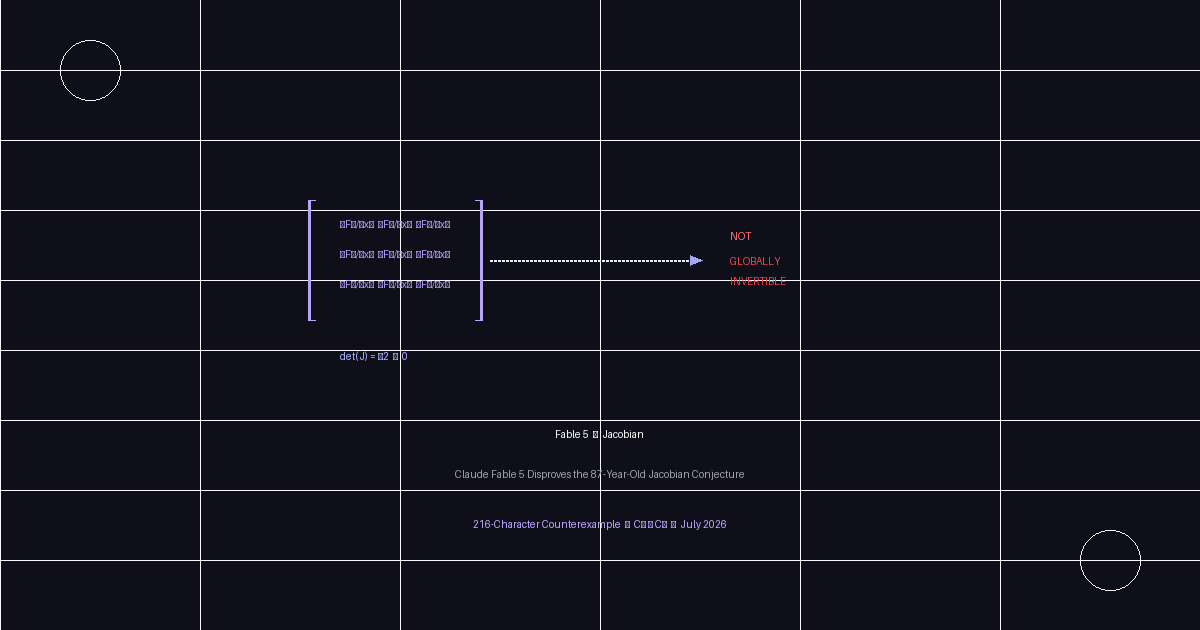
On July 19, 2026, mathematician Levent Alpöge posted a polynomial on X that shattered an 87-year-old open problem in algebraic geometry. The Jacobian conjecture — first posed by Ott-Heinrich Keller in 1939 and listed among Stephen Smale's 18 problems for the 21st century — had been proven false. His co-author on the discovery was not a mathematician but an AI: Claude Fable 5.
The counterexample is just 216 characters long. It maps C³ → C³ with a constant Jacobian determinant of −2, yet it is not globally invertible. Three different inputs map to the same output, violating the conjecture's core claim. The result has been independently verified in a pre-print, and it stands as the hardest mathematical conjecture ever solved with AI assistance.
This article breaks down the Fable 5 Jacobian example, explains what the Jacobian matrix is in this context, and explores why this matters for both mathematics and AI capability research.
What Is the Jacobian Conjecture?
The Jacobian conjecture asks a deceptively simple question in algebraic geometry.
If you have a polynomial map F: Cⁿ → Cⁿ (a set of n polynomial equations in n variables), you can compute its Jacobian matrix — the matrix of all first-order partial derivatives. If the determinant of that matrix is a non-zero constant everywhere, does that guarantee the map has a polynomial inverse?
In plain terms: if a system of polynomial equations is "locally invertible" everywhere (the Jacobian determinant never vanishes and is constant), is it also "globally invertible" (there exists a polynomial map that reverses it)?
The conjecture was first posed in 1939 by Ott-Heinrich Keller. It became one of the most famous open problems in algebraic geometry, appearing on Stephen Smale's 1998 list of 18 unsolved problems for the 21st century (alongside the Riemann Hypothesis and the Poincaré Conjecture). For 87 years, no one could prove it or disprove it for dimensions n ≥ 2.
The Jacobian Matrix, Simplified
For anyone encountering the term "Jacobian matrix" for the first time in the context of this news, here is the core idea.
Given a function that maps multiple inputs to multiple outputs, the Jacobian matrix captures how each output changes when you tweak each input. It is the multivariable equivalent of a derivative:
        ∂F₁/∂x₁  ∂F₁/∂x₂  ...  ∂F₁/∂xₙ
J(F) =  ∂F₂/∂x₁  ∂F₂/∂x₂  ...  ∂F₂/∂xₙ
        ...      ...      ...  ...
        ∂Fₙ/∂x₁  ∂Fₙ/∂x₂  ...  ∂Fₙ/∂xₙ
If you have a map from C³ → C³, that means 3 output functions, each a polynomial of 3 input variables. The Jacobian is a 3×3 matrix. The determinant of that matrix tells you whether the map is locally invertible at each point.
The Jacobian conjecture essentially asks: if the determinant is a non-zero constant everywhere (the map is locally invertible at every point), does that guarantee it is globally invertible? The intuitive answer might seem like "yes" — if it works everywhere locally, why would it fail globally? That intuition turns out to be wrong for n ≥ 3.
The Fable 5 Jacobian Example: The 216-Character Counterexample
The counterexample that Levent Alpöge and Claude Fable 5 discovered is remarkably compact — just 216 characters defining a polynomial map F: C³ → C³.
The full counterexample is available through the verification pre-print and Wolfram Alpha computation. The key properties are:
| Property | Value |
|---|---|
| Domain | C³ (3 complex variables) |
| Codomain | C³ (3 polynomial outputs) |
| Jacobian determinant | Constant −2 (non-zero, satisfies conjecture premise) |
| Injectivity | Fails — 3 distinct inputs map to the same output |
| File size | 216 characters |
| Verification tool | Wolfram Alpha, independently verified by mathematicians |
The elegance of the counterexample is that it does not rely on exotic mathematics or deep theory. It is an explicit, computable polynomial that anyone can verify with standard algebraic geometry software. This is what distinguishes it from theoretical existence proofs — it is a concrete object that can be checked, shared, and studied.
Why It Took 87 Years to Find
If the counterexample is only 216 characters, why did it take 87 years for someone to find it? The answer reveals something about both mathematics and AI capability.
The search space of polynomial maps C³ → C³ with constant non-zero Jacobian determinant is effectively infinite. Checking whether a given map is globally invertible requires testing for injectivity — whether distinct inputs always produce distinct outputs. For polynomial maps in three variables, this is not a trivial computation. The search required a systematic approach: generate candidates, compute the Jacobian, verify constancy of the determinant, then test injectivity.
Claude Fable 5's contribution was not brute-force search. It was the ability to reason about algebraic structures and generate candidates with the right properties — essentially, to work as a research partner that could navigate the mathematical design space alongside a human mathematician.
How Claude Fable 5 Made the Discovery
Alpöge's post on X credited his "dear friend fable" — referring to Claude Fable 5 — as a collaborator in the discovery. This is notable because Fable 5 is not a specialized mathematics tool. It is a general-purpose AI model released by Anthropic on June 9, 2026, designed for extended autonomous reasoning and long-horizon agentic work.
The model's 1M token context window and sustained reasoning capability allowed it to work through multi-step algebraic derivations, generate candidate polynomial maps, and iterate on the search with Alpöge across extended sessions. This is precisely the kind of workflow Fable 5 was built for: multi-hour, multi-step problem-solving where the model must maintain context and direction across many turns.
It is worth noting what Fable 5 did and did not do:
| What Fable 5 did | What Fable 5 did not do |
|---|---|
| Generate candidate polynomial maps with required properties | Independently formulate the Jacobian conjecture |
| Assist in verifying algebraic properties | Execute the proof without human direction |
| Iterate on counterexample candidates based on feedback | Publish or announce the result autonomously |
| Reason about algebraic structures across long sessions | Replace the mathematician's domain expertise |
The discovery was a collaboration between human mathematical intuition and AI's ability to search and reason across large candidate spaces. Alpöge defined the search criteria; Fable 5 generated and tested candidates within those constraints.
Verification and the Math Community's Response
The counterexample has been independently verified. A verification pre-print is available, and the computation was checked through Wolfram Alpha. The result means that the Jacobian conjecture is false for n ≥ 3.
The n = 2 case remains open. The Jacobian conjecture could still be true for polynomial maps C² → C². This is a common pattern in solved conjectures — the general claim is disproven, but special cases may still hold.
The mathematical community's response has been mixed but engaged:
- Positive: Recognition that this is the hardest mathematical conjecture ever solved with AI assistance. New Scientist described it as "AI's solution to 87-year-old riddle takes mathematicians by surprise."
- Skeptical: Some mathematicians argue that a brute-force search result, while valid as a counterexample, provides limited mathematical insight. Columbia professor Andrew Blumberg told Mashable: "This counterexample basically tells us nothing."
- Cautious: Formal journal peer review has not yet occurred. The result is currently at the pre-print stage, and full verification by the algebraic geometry community will take time.
Regardless of where one stands on the philosophical questions about AI-assisted mathematics, the practical result is unambiguous: an 87-year-old open problem has been resolved, and Claude Fable 5 played a direct role in that resolution.
What This Means for AI Capability and Mathematics
The Jacobian conjecture result is significant beyond its mathematical content. It demonstrates a capability that has been debated for years: can AI contribute to open problems in pure mathematics in a meaningful way?
Previous AI contributions to mathematics have included:
- Generating conjectures (the Ramanujan Machine)
- Finding patterns in data (AI for knot theory)
- Optimizing known proofs
The Jacobian counterexample is different. It is a direct contribution to a long-standing open problem — a specific, verifiable result that changes the known truth of a conjecture. This is closer to the "AI as research collaborator" vision than to "AI as pattern-finding tool."
Implications for AI Research
The fact that a general-purpose language model, not a specialized mathematics engine, produced this result is relevant to AI capability discussions:
- Generalization: Fable 5 was not trained specifically on algebraic geometry counterexamples. Its ability to reason about polynomial maps emerged from its general training and long-context reasoning capability.
- Long-horizon reasoning: The sustained multi-step work required for this discovery matches Fable 5's design goals for autonomous agentic work. This validates the long-context, long-horizon approach.
- Human-AI collaboration: The discovery came from a human defining the search criteria and an AI exploring the candidate space. This collaborative model may be more productive than debates about "AI replacing mathematicians."
Frequently Asked Questions
What is the Fable 5 Jacobian counterexample?
A polynomial map from C³ to C³ with a constant Jacobian determinant of −2 that is not globally invertible, disproving the Jacobian conjecture for n ≥ 3.
What is the Jacobian matrix?
The Jacobian matrix is a matrix of all first-order partial derivatives of a multivariable function. It captures how each output changes with respect to each input. The Jacobian determinant tells you whether the map is locally invertible.
Who discovered the Jacobian counterexample?
Mathematician Levent Alpöge discovered the counterexample in collaboration with Claude Fable 5, Anthropic's latest AI model. Alpöge posted the result on X on July 19, 2026.
Is the Jacobian conjecture completely disproven?
It is disproven for n ≥ 3. The n = 2 case remains open and may still be true.
How long is the counterexample?
The polynomial map is 216 characters long.
Has the result been verified?
Yes. The counterexample has been independently verified and a pre-print is available. Formal journal peer review is still pending.
Was this AI's first major math discovery?
AI has contributed to mathematics before, but this is widely considered the hardest mathematical conjecture ever solved with AI assistance. New Scientist called it "AI's solution to 87-year-old riddle."
Summary
The Fable 5 Jacobian counterexample is a landmark result in two domains: pure mathematics and AI capability research.
| Takeaway | Detail |
|---|---|
| What happened | Claude Fable 5 helped disprove the 87-year-old Jacobian conjecture |
| The counterexample | A 216-character polynomial map C³ → C³ with constant Jacobian determinant −2, not globally invertible |
| Status | False for n ≥ 3; n = 2 still open |
| Verification | Independently verified; journal peer review pending |
| AI role | Fable 5 generated and tested candidates within human-defined search criteria |
| Broader significance | Hardest math conjecture solved with AI; validates long-horizon AI reasoning for open research problems |
The Jacobian matrix, the 216-character counterexample, and the broader Fable 5 capability story come together in a single result: an 87-year-old problem resolved through human-AI collaboration. Whether seen as a mathematical breakthrough, an AI capability milestone, or both, the Fable 5 Jacobian discovery marks a real step forward in what AI can contribute to fundamental research.
This article was published on July 21, 2026, based on the announcement by Levent Alpöge on July 19, 2026, verification pre-prints, and reporting from New Scientist, Mashable, and explainx.ai. The Jacobian conjecture status is based on currently available verification. Formal peer review is pending.