Table of Contents

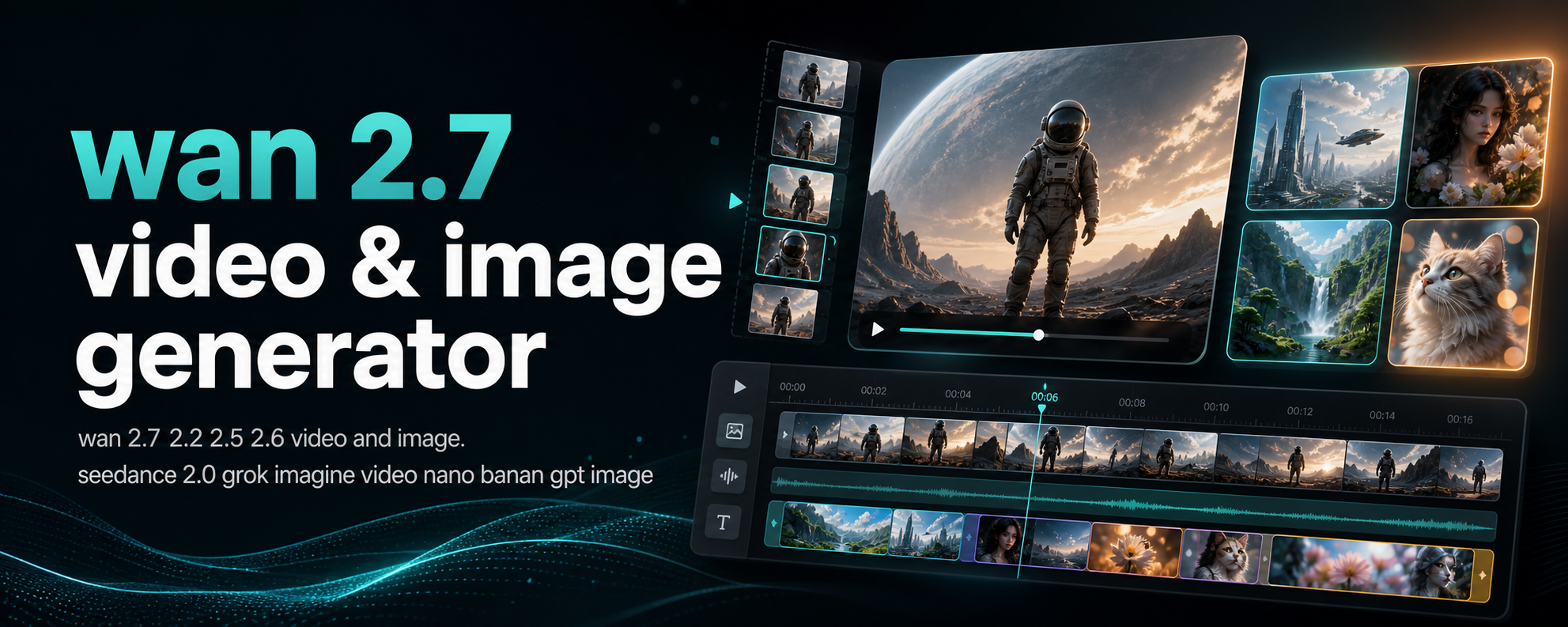
Alibaba's Wan 2.7 has been described as a "director's suite" by its own team. The community has called it a "controllable visual system." Others have said it is not a Seedance 2.0 killer and falls more in line with recent Kling models.
All of these are true, and none of them fully capture what Wan 2.7 actually is.
This is a clear-eyed look at what works, what does not, and who should be using it.
What Wan 2.7 Actually Is
Wan 2.7 is not one model. It is a four-mode suite:
- Text-to-Video (T2V) — generate video from a text prompt
- Image-to-Video (I2V) — animate a reference image with optional first/last frame control
- Video Edit — modify existing footage with natural language instructions
- Reference-to-Video (R2V) — generate consistent video from character and voice references
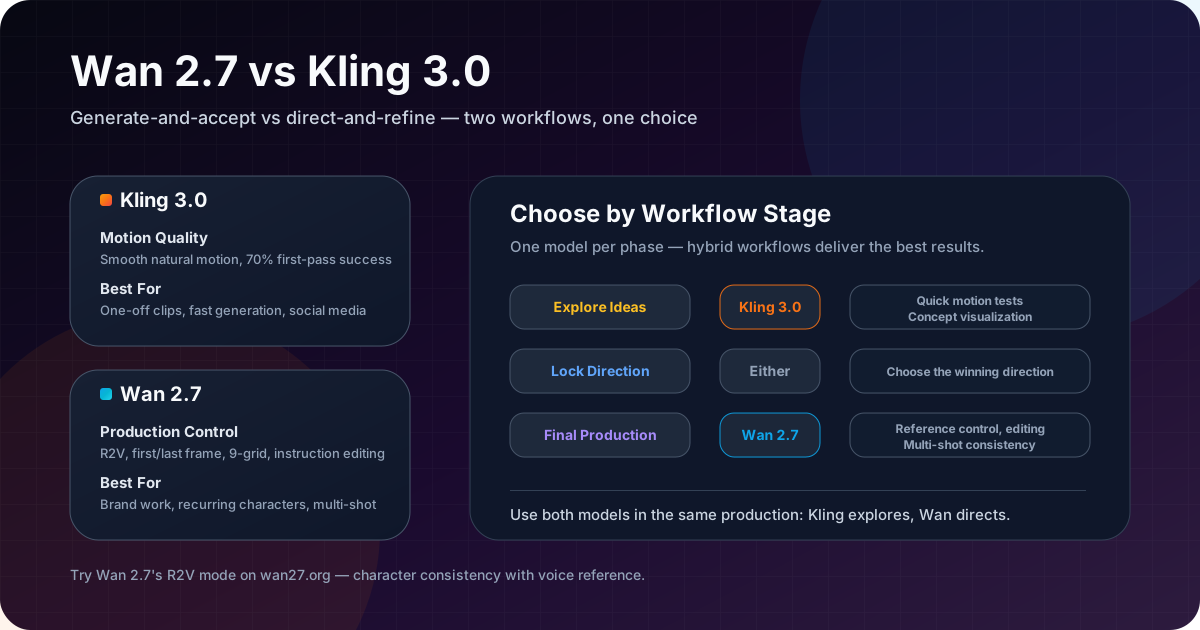
This architecture is the real story. Wan 2.7 is not trying to generate the best single clip from a prompt — it is trying to give you tools to direct and iterate across a production workflow. That is a fundamentally different goal from what most AI video models have pursued.
The community reaction at launch captured this well: "This feels less like a pure image model and more like a controllable visual system."
Video Quality
On raw generation quality — sharpness, color, motion smoothness — Wan 2.7 is a meaningful step up from Wan 2.6. Visual fidelity and temporal consistency are both improved. Lighting behavior is more physically plausible. Motion holds up better on complex multi-subject scenes.
Is it the best pure generator in 2026? No. Seedance 2.0 produces more cinematic output on single-shot generation. Kling's recent models have stronger motion realism in specific categories like face and hand movement.
Where Wan 2.7 competes is on controlled generation — output that behaves predictably across a sequence. When reviewers tested it with Kling 3.0 and Seedance 2.0 prompts, Wan 2.7 produced results that worked for shots those models could not handle. The advantage is not absolute quality — it is consistency under constraint.

Image Generation (Wan 2.7-Image)
The image model is genuinely impressive and in some ways more immediately useful than the video suite.
What works well:
- Facial diversity — the "千人千面" (thousand faces) system produces genuinely distinct characters, addressing one of the most persistent complaints about AI image generation
- Hex-based color control — up to 8 hex values per generation, which actually constrains color output to your palette rather than approximating it
- Text rendering — up to 4,000 characters, multilingual, with support for tables and formulas
- Multi-image composition — up to 12 images in one generation with consistent visual treatment
- Region editing — marquee-select and modify specific areas without regenerating the full image
The candid verdict from the community: compared to Nano Banana 2 on portrait photography, Wan 2.7's image output is competitive and in some cases better on fine texture and detail. The color palette control is a feature that simply does not exist at this level elsewhere.
Video Editing
This is where Wan 2.7 separates itself from every other model in its class.
The instruction-based editing system lets you modify specific elements in an existing video clip using natural language — without regenerating the full clip. Remove an object, change a background, restyle a character, alter lighting, adjust camera movement, rewrite dialogue with synced lip animation.
The community response to this on launch: "Text-based video editing is getting real."
For production workflows — agencies, content teams, studios — this changes the cost model of AI video. The expensive part of AI video is not generation. It is the time spent between failed attempts. Instruction-based editing means you fix, not re-roll.
Where it falls short: complex multi-instruction edits in a single command tend to produce inconsistent results. Scoped instructions — one change at a time — work significantly better.
Character Consistency (R2V)
Reference-to-Video (R2V) supports up to 5 character references simultaneously, with voice references assigned per character. This is the most ambitious character consistency system in any open-weight model to date.
In the official demo, the model generates a scene with five distinct characters — each with locked visual identity and voice timbre — interacting with each other in a scripted sequence. This is genuinely new territory.
The practical question is how well it holds up outside curated demos. Community testing has been limited at this early stage. The system works best with clean, consistent reference images and explicit character-level instructions in the prompt.
What the Community Is Actually Saying
Across Twitter/X at launch:
- @fal (333 likes, 24K views): "Big upgrades in visuals, motion, audio, style, and consistency. First and last frame, 9-grid I2V, subject and voice reference, instruction-based editing and video recreation."
- @Alibaba_Wan (577 likes, 4.3M views): "We've built a director's suite — from single clips to full-scale narrative direction."
- @alisaqqt (199 likes, 25K views): "This feels less like a pure image model and more like a controllable visual system."
- One critical voice: "Not a fan of WAN whatsoever" — citing issues with simple, slow-action prompts producing glitches. This is consistent with the model's behavior: it handles complex, directed scenes better than vague simple ones.
Who Should Use Wan 2.7
Strong fit:
- Content teams producing episodic or campaign video who need character consistency across shots
- Agencies that iterate heavily and need to fix specific elements rather than re-generate from scratch
- Creators who work at the intersection of image and video and want one system for both
- Storyboard-to-animatic workflows where 9-grid image input and frame control are directly useful
Weaker fit:
- Single-shot cinematic generation where raw visual quality is the only metric (Seedance 2.0 has an edge here)
- Creators who work with very simple, undirected prompts and expect good results from minimal input
- Workflows that need the most unrestricted generation without content filtering
The Honest Verdict
Wan 2.7 is not the best AI video model at any single thing. It is the most complete AI video production system available right now.
The direction Alibaba has taken — building editing, reference conditioning, and multi-mode control into a single model rather than chasing peak single-shot quality — is the right call for real production workflows. The question at launch is always whether the demos hold up in practice. Early signals suggest the editing and frame control systems are the most reliable features. R2V and multi-subject consistency are the most promising and the most unproven.
If you are building workflows, not just generating clips, Wan 2.7 is the model to evaluate right now.
Try it at Wan 2.7.