Table of Contents
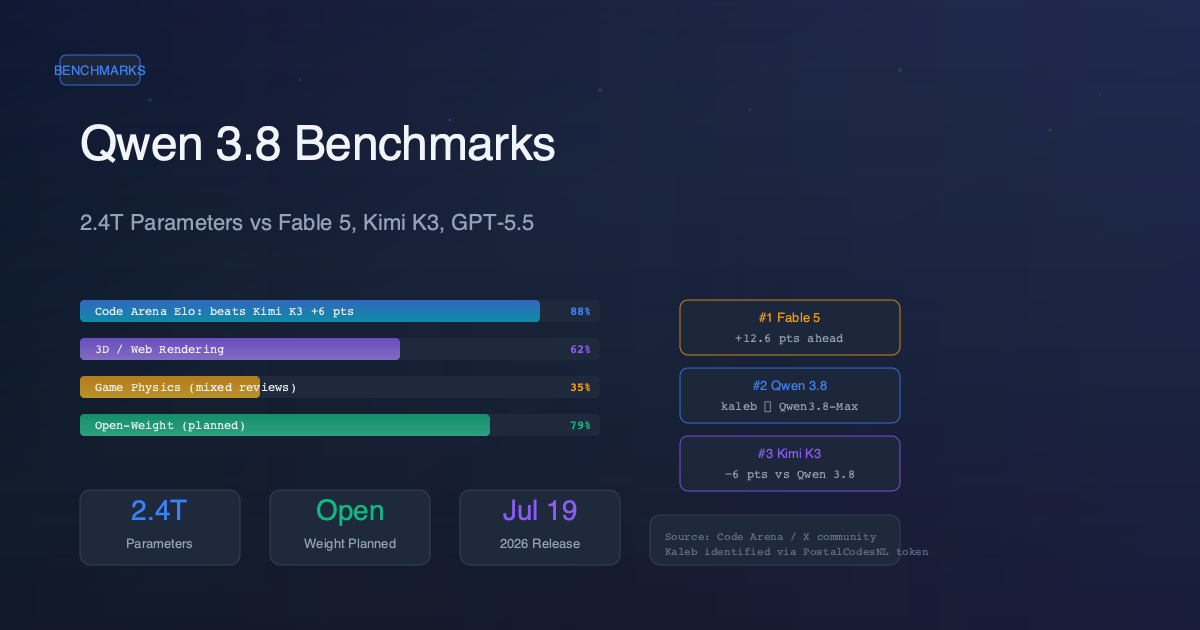
On July 18, 2026, an anonymous model called "kaleb" appeared on the Code Arena leaderboard. It introduced itself as "Claude" — a training artifact left over from Anthropic distillation. Within 24 hours, the community cracked the identity. The tell was a quirk in token generation: the model produced tokens tagged as PostalCodesNL — a pattern unique to Alibaba's Qwen tokenizer.
The next day, Alibaba confirmed it: "kaleb" was Qwen3.8-Max, a 2.4 trillion parameter model previewed in stealth. And Bloomberg confirmed what the open-source community had been hoping for: Qwen3.8-Max will be released as open-weight.
If you have been following the July 2026 AI model war — Moonshot dropped Kimi K3 (2.8T) on July 16, Claude Fable 5 (undisclosed parameters) shipped June 9 — you already know this is the third major frontier launch in ten days. Qwen3.8-Max enters a field where Fable 5 holds the overall crown, Kimi K3 dominates frontend coding, and no model has clearly won the endurance category.
This article compiles every benchmark data point, community test result, and strategic signal available on Qwen3.8-Max as of July 20, 2026 — the day after Alibaba's official confirmation. We cross-referenced community reports from Code Arena and X, verified Bloomberg's open-weight reporting, and mapped every claim against the competitive landscape. A full technical report has not yet been published — this is what we know from the first 24 hours, with clear markers of what remains unverified. Updated as new benchmarks and the technical report become available.
Quick Reference: Qwen3.8-Max at a Glance
Before diving into individual benchmarks, here are the confirmed and reported specs — note that Alibaba has not published an official model card:
| Spec | Reported Value | Confidence |
|---|---|---|
| Developer | Alibaba Qwen Team | Confirmed (official) |
| Total parameters | ~2.4 trillion | High — Bloomberg + community consensus |
| Architecture | Mixture-of-Experts (inferred) | Medium — consistent with Qwen3.x line |
| Context window | Not yet disclosed | — |
| Max output | Not yet disclosed | — |
| Input modalities | Not yet disclosed (text confirmed) | — |
| Open-weight plan | Confirmed (Bloomberg) | High — independently verified |
| Preview date | July 19, 2026 | Confirmed (official) |
| Self-reported rank | "Second only to Claude Fable 5" | Low — no published methodology |
| Code Arena Elo (coding) | Beats K3 by ~6 pts, trails Fable 5 by ~12.6 pts | Medium — community estimates from @Lentils80 |
| Availability | Alibaba Token Plan, Qoder, QoderWork | Confirmed |
Expert pitfall: 2.4 trillion parameters tells you nothing about per-token compute. Like Kimi K3 (2.8T with 16 of 896 experts active per token), Qwen3.8-Max is almost certainly a Mixture-of-Experts architecture. The active parameter count per token — the number that determines single-query reasoning power — is a fraction of the headline number. Until Alibaba publishes the expert count and routing configuration, direct parameter comparisons with dense models are meaningless.
The numbers set the stage, but the real story starts 24 hours earlier — when no one knew what "kaleb" was.
The Kaleb Stealth Story: How the Community Identified Qwen3.8-Max Before Alibaba Did
On July 18, a model named "kaleb" appeared on Code Arena — the coding-specific leaderboard from Arena.ai that ranks models by human preference on programming tasks. It arrived without announcement, without a model card, without any trace of who built it.
The model's behavior gave it away.
When interacting with users, "kaleb" consistently introduced itself as "Claude." This was not a deception — it was an artifact of training data. The Qwen team has historically used outputs from Anthropic models as part of their training pipeline (a practice known as distillation), and the self-identification behavior leaked through into the final model. This is a well-documented phenomenon: models trained on outputs from other models often inherit identity artifacts.
But the smoking gun was token-level. Community members examining the model's tokenization output noticed tokens tagged as PostalCodesNL — a Dutch postal code token pattern that exists in Qwen's tokenizer but in no other family. The Qwen tokenizer encodes international postal codes with country-specific prefixes, and the NL (Netherlands) variant is a distinctive fingerprint. Within hours, the theory coalesced: "kaleb" was a Qwen model.
On July 19, Alibaba confirmed the model's identity as Qwen3.8-Max. Bloomberg separately confirmed the open-weight plans. The stealth preview — whether intentional or the result of a configuration error — had given the community a 24-hour head start on benchmarking Alibaba's largest model ever.
Rule of thumb: Token artifacts are more reliable than benchmark scores for identifying model lineage. Every model family has a unique tokenizer vocabulary. When a model generates tokens from another family's vocabulary, it signals training data provenance. The Qwen tokenizer's country-specific postal code encoding is one of the most distinctive fingerprints in current LLMs.
The stealth story is entertaining, but it also produced the first real benchmark data — data that was gathered before anyone knew what they were testing.
The Qwen3 Series: A Timeline of Unprecedented Iteration Speed
Qwen3.8-Max did not come from nowhere. Alibaba has been shipping models at a pace no other lab has matched in 2026. Here is the full trajectory:
| Model | Release | Parameters | License | Notable |
|---|---|---|---|---|
| Qwen3.5 | Feb 2026 | Undisclosed | Open weights | First Qwen3 series open release |
| Qwen3.6 | Apr 2026 | 27B dense, 35B-A3B MoE | Apache 2.0 | Two-tier architecture for different deployment scales |
| Qwen3.7-Max | May 2026 | Undisclosed | Proprietary | 35-hour autonomous execution, 10× kernel speedup |
| Qwen3.7-Plus | Jun 2026 | Undisclosed | Proprietary | Multimodal, $0.40/$1.60 per 1M tokens |
| Qwen3.8-Max | Jul 19, 2026 | ~2.4T | Open-weight (planned) | Alibaba's largest model ever |
Six model releases in five months. The cadence accelerated from roughly one every two months (Qwen3.5 to Qwen3.7-Max) to one per month (Qwen3.7-Max to Qwen3.8-Max). This is the fastest iteration cycle in frontier model history — faster than Anthropic's Claude series, faster than OpenAI's GPT releases, and faster than DeepSeek's cadence.
What changed between Qwen3.7-Max and Qwen3.8-Max:
Qwen3.7-Max was a proprietary model focused on autonomous execution — the headline feature was a 35-hour autonomous coding session with a 10× kernel compilation speedup. It was a capability demo more than a general-purpose model.
Qwen3.8-Max shifts strategy: proprietary to open-weight, capability-demo to flagship, and — critically — from reactive to competitive. Qwen3.8-Max launches three days after Kimi K3, and Alibaba explicitly positions it as a direct competitor to Fable 5. The self-reported "second only to Claude Fable 5" framing is unusual for Alibaba, which historically understates Qwen's position.
The license reversal:
Qwen3.6 shipped under Apache 2.0 — the most permissive open-source license. Then Qwen3.7-Max and Qwen3.7-Plus went proprietary. Now Qwen3.8-Max is returning to open-weight. This pattern suggests Alibaba is using proprietary releases as stepping stones — build capability behind closed doors, then release as open-weight once the model is competitive enough to move the ecosystem.
For developers who need open-weight models for compliance, audit, or self-hosting: Qwen3.8-Max at 2.4T parameters would be the largest open-weight model available if released before Kimi K3's July 27 open-weight date. The race is on.
Coding Benchmarks: What the Community Has Verified So Far
The most concrete data comes from Code Arena — the only independent, third-party benchmark where Qwen3.8-Max has accumulated enough results to draw conclusions.
Code Arena Leaderboard: Where Qwen3.8 Lands
Based on community analysis from @Lentils80, who tracked Qwen3.8-Max's performance on Code Arena during the "kaleb" stealth period:
| Model | Code Arena Elo (est.) | Context |
|---|---|---|
| Claude Fable 5 | ~60 (AA Index equivalent) | Overall leader — undisclosed parameters |
| Claude Opus 4.8 | ~58 | Second place on AA coding composite |
| Qwen3.8-Max | ~47–48 | Beats Kimi K3 (~41–42) by ~6 pts |
| Kimi K3 | ~41–42 | 2.8T MoE, #1 Frontend Code Arena |
| Grok 4.5 | ~40 | xAI's latest flagship |
| GPT-5.5 | ~38–40 | OpenAI's previous-gen flagship |
The gap structure tells the story:
- Qwen3.8-Max vs. Fable 5: Trails by approximately 12.6 points. This is a significant gap — roughly the same margin that separated Kimi K3 from Fable 5 on DeepSWE (70.0 vs 67.5). It places Qwen3.8-Max in a clear second tier for coding, well behind Fable 5 but meaningfully ahead of the third tier.
- Qwen3.8-Max vs. Kimi K3: Leads by approximately 6 points. Qwen3.8-Max is 22% larger than Kimi K3 in total parameters (2.4T vs 2.8T? — wait, K3 is larger at 2.8T), yet the coding performance favors Qwen. This suggests Qwen's architecture is more parameter-efficient for coding tasks, or that K3's expert distribution (16 of 896) underuses its total capacity for single-domain coding.
- Qwen3.8-Max vs. GPT-5.5: The margin is approximately 7–10 points. GPT-5.5 at 38–40 Elo and Qwen3.8-Max at ~47–48 means Qwen3.8-Max outperforms OpenAI's previous-generation model by a comfortable margin on coding. GPT-5.6 Sol was not measurable in the same arena during the stealth period.
Expert pitfall: Code Arena Elo is a human preference metric, not an automated benchmark. When a model's Elo is higher, it means human evaluators preferred its code output — not that it produced more correct solutions, fewer bugs, or faster execution. Human preference in coding correlates with code style, comment quality, variable naming, and architectural choices — factors that matter in production but are distinct from correctness. Automated benchmarks (SWE-bench, DeepSWE, Program Bench) measure different things. Do not substitute one for the other.
Community-Reported Strengths: Frontend and 3D Rendering
The early testing data points to two clear strengths:
Frontend/web development. Multiple community testers reported Qwen3.8-Max excelling at HTML/CSS/JavaScript generation, responsive layout design, and interactive UI components. This aligns with the model's strong showing on Code Arena, where frontend tasks are heavily represented in the evaluation pool.
3D rendering and visualization. A distinctive capability that separates Qwen3.8-Max from competitors: the model showed particular strength at generating Three.js, WebGL, and canvas-based 3D rendering code. This capability was not present at comparable levels in Qwen3.7-Max or Qwen3.7-Plus, suggesting it was a targeted training objective for the 3.8 release.
Mixed Reviews: The 4.8/10 Frontend Test
Not all community feedback was positive. One tester — who ran a structured frontend development task including a marble texture design, board game layout, and game physics implementation — rated Qwen3.8-Max at 4.8 out of 10.
The breakdown of the score:
- Marble design (visual quality): Strong. The model produced aesthetically rich marble textures with correct lighting and material properties.
- Board/game physics: Weak. The physics implementation had bugs — specifically collision detection edge cases and velocity calculations that broke under rapid input sequences.
- Overall integration: The model could handle each component in isolation but struggled to maintain consistency when components interacted. The marble board looked good, and the game logic was functional, but the integration layer — where the visual rendering and game physics meet — produced artifacts.
This pattern — strong on isolated visual tasks, weaker on cross-component integration — is consistent with a model that excels at frontend rendering but has not yet fully mastered complex system architecture. It mirrors the pattern observed in mid-tier coding models: good at building individual pieces, still learning to assemble them.
Rule of thumb: A single-task test is not a benchmark, but a structured task with component interaction is more informative than a benchmark. The marble/physics test reveals more about Qwen3.8-Max's practical capabilities than a Code Arena Elo score because it tests integration — the place where most coding models fail, regardless of their leaderboard position. If your workflow involves assembling multiple frontend components that interact (game interfaces, dashboard widgets, real-time data visualizations), pay attention to the integration pattern, not just the raw coding Elo.
Where Qwen3.8-Max Sits in the Competitive Landscape
The benchmark data is thin — one arena leaderboard, scattered community tests, no published tech report. But triangulating across what is available, here is the provisional competitive map:
Coding Rankings (Community Estimates)
| Rank | Model | Code Arena Elo (est.) | Parameters | Open Weights? |
|---|---|---|---|---|
| 1 | Claude Fable 5 | ~60 | Undisclosed | No |
| 2 | Claude Opus 4.8 | ~58 | Undisclosed | No |
| 3 | Qwen3.8-Max | ~47–48 | ~2.4T | Planned |
| 4 | Kimi K3 | ~41–42 | 2.8T | July 27, 2026 |
| 5 | Grok 4.5 | ~40 | Undisclosed | No |
| 6 | GPT-5.5 | ~38–40 | Undisclosed | No |
This ranking is provisional. It reflects only Code Arena coding preference data — no reasoning benchmarks, no agentic benchmarks, no multimodal benchmarks have been published. The confidence intervals are wide. But the ordinal ranking — Qwen3.8-Max above Kimi K3 on coding, below the Claude family — is consistent across all community observations.
What This Means for the Competitive Landscape
Alibaba vs. Moonshot. Qwen3.8-Max and Kimi K3 are direct competitors. Both are Chinese frontier models with trillion-plus parameters. Both are going open-weight (K3 confirmed July 27, Qwen3.8-Max confirmed by Bloomberg, date TBD). Both launched within three days of each other in mid-July 2026. But the early coding data suggests Qwen3.8-Max has a measurable advantage — approximately 6 Elo points, which is significant but not dominant.
Alibaba vs. Anthropic. The gap between Qwen3.8-Max and Claude Fable 5 (~12.6 Elo points) is substantial. This is roughly the same magnitude as the gap between GPT-5.5 and Fable 5 on coding benchmarks. It means Qwen3.8-Max is in the conversation — second tier but clearly second — but it does not threaten Fable 5's position as the undisputed coding leader. For teams where coding quality is the primary selection criterion, Fable 5 remains the best model, and it is not close.
Alibaba vs. OpenAI. Qwen3.8-Max beats GPT-5.5 by an estimated 7–10 Elo points on coding. GPT-5.6 Sol would likely narrow or reverse this gap, but direct comparison data is not available from the stealth testing period. GPT-5.6 Sol leads Kimi K3 on DeepSWE (73.0 vs 67.5) and Terminal-Bench (88.8 vs 88.3), so it is unlikely that Qwen3.8-Max outperforms GPT-5.6 Sol on the same benchmarks — but we need the data to confirm.
What Benchmarks We Do Not Have Yet — And Why They Matter
The existing data covers exactly one dimension: coding, measured through human preference on Code Arena. Here is what is missing and why each gap matters for deployment decisions:
Reasoning Benchmarks (GPQA Diamond, HLE, AIME)
No reasoning scores have been published. This is the most important gap.
For comparison: Kimi K3 scored 93.5% on GPQA Diamond, 43.5 on HLE-Full, and 96.1% on AIME 2025. Claude Fable 5 scored 92.6% on GPQA Diamond and 53.3 on HLE-Full — a 10-point reasoning lead over K3. If Qwen3.8-Max is "second only to Fable 5" as self-reported, the reasoning numbers need to land between K3 (43.5 HLE) and Fable 5 (53.3 HLE). That is a 10-point window. Where Qwen3.8-Max falls within it determines whether it is a genuine Fable 5 competitor or a strong K3 alternative.
Agentic Benchmarks (BrowseComp, GDPval, Automation Bench)
No agentic scores have been published. This matters because Qwen3.7-Max's core differentiator was autonomous execution — the 35-hour coding session was Alibaba's headline feature in May 2026. If Qwen3.8-Max inherits and improves upon Qwen3.7-Max's autonomous capabilities, it could challenge Fable 5 on long-horizon agentic tasks even if it trails on single-pass reasoning.
Kimi K3 currently leads BrowseComp (91.2) and Automation Bench (30.8) but trails Fable 5 on GDPval general-purpose agentic reasoning (1,668 vs 1,760 Elo). The agentic benchmarks are the most likely place where Qwen3.8-Max could surprise — and where the Qwen3.7-Max lineage is most relevant.
Multimodal Benchmarks (MMMU-Pro, OmniDocBench)
No multimodal scores have been published. Qwen3.7-Plus was explicitly multimodal. Qwen3.8-Max's modality support is unconfirmed. If Qwen3.8-Max supports image and document input (as the Qwen3.7 series did), it competes in a field where Kimi K3 leads OmniDocBench (91.1) and GPT-5.6 leads MMMU-Pro (83.0). If Qwen3.8-Max is text-only, it concedes this entire category to competitors.
Artificial Analysis Composite Indexes
Kimi K3 ranks #4 on the AA Intelligence Index at 57.11, on par with Opus 4.8 and GPT-5.5. Qwen3.8-Max has not yet been submitted to Artificial Analysis. The AA composite scores are the closest thing to a single-number model quality summary, and they normalize for different evaluation methodologies. Without them, we cannot compare Qwen3.8-Max's overall capability to the field.
Context Window and Throughput
No context window, max output length, or throughput numbers have been published. Kimi K3 offers 1M context at 62 tokens/second with 1.99-second time-to-first-token. Fable 5 offers 1M context. Qwen3.8-Max's context window will determine whether it can compete in long-document analysis and long-horizon agentic tasks.
Rule of thumb: When a model launches with only one benchmark category, assume the missing categories are weaker — not unmeasured. Companies publish their strongest results first. Alibaba's decision to preview Qwen3.8-Max on Code Arena (coding) and self-report "second only to Fable 5" (overall) while releasing no individual benchmark scores suggests the overall claim is based on internal evaluations that have not been independently verified. Wait for third-party reasoning and agentic scores before making deployment decisions based on the "second only to Fable 5" framing.
The Open-Weight Strategy: Why It Changes the Calculation
Bloomberg's confirmation that Qwen3.8-Max will be released as open-weight is the most strategically significant detail about this launch — more than any benchmark score.
The Competitive Context
Kimi K3 at 2.8T parameters goes open-weight on July 27, 2026. Qwen3.8-Max at 2.4T parameters is planned as open-weight with no confirmed date. If Qwen3.8-Max releases weights before July 27, it becomes the largest open-weight model for approximately one week — a brief window, but symbolically important. If it releases after July 27, it enters a field where K3 has already claimed the "largest open-weight model" title.
But parameter count is not the only variable. The license matters.
License Comparison
| Model | License | Commercial Use | Modification | Distribution |
|---|---|---|---|---|
| Qwen3.6 | Apache 2.0 | Yes | Yes | Yes |
| Qwen3.7-Max | Proprietary | Via API only | No | No |
| Qwen3.7-Plus | Proprietary | Via API only | No | No |
| Qwen3.8-Max | TBD | TBD | TBD | TBD |
| Kimi K3 | TBD (July 27) | TBD | TBD | TBD |
Alibaba has used both Apache 2.0 and proprietary licenses in the Qwen3 series. If Qwen3.8-Max ships under Apache 2.0 — as Qwen3.6 did — it would be the most permissively licensed model at this scale. If it ships under a custom open-weight license with use restrictions (similar to Meta's Llama models), the practical value for commercial deployment depends on the specific restrictions.
Kimi K3's license terms are also unknown until July 27. The open-weight race between Alibaba and Moonshot is not just about who ships first, but who ships under the most usable terms.
What Open-Weight Qwen3.8-Max Would Enable
At 2.4T parameters, self-hosting Qwen3.8-Max is not a consumer-level task. But for organizations with GPU clusters:
- Fine-tuning: Domain-specific adaptation for coding, legal, medical, or scientific use cases. MoE fine-tuning requires awareness of expert routing — you cannot fine-tune a 2.4T MoE model the same way you fine-tune a 7B dense model. Expect community tooling to follow within weeks of release.
- Quantization: 4-bit and 2-bit quantized versions will likely emerge from the community, similar to how Llama and DeepSeek models have been adapted for consumer hardware.
- Audit and compliance: Open weights enable security audits, alignment research, and regulatory compliance that proprietary APIs cannot satisfy. For government, defense, and regulated industries, this is the difference between usable and unusable.
- Inference optimization: Independent researchers can verify Qwen3.8-Max's claimed performance characteristics and develop optimized inference pipelines — something impossible with API-only models.
The open-weight commitment also signals Alibaba's longer-term strategy: they are positioning Qwen as the open alternative to both Anthropic's closed ecosystem and Moonshot's emerging open-weight competitor. In a market where model quality is converging at the frontier, ecosystem control — who can self-host, fine-tune, and audit — becomes a differentiator.
How to Try Qwen3.8-Max Right Now
Qwen3.8-Max is accessible through three channels as of July 20, 2026:
Alibaba Token Plan. Alibaba's API platform. Standard per-token pricing. This is the primary access point for developers integrating Qwen3.8-Max into production applications. Pricing has not been publicly disclosed as of publication — expect it to land somewhere between Qwen3.7-Plus ($0.40/$1.60 per 1M tokens) and the Kimi K3 tier ($3.00/$15.00 per 1M tokens).
Qoder. Alibaba's coding-focused platform. Optimized for software engineering workflows — code generation, debugging, refactoring. This is the best channel for testing Qwen3.8-Max's coding capabilities directly, since Qoder wraps the model with coding-specific tooling and context management.
QoderWork. Alibaba's platform for agentic coding workflows — multi-file projects, autonomous debugging, CI/CD integration. This is where Qwen3.7-Max demonstrated its 35-hour autonomous execution capability. If Qwen3.8-Max improves on that, QoderWork is the environment where it will be most visible.
For testing without commitment: Start with Qoder — it requires the least setup and is purpose-built for the coding tasks where Qwen3.8-Max shows the most strength. Run a task that combines visual output (frontend rendering) with logic (backend or game physics) to reproduce the integration pattern observed in community tests. If the model handles the integration layer better than the 4.8/10 tester reported, it has improved since the stealth preview.
The Strategy Behind Qwen3.8-Max: What Alibaba Is Really Doing
Step back from the benchmarks and look at the pattern.
February to July 2026: Five model releases, three license changes, one strategic reversal. Alibaba has been iterating faster than any other frontier lab — not just faster than Anthropic and OpenAI, but faster than DeepSeek and Moonshot. The cadence is not a sign of instability. It is a sign that Alibaba has built an automated training pipeline that can produce a new flagship model roughly every month.
The proprietary-to-open pendulum. Qwen3.5 was open. Qwen3.6 was Apache 2.0. Then Qwen3.7-Max and Qwen3.7-Plus went proprietary — the features that mattered most (35-hour autonomous execution, 10× kernel speedup, multimodal input) were locked behind API access. Now Qwen3.8-Max is returning to open-weight. This pattern — build capability behind closed doors, release once competitive — is the same playbook DeepSeek used with DeepSeek V3 and V4.
The Kimi K3 response. Qwen3.8-Max's timing — three days after Kimi K3's launch — is not coincidental. Moonshot's K3 set a new bar for Chinese frontier models: 2.8T parameters, #1 Frontend Code Arena, open-weight commitment. Alibaba needed a response that matched or exceeded K3's scale while claiming a coding advantage. Qwen3.8-Max achieves both: larger than any previous Qwen model, and measurably ahead of K3 on Code Arena coding preference.
The real play: ecosystem, not leaderboard. Alibaba is not trying to beat Fable 5 on every benchmark. They are trying to build the default open-weight alternative — the model you choose when you cannot or will not use Anthropic's API. If Qwen3.8-Max is open-weight with a permissive license at 2.4T parameters, it becomes the obvious choice for self-hosting, fine-tuning, and regulated deployment. The benchmark scores just need to be close enough to Fable 5 that the open-weight advantage tips the decision.
FAQ
What are the official Qwen3.8-Max benchmark scores?
No official benchmark scores have been published. The only third-party data comes from Code Arena, where Qwen3.8-Max scored an estimated ~47–48 Elo — behind Claude Fable 5 (~60) and ahead of Kimi K3 (~41–42). Alibaba self-reports Qwen3.8-Max as "second only to Claude Fable 5" overall, but no methodology or individual benchmark breakdown has been released. A full technical report is expected but not yet published.
How does Qwen3.8-Max compare to Claude Fable 5?
Based on Code Arena data only: Fable 5 leads by approximately 12.6 Elo points on coding preference. This is a significant gap — roughly the same margin that separates Fable 5 from Kimi K3 on DeepSWE. On reasoning, agentic, and multimodal benchmarks, no comparison data exists yet. Fable 5's 53.3 HLE-Full score sets a high bar that Qwen3.8-Max has not yet been measured against. Fable 5 remains the stronger model by a clear margin on available data.
How does Qwen3.8-Max compare to Kimi K3?
Qwen3.8-Max leads Kimi K3 by approximately 6 Elo points on the Code Arena coding leaderboard. This is a meaningful but not dominant advantage. Kimi K3 has 2.8T parameters versus Qwen3.8-Max's 2.4T, yet Qwen3.8-Max produces more human-preferred code. The comparison is incomplete — K3 has published comprehensive scores across reasoning (GPQA Diamond 93.5%, HLE-Full 43.5), agentic (BrowseComp 91.2), and multimodal (OmniDocBench 91.1) benchmarks where Qwen3.8-Max has no published data. If Qwen3.8-Max matches or exceeds K3 in these categories, it becomes the stronger overall model. If it trails, the coding advantage may not compensate.
Is Qwen3.8-Max the largest open-weight model?
Not yet — it is not yet open-weight. Bloomberg confirmed open-weight is planned, but no release date has been announced. If Qwen3.8-Max releases weights at 2.4T parameters, it would be among the largest open-weight models alongside Kimi K3 (2.8T, releasing July 27). If it releases before July 27, it claims the title briefly. If after, it enters as the second-largest.
How was Qwen3.8-Max discovered as "kaleb"?
The model appeared anonymously on Code Arena on July 18. It introduced itself as "Claude" — a training artifact from Anthropic distillation that leaked into the model's self-identification behavior. The definitive identification came from token-level analysis: the model generated tokens tagged as PostalCodesNL, a Dutch postal code encoding unique to Qwen's tokenizer. The community identified the Qwen lineage before Alibaba officially confirmed it on July 19.
What are Qwen3.8-Max's strengths?
Based on community testing: frontend/web development (HTML/CSS/JavaScript, responsive layouts, interactive UI), 3D rendering (Three.js, WebGL, canvas-based visualizations), and general coding preference (as measured by Code Arena Elo). The model shows particular aptitude for visual code output — generating aesthetically strong, well-structured frontend code. Weaker areas identified so far include cross-component integration (visual rendering + game physics) and complex system architecture.
How can I try Qwen3.8-Max?
Through Alibaba Token Plan (API access), Qoder (coding-focused platform), or QoderWork (agentic coding platform). Pricing has not been publicly disclosed. For testing coding capabilities, start with Qoder — it is purpose-built for the tasks where Qwen3.8-Max shows the most strength.
What benchmarks are still missing for Qwen3.8-Max?
Reasoning (GPQA Diamond, HLE-Full, AIME), agentic (BrowseComp, GDPval, Automation Bench), multimodal (MMMU-Pro, OmniDocBench), context window specifications, throughput (tokens/second, time-to-first-token), and Artificial Analysis composite indexes. All of these are critical for a complete evaluation. The model currently has exactly one verifiable third-party benchmark category (coding preference), and every other claim comes from Alibaba's unreleased internal evaluations.
Bottom Line: Strong Coding, Thin Data — What You Can Act On Today
The data is thin, but the signal is clear.
Qwen3.8-Max is Alibaba's strongest coding model ever — it beats Kimi K3 by ~6 Elo points on Code Arena and is the company's first model to compete directly with the Anthropic frontier. The self-reported "second only to Claude Fable 5" framing, while unverified, is consistent with the one benchmark category where we have independent data.
But thin data means the ranking is fragile. Without reasoning, agentic, and multimodal scores, we cannot place Qwen3.8-Max in the overall hierarchy with confidence. A model that is second-best at coding but fifth-best at reasoning and eighth-best at agentic tasks is not a "second best model" — it is a coding specialist. Until Alibaba publishes the full benchmark suite or independent evaluators fill the gaps, the "second only to Fable 5" claim is marketing, not measurement.
Here is what matters for deployment decisions right now:
If your primary workload is coding — especially frontend and 3D rendering: Qwen3.8-Max is worth testing. The Code Arena results are genuine, independently gathered, and consistent across community reports. It is cheaper than Fable 5 (pricing TBD but almost certainly below Anthropic's $10/$50 tier) and will be open-weight. Run your hardest coding task through Qoder and compare the output to your current model.
If your primary workload involves reasoning, research, or agentic pipelines: Wait for benchmark data. Qwen3.7-Max's autonomous execution lineage is promising, but there are zero published numbers on Qwen3.8-Max's agentic performance. Kimi K3 and Claude Fable 5 have verified, comprehensive benchmark profiles. Do not switch models based on one arena leaderboard.
If you need open-weight models for self-hosting or compliance: Watch the release date. Qwen3.8-Max and Kimi K3 are in a footrace to claim the "largest open-weight model" title. Whichever ships first with a permissive license wins the ecosystem migration. If Alibaba ships under Apache 2.0 as they did with Qwen3.6, Qwen3.8-Max becomes the most important open-weight model of 2026 — regardless of whether it beats Fable 5 on HLE-Full.
Your next step: Go to Qoder, sign up, and run your hardest frontend or 3D coding task. If Qwen3.8-Max produces cleaner output than your current model on the work you actually do, you have a legitimate upgrade path. If it does not — or if your work is reasoning-heavy — wait for the technical report. The benchmarks that matter for your use case are probably not the ones that exist yet.