Table of Contents
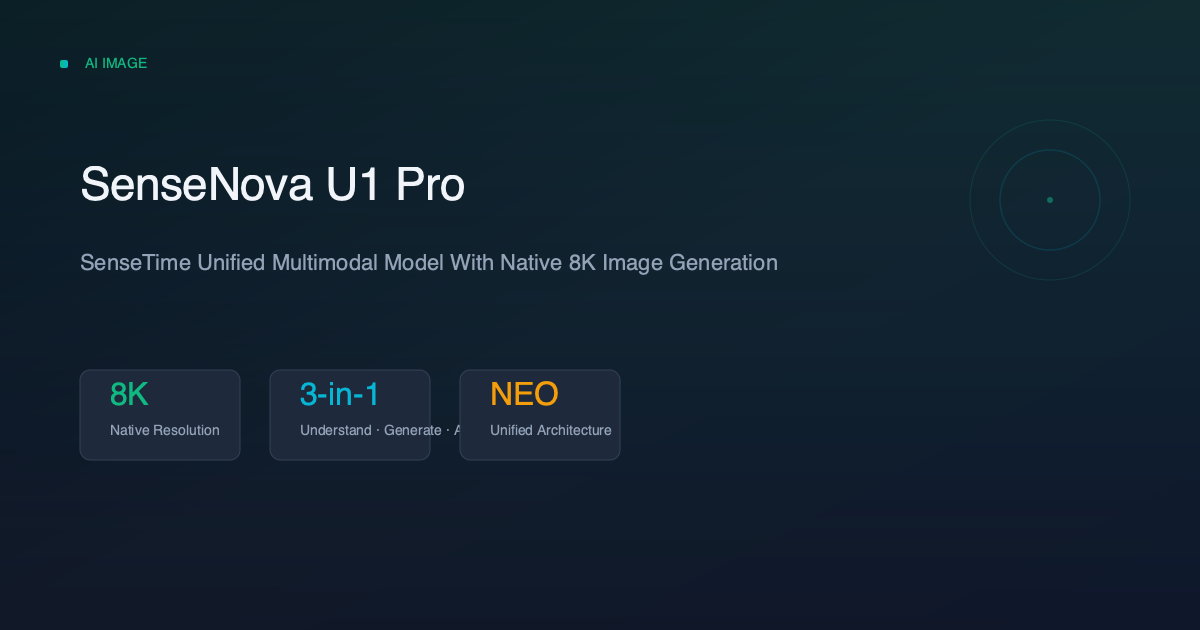
If you have ever tried to build a visual content pipeline — generating an image with one model, correcting text artifacts with another tool, segmenting objects with yet another library, and laying out a poster by hand — you know where the friction lives. Each handoff between models degrades fidelity, each conversion loses detail, and by the time you reach the final output, the "AI look" has crept in from five different directions. At the World AI Conference (WAIC) 2026 in Shanghai on July 18, 2026, SenseTime (商汤科技) unveiled SenseNova U1 Pro, a native unified multimodal model engineered to collapse that entire pipeline into one architecture. Three capabilities — multimodal understanding, image generation, and agentic action — run inside the same representational space, not glued together across separate models.
The announcement arrives at a moment when the AI image generation market is splitting into two camps: models that generate beautiful images but cannot understand them, and models that reason about images but cannot produce them at production resolution. SenseNova U1 Pro is SenseTime's bet that the future belongs to models that do both — and then act on what they see.
What Is SenseNova U1 Pro? — The Native Unified Multimodal Model Explained
SenseNova U1 Pro is not a multimodal system in the conventional sense. Most so-called multimodal models today work by chaining a visual encoder — typically CLIP or SigLIP — onto a large language model backbone, then routing generation requests through a separate VAE decoder. The LLM handles text, the visual encoder handles images, and a complex web of adapters stitches them together. Each component was trained separately, and the interface between them is an approximation.
SenseNova U1 Pro takes a fundamentally different approach. It is a native unified multimodal model: a single architecture where pixels and words live in one representational space from training through inference. There is no visual encoder. There is no VAE. Text tokens and image patches are processed through the same transformer backbone, represented in the same latent space, and decoded through the same generation pathway.
The three capabilities SenseTime claims for U1 Pro are:
-
Multimodal Understanding — text and image comprehension, visual reasoning, interleaved image-text analysis with native instance segmentation, object detection, and OCR integrated into the understanding pipeline rather than bolted on as post-processing layers.
-
Image Generation — text-to-image generation, infographic creation, commercial presentation deck generation, and precision image editing with controllable text and content, all at native 8K resolution.
-
Agentic Action — long-range task planning and execution in a closed loop: the model understands a brief, plans a sequence of visual assets, generates them, checks each output against the brief, and self-corrects without external orchestration.
This is not a language model that happens to also generate images, nor an image model that can answer questions about pictures. It is a single system trained end-to-end on interleaved text-image sequences, designed from the ground up to move fluidly between understanding and creating.
The NEO-Unify Architecture: No Visual Encoder, No VAE, One Representational Space
The technical foundation of SenseNova U1 Pro is the NEO-unify architecture, which SenseTime first introduced in March 2026. The name is deliberately chosen: NEO signals a new generation, and "unify" signals the core architectural bet — that pixels and tokens can share the same representational space without intermediary encoders or decoders.
Why Eliminating the Visual Encoder Matters
In a conventional multimodal pipeline, a visual encoder like CLIP converts an image into a fixed-length embedding vector that the language model can consume. Information loss begins at this conversion step: fine spatial details, precise color values, small text, and edge relationships are compressed into a vector optimized for semantic similarity, not pixel-level fidelity.
Consider what happens when you ask a standard vision-language model to read fine print in an image. The visual encoder compresses a 2048×2048 image into a 576-token CLIP embedding. A 12-point font character that occupies 30×40 pixels in the original image gets reduced to a fraction of a token — the visual encoder simply cannot preserve that detail. No amount of post-processing can recover it.
NEO-unify sidesteps this entirely. Image patches enter the transformer backbone directly, represented in the same latent space as text tokens. The attention mechanism operates over image patches and text tokens together, with no compression bottleneck in between. For tasks like OCR, instance segmentation, and precise text-in-image generation, this architectural choice is the difference between approximate and native.
Why Eliminating the VAE Matters
On the generation side, diffusion models typically decode latent representations through a VAE that reconstructs pixels. The VAE introduces its own compression artifacts — blurring, color shifts, and the characteristic "smooth plastic" texture that people recognize as AI-generated.
NEO-unify decodes pixels directly from the unified representational space, without a separate VAE bottleneck. This matters for the output quality SenseTime is claiming: 8K native resolution with sharp text, clean edges, and accurate colors. When the generation pathway shares the same space as the understanding pathway, there is no domain gap between what the model "sees" and what it produces.
The Technical Trade-offs
Eliminating both the visual encoder and VAE is architecturally elegant but computationally expensive. Processing raw image patches through a transformer at 8K resolution requires substantial memory and FLOPs. SenseTime has not disclosed the parameter count or inference cost of U1 Pro, but the NEO-unify architecture suggests a model that is computationally intensive at inference time — one reason the August 2026 API launch may come with usage-based pricing rather than a flat subscription.
For context, the open-source U1 Lite variants released in April 2026 use Mixture-of-Experts (MoE) routing to manage compute: the 8B-MoT and A3B-MoT configurations activate only a subset of parameters per token, trading some capability for efficiency. U1 Pro appears to be a denser, more capable deployment of the same architectural principles, aimed at production-quality output rather than research accessibility.
8K Native Resolution: What It Actually Means for Visual Output
The "8K" specification in SenseNova U1 Pro refers to native output resolution — the model generates images at 8K directly, not by upscaling a lower-resolution generation through a separate super-resolution pass. For high-density visual content like infographics, posters, data visualizations, and commercial presentation slides, this distinction is the difference between production-ready output and something that requires manual post-processing.
Resolution vs. Upscaling: Why "Native" Matters
Most image generation models that claim high resolution actually generate at 1024×1024 or 2048×2048 and then upsample. The upsampling pass uses a convolutional or diffusion-based super-resolution model that guesses additional pixels. For photographs and natural scenes, the guessing often works well enough — a blurry leaf or slightly smoothed texture is not catastrophic. For information-dense graphics, it fails.
Small text rendered at 1024×1024 and upscaled to 8K is legible but soft, with inconsistent stroke widths and alignment artifacts. Charts upscaled from lower resolutions show jagged edges on bars and distorted axis labels. Layouts with fine grid systems lose alignment because the upscaler was not trained on typographic precision — it was trained on natural images.
Native 8K generation means the model places every pixel with awareness of the full output canvas from the start. Text characters, vector-style graphics, and layout grids are rendered at their target resolution in a single forward pass. For the commercial use cases SenseTime is targeting — presentation decks, marketing posters, complex infographics — this is not a nice-to-have; it is the difference between usable output and output that still requires a human designer to fix.
High-Density Information Rendering
SenseTime specifically highlighted high-density information rendering as a core U1 Pro capability: complex infographics, multi-chart data visualizations, diagrams with annotations, commercial presentation slides with mixed text and graphics, and film storyboards with frame-by-frame continuity.
Most image models struggle with a single paragraph of text. U1 Pro is designed to handle documents — pages of interleaved text, charts, images, and layout elements — generated in one coherent pass. The WAIC demos included a 22-shot film storyboard, which means the model maintains character consistency, scene continuity, and stylistic coherence across 22 sequential frames. That level of visual memory across long sequences is not something current text-to-image models can reliably achieve.
Three-in-One Capability Stack: Understanding, Generation, and Agentic Action
The product architecture of SenseNova U1 Pro can be understood as three integrated capability layers that share the same underlying model, rather than three separate modules called by a router.
Layer 1: Multimodal Understanding
U1 Pro accepts text, images, or interleaved text-image sequences as input. Its understanding capabilities include:
-
Visual reasoning — answering questions about image content that require multi-step inference, not just recognition. "Why is this chart misleading?" requires understanding both the visual encoding and the statistical meaning, which U1 Pro can reason through because text and image tokens attend to each other directly.
-
Instance segmentation and object detection — identifying and outlining individual objects within an image, natively, as part of the same forward pass that understands the image. This is not a separate YOLO or SAM model called after image encoding; the same transformer that processes the image also produces segmentation masks.
-
OCR (Optical Character Recognition) — reading text from images with the same precision as text-to-image generation, because the model's understanding of typography is symmetrical: the same representational space that generates precise text also reads it precisely.
Layer 2: Image Generation
The generation capabilities span the full creative spectrum:
-
Text-to-image — standard prompt-to-image generation, but at 8K native resolution with the architectural advantages of NEO-unify (no VAE artifacts, precise text rendering).
-
Infographic and diagram generation — structured visual content with text, charts, and layout elements generated in a single pass. The model understands both the data semantics and the visual grammar of information design.
-
Commercial presentation generation — full PPT slides with headers, body text, charts, and decorative elements, generated from a topic prompt. This is a direct attack on the "make a slide deck" use case that currently requires a designer or a template-based tool.
-
Precision editing — text-guided image editing with controllable text insertion, object replacement, and style transfer, all operating in the native 8K pipeline without downscaling.
Layer 3: Agentic Action
The third capability layer is what distinguishes U1 Pro from being "just" a very good multimodal model. Agentic action means the model can execute multi-step tasks autonomously, in a closed loop:
- Understand the brief — parse what the user wants, identify constraints, recognize implied requirements.
- Plan the visual assets — break the brief into a sequence of images, determine composition for each, plan layout and text placement.
- Execute the generation — produce each asset at native resolution with the planned composition.
- Check the output against the brief — compare generated assets to the original requirements, identify deviations in text, layout, color, or content.
- Correct — regenerate or edit assets that did not pass the check, iterating until the output matches the brief.
This closed loop runs without external orchestration — no langchain-style agent framework, no separate planner model, no evaluation model. The unified architecture means the same model that generates an image can also evaluate whether that image satisfies the specification, because understanding and generation share the same representational space.
For complex multi-step tasks like producing a 30-slide investor deck, a 22-shot film storyboard, or a data analysis report with auto-generated charts, this agentic loop is the difference between a tool you operate and a system that operates itself.
Professional Design Aesthetics: Does It Really Eliminate the "AI Look"?
One of SenseTime's boldest claims is that SenseNova U1 Pro produces images with professional design aesthetics that eliminate the "AI look." This is a claim every major image model makes, and almost none deliver. The "AI look" is not one thing — it is a bundle of artifacts that different architectures produce in different combinations: plastic skin textures, inconsistent lighting, garbled text, unnatural symmetry, and the general sense that something is slightly off.
What the "AI Look" Actually Consists Of
To evaluate SenseTime's claim, it helps to break down the specific artifacts that create the AI look:
-
VAE grid artifacts — the 8×8 or 16×16 latent grid that VAE-based diffusion decoders produce, visible as subtle checkerboard patterns in smooth gradients. U1 Pro eliminates the VAE entirely, removing this class of artifact.
-
Text corruption — garbled characters, inconsistent font rendering, and words that start correctly but degenerate into nonsense. This happens because text-to-image models learn text as visual patterns, not as semantic language. In NEO-unify, text and image share the same attention space, meaning the model can attend to what a word means while rendering it visually — a fundamentally different approach.
-
Compositional clichés — the tendency of image models to revert to training-set stereotypes: perfectly centered subjects, rule-of-thirds compositions applied mechanically, symmetrical framing, and lighting that comes from nowhere in particular. SenseTime claims U1 Pro was trained with a focus on professional design principles, which in practice means the training data was curated to include high-quality commercial and editorial imagery rather than just web-scale scraping.
-
Resolution inconsistency — fine details like hair, fabric texture, and small text that look sharp at a glance but fall apart on close inspection because they were generated at a lower resolution and upscaled. Native 8K generation addresses this at the architectural level.
The Realistic Assessment
The claim of "eliminating the AI look" should be treated as aspirational until independent third-party testing is available. Every model launch makes this promise. What makes U1 Pro's claim more credible than most is the architectural basis: removing the VAE eliminates one entire class of artifacts, and 8K native resolution eliminates the upscaling artifacts. The unified text-image representation also provides a mechanism for text rendering that is qualitatively different from the visual-pattern-matching approach used by diffusion models.
That said, "professional design aesthetics" is also a function of training data curation, prompt adherence, and composition guidance — not just architecture. Until U1 Pro is publicly available and tested across a wide range of prompts and use cases, the claim remains unverified.
Long-Range Agentic Closed-Loop: Think → Plan → Execute → Check → Correct
The agentic capability of SenseNova U1 Pro deserves a closer look because it represents a departure from how most AI tools handle complex creative tasks. A standard workflow today looks like this: a human writes a prompt, reviews the output, identifies problems, rewrites the prompt, reviews again, and repeats until satisfaction. The model is a tool; the human is the orchestrator.
U1 Pro's agentic closed loop redistributes that orchestration work. The model takes a high-level brief — "create a 20-slide presentation on Q3 earnings with charts for revenue, margin, and geographic breakdown" — and internally:
-
Parses the brief into a structured task graph ("I need a title slide, an agenda slide, 6 revenue slides with bar charts, 4 margin slides with line charts, 3 regional breakdown slides with maps, and a summary slide").
-
Plans each slide's composition — layout grid, text placement, chart type, color scheme, image selection — as a sequence of interleaved text-and-image generation steps.
-
Executes each slide, rendering charts, text, and layout elements in a single forward pass at 8K resolution.
-
Checks each generated slide against the brief: "Does the Q3 revenue chart use the correct data? Is the regional breakdown map geographically accurate? Does the summary slide include all key numbers?"
-
Corrects any slide that fails the check, regenerating only the components that are wrong while preserving the correct elements.
This is the kind of workflow that previously required a human project manager coordinating multiple AI tools — one for charts, one for images, one for text, and manual layout assembly. U1 Pro aims to collapse that into a single model call.
The Practical Limits
Agentic closed-loop execution sounds transformative, but there are practical limits worth noting. Multi-step self-correction introduces inference cost: if the model checks and regenerates 30% of slides, total compute increases proportionally. The quality of the check phase depends on the model's ability to evaluate its own output accurately — and self-evaluation is a known weakness across most AI systems, which tend to be overconfident in their own wrong answers.
Whether U1 Pro's unified architecture improves self-evaluation (because understanding and generation share the same space) is an open question that only real-world testing can answer.
Precision Editing and Interleaved Image-Text Reasoning
Two additional capabilities of SenseNova U1 Pro set it apart from most image generation models: precision editing with controllable text and content, and interleaved image-text reasoning across multi-step sequences.
Precision Editing: Controllable Text and Content
Image editing in most AI tools works through inpainting — you mask a region and prompt the model to fill it. The result is approximate, and text editing specifically (changing a word in a generated poster, for example) is notoriously unreliable because the model does not truly understand the text it rendered.
U1 Pro's unified representation means editing operations can target semantic content rather than visual regions. To change the title text on a generated poster, the model understands both the visual appearance of the text and its linguistic meaning, allowing it to replace the text semantically while preserving font, size, color, and position. This is a fundamentally different capability from inpainting — it is more like what a human designer does when they edit a text layer in Figma or Photoshop.
Interleaved Image-Text Reasoning
Interleaved reasoning means the model can process a sequence where images and text alternate — for example, a step-by-step cooking guide where each step has a generated image showing the current state of the dish, or a multi-page narrative where illustrations must show consistent characters across scenes.
This is technically harder than it sounds. Most models process images and text as separate input modalities that get concatenated at a fixed point — the image embedding is prepended to the text tokens, and the whole sequence is processed once. Interleaved reasoning requires the model to switch between modalities mid-sequence: process text, generate or understand an image, process more text that references that image, generate or understand another image, and so on. The attention mechanism must track relationships across an arbitrary number of modality switches.
For practical use cases like film storyboarding (SenseTime's 22-shot demo), educational content with step-by-step illustrations, and commercial proposals with alternating text and visual sections, interleaved reasoning is the enabling capability.
WAIC 2026 Demo Highlights: Ink Scrolls, Storyboards, and Auto-Reports
SenseTime used its WAIC stage to demonstrate three specific applications that showcase different aspects of U1 Pro's capabilities.
9-Year Anniversary Ink Scroll (4:1 Ultra-Wide)
WAIC was celebrating its 9th anniversary, and SenseTime used U1 Pro to generate an ink-scroll-style commemorative artwork in a 4:1 ultra-wide aspect ratio — essentially a digital scroll painting spanning across multiple screens. The technical significance: generating coherent artwork at extreme aspect ratios is a hard problem for diffusion models, which are typically trained on near-square aspect ratios. The 4:1 ratio means the model must maintain visual coherence across a canvas where the long dimension is four times the short dimension, with no repetition, no visible seams, and consistent artistic style from edge to edge. U1 Pro's native 8K pipeline handled this in a single generation pass.
22-Shot Film Storyboard
A 22-shot storyboard generated from a single creative prompt demonstrates both interleaved reasoning and long-range visual memory. The model must maintain consistent characters across 22 frames, track props and clothing from shot to shot, and vary camera angles, shot sizes, and composition according to cinematic conventions — all while keeping the narrative coherent. This is a stress test of the model's ability to hold a visual context across a long sequence, and it is a capability that no diffusion-based model currently offers at this level of shot count and consistency.
World Cup Data Analysis Auto-Report
The most commercially relevant demo was a real-time World Cup data analysis report with auto-generated charts, text summaries, and visual layouts. The model ingested match statistics, generated infographics and charts, wrote analytical text, and laid out a coherent multi-page report — all without human intervention. This is the agentic closed loop in action: understand the data, plan the report structure, generate the visuals and text, check for accuracy, and deliver the final output.
U1 Lite: The Open-Source Predecessor on HuggingFace and GitHub
On April 27, 2026, three months before the U1 Pro announcement, SenseTime released U1 Lite as open-source under the Apache 2.0 license. The two available variants are:
- 8B-MoT — an 8-billion-parameter Mixture-of-Experts model.
- A3B-MoT — an A3B (activated 3 billion) Mixture-of-Experts configuration, which is the more inference-efficient variant for deployment.
Both are available on HuggingFace and GitHub with full weights, Apache 2.0 licensing, and technical documentation. U1 Lite is not a scaled-down version of U1 Pro — it is a research release built on the same NEO-unify architectural principles, designed for the community to experiment with unified multimodal modeling. It does not match U1 Pro's 8K output, agentic capabilities, or design aesthetics, but it validates the core architectural claim that a single unified representation can handle both understanding and generation.
For developers who want hands-on experience with NEO-unify before the U1 Pro API launches, U1 Lite is the only official route. It is free, open-source, and runs on consumer hardware for the A3B-MoT variant.
Pricing, Availability, and the Third-Party Wrapper Problem
Official Pricing: Not Announced
As of the WAIC July 2026 announcement, SenseTime has not published pricing for SenseNova U1 Pro. The company confirmed that official launch and API availability are planned for August 2026. The current state is invite-only preview — select enterprise partners and researchers have access, but general availability has not opened.
Pricing speculation is difficult because few comparable products exist. U1 Pro is not a simple text-to-image API like Midjourney or DALL·E — its combined understanding, generation, and agentic capabilities make it closer to a full creative production platform delivered through an API. If U1 Lite's compute requirements are any guide (A3B-MoT activates 3B parameters but runs MoE routing, implying the full U1 Pro could be 20B+ activated parameters), inference costs will be non-trivial. Usage-based pricing with per-generation or per-task billing seems more likely than a flat subscription.
U1 Lite: Free and Open-Source
For those who want immediate access without waiting for U1 Pro, U1 Lite (both 8B-MoT and A3B-MoT) is freely available on HuggingFace and GitHub under Apache 2.0. This is a genuine open-source release — full model weights, no registration gate, no usage restrictions beyond the Apache license terms.
Warning: sensenovau1.com Is NOT Official
A third-party website at sensenovau1.com is already selling access at $12 to $122 per month, positioning itself as a SenseNova U1 platform. This is not an official SenseTime product. The domain is not registered to SenseTime, the pricing is set by an unaffiliated reseller, and there is no guarantee that the API behind it is running U1 Pro or any SenseTime model. Anyone evaluating SenseNova U1 should use official channels only — the SenseTime developer portal, HuggingFace for U1 Lite, or the upcoming official API.
This pattern of third-party wrappers rushing to monetize unreleased models is increasingly common. It happened with Sora, with Kling, and with Seedance — opportunistic resellers register domains matching model names, set up payment pages, and either resell API access through unofficial channels or, in the worst case, run entirely different models behind the branding.
How SenseNova U1 Pro Compares to the Current AI Image Generation Landscape
SenseNova U1 Pro enters a market where image generation quality has largely commoditized. FLUX, Midjourney, DALL·E, Ideogram, and open-weight alternatives like Stable Diffusion all produce high-quality images. The differentiation is no longer "can it generate a beautiful image?" — the answer across the board is yes. The differentiation is moving toward three vectors: resolution, control, and integration.
Resolution
Most commercial models top out at 1024×1024 or 2048×2048 for native generation, with higher resolutions achieved through upscaling. U1 Pro's 8K native output is a meaningful gap — if it delivers at that resolution without upscaling artifacts, it moves from "AI-generated image" to "production-ready asset" for print, large-format displays, and commercial design work.
Control
Precision editing with semantic control over text and content, interleaved reasoning across multi-step sequences, and agentic self-correction give U1 Pro a control surface that is qualitatively different from prompt-and-hope generation. This is the vector that professional creatives care most about — not whether the image looks good, but whether they can specify exactly what they want and get exactly that.
Integration
The three-in-one capability — understanding, generating, and acting — means U1 Pro can replace multiple tools in a creative workflow. A team using separate models for image generation, OCR, segmentation, and layout can potentially consolidate around a single API call. For enterprise deployments, this consolidation has real cost and complexity implications beyond the per-generation price.
Where U1 Pro Fits
U1 Pro is not competing against free consumer image generators — it is targeting the professional and enterprise creative pipeline. The comparison set is more like Adobe Firefly (integrated into Creative Cloud), Canva's AI suite (integrated into a design platform), and custom image generation pipelines that enterprises build from multiple APIs. In that context, U1 Pro's value proposition is clear: one model, one API, one integration — and an agentic loop that reduces the human orchestration burden.
What SenseNova U1 Pro Signals About the Future of Multimodal AI
The architectural direction SenseTime is pushing — unified native multimodal processing without separate encoders and decoders — is likely the direction the entire field moves over the next two to three years. Several signals point this way:
First, the "glue models together" era is ending. The current approach of chaining vision encoders, language models, and diffusion decoders was a practical shortcut to ship multimodal products without training models from scratch on interleaved data. It worked — GPT-4V, Gemini, and Claude all use this pattern. But the information loss at each interface, the training-scheduling complexity, and the inability to deeply integrate modalities are becoming the limiting factors. Native unified architectures solve these problems at the training level, not the orchestration level.
Second, resolution is the next arms race. 1024×1024 images are not commercial-grade output for most professional use cases. As the quality gap between models narrows, resolution becomes a differentiator. SenseTime is betting on 8K now, and competitors will need to respond — either with native high-resolution generation or with ever-better upscaling pipelines. For information-dense content like infographics and presentations, upscaling is not a substitute for native resolution.
Third, agentic self-correction is becoming table stakes. Users are tired of prompt engineering as a skill requirement. They want to describe what they need and get it, without iterative trial and error. U1 Pro's closed-loop agentic execution is one approach. Competitors will need their own answers — whether through similar self-correction loops, better prompt adherence in a single pass, or hybrid human-AI workflows that reduce but do not eliminate human intervention.
Fourth, open-source releases are strategic, not charitable. U1 Lite's Apache 2.0 release is not altruism — it is market development. Developers who build on U1 Lite's NEO-unify architecture today are pre-qualified U1 Pro API customers tomorrow. The open-source release validates the architecture, builds community expertise, and creates a developer ecosystem that is already invested in the SenseTime stack when the paid API launches.
FAQ: SenseNova U1 Pro
When was SenseNova U1 Pro announced?
SenseNova U1 Pro was announced on July 18, 2026, at the World AI Conference (WAIC) in Shanghai, China.
What makes SenseNova U1 Pro different from other multimodal AI models?
Unlike conventional multimodal models that chain a visual encoder, language model, and VAE decoder together, SenseNova U1 Pro uses a native unified NEO-unify architecture where pixels and tokens share a single representational space — no separate visual encoder, no separate VAE.
What resolution does SenseNova U1 Pro support?
SenseNova U1 Pro supports native 8K resolution output, meaning images are generated at 8K in a single forward pass, without upscaling from a lower resolution.
Can SenseNova U1 Pro edit images?
Yes, U1 Pro supports precision image editing with controllable text and content, operating at native 8K resolution. Because text and images share the same representational space, text editing is semantically aware — the model can replace text while preserving font, size, and position.
What is agentic closed-loop execution?
Agentic closed-loop execution means U1 Pro can understand a creative brief, plan visual assets, generate them, check the output against the brief, and self-correct — all within a single model without external orchestration. The loop runs as: understand → plan → execute → check → correct.
Is SenseNova U1 Pro available now?
U1 Pro is currently in invite-only preview. The official launch and API availability are planned for August 2026. Pricing has not been announced.
What is SenseNova U1 Lite?
U1 Lite is an open-source research release built on the same NEO-unify architecture as U1 Pro. It was released on April 27, 2026, under Apache 2.0, with two variants: 8B-MoT and A3B-MoT. Both are available on HuggingFace and GitHub for free.
Is sensenovau1.com the official site for SenseNova U1?
No. sensenovau1.com is a third-party commercial website selling access at $12–122/month. It is not affiliated with SenseTime, and it is not an official source for SenseNova U1.
What can SenseNova U1 Pro generate?
U1 Pro generates high-density visual content including complex infographics, multi-chart data visualizations, commercial presentation slides, film storyboards, posters, diagrams, and standard text-to-image outputs — all at native 8K resolution.
Does SenseNova U1 Pro support OCR and object detection?
Yes. OCR, instance segmentation, and object detection are native capabilities of the unified architecture, not external modules bolted on after image encoding.
What were the SenseNova U1 Pro demos at WAIC 2026?
SenseTime demonstrated three applications: a 9-year WAIC anniversary ink scroll artwork in 4:1 ultra-wide aspect ratio, a 22-shot film storyboard with consistent characters across all frames, and a real-time World Cup data analysis auto-report with auto-generated charts and text.
Which company developed SenseNova U1 Pro?
SenseNova U1 Pro was developed by SenseTime (商汤科技), a Chinese AI company headquartered in Shanghai, known for computer vision and multimodal AI research.
Bottom Line
SenseNova U1 Pro is an ambitious architectural bet. Eliminating the visual encoder and VAE, unifying pixels and tokens in one representational space, and shipping 8K-native generation with agentic self-correction — these are not incremental improvements. They are a different approach to building multimodal AI.
The risk is execution. Native unified architectures are harder to train, more expensive to run, and unproven at scale compared to the encoder-LLM-decoder pipeline that every major model uses today. The August 2026 API launch will be the real test: can SenseTime deliver on the WAIC demos in a production environment, at a price that makes economic sense, with reliability that enterprises can depend on?
For developers and creative teams building visual content pipelines, SenseNova U1 Pro is worth tracking — not necessarily as an immediate migration target, but as a signal of where multimodal architecture is heading. The era of glued-together models is ending. Whether SenseTime is the company that ends it, or just the first to announce its end, the August API launch will answer.