Table of Contents
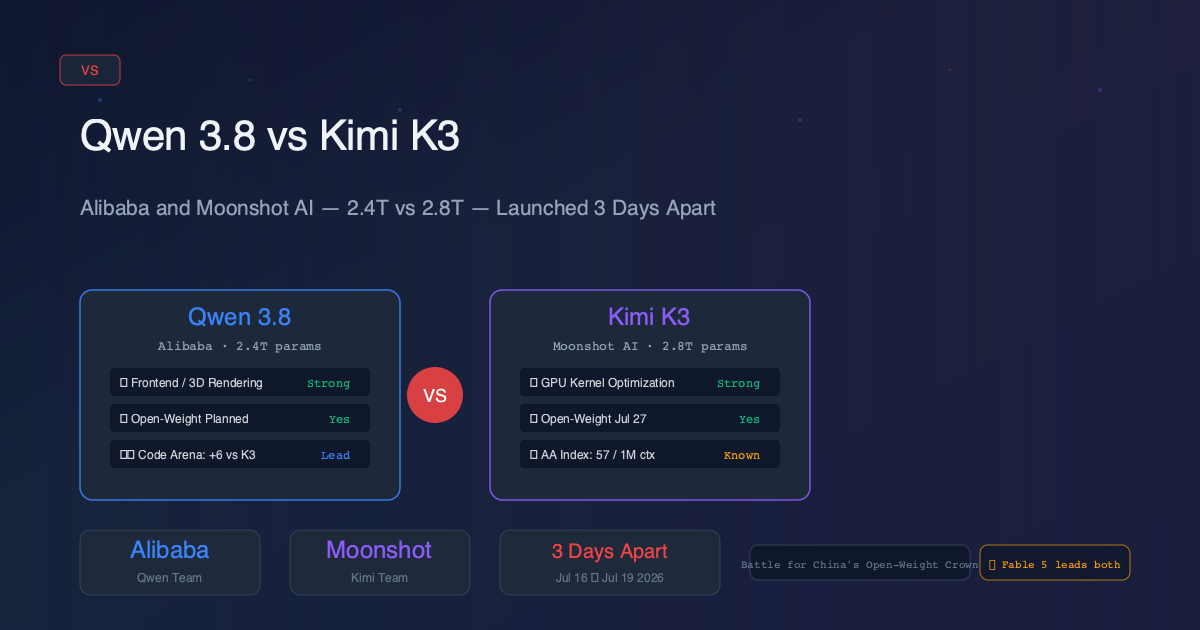
In the span of 72 hours, two of China's largest AI labs dropped trillion-parameter frontier models. Moonshot AI launched Kimi K3 on July 16. Alibaba answered with Qwen3.8-Max on July 19. Both land above 2 trillion parameters. Both are open-weight. Both target developers who need frontier reasoning at a fraction of Claude Fable 5 or GPT-5.6 prices.
And both launched before independent evaluators had enough time with either model.
If you searched "Qwen 3.8 vs Kimi K3" because you need to decide which model to build on — not which one has the better press release — you have landed in the right place. This article triangulates official specifications, third-party benchmarks from Arena.ai's Code Arena, leaked performance traces (Qwen3.8-Max's stealth "kaleb" alias on Arena), and the pricing and licensing details available as of July 20, 2026. Every number that can be verified independently is flagged. Numbers sourced only from company announcements are marked as vendor claims.
By the end, you will have a concrete comparison across eight dimensions — scale, architecture, benchmarks, pricing, context, licensing, reasoning style, and ecosystem — plus a decision framework that tells you which model to reach for first.
The 72-Hour Window: Why These Two Models Launched So Close Together
The July 2026 release calendar made no sense until it did.
On July 15, Moonshot AI's Kimi K3 promotional page leaked early on the Kimi Open Platform. Within hours, screenshots spread through Chinese AI WeChat groups and onto X. The leak confirmed what the developer community had suspected since K2.7 Code in June: Moonshot was preparing a generational jump — from ~1 trillion total parameters to nearly 3 trillion. Moonshot went live with the full launch on July 16, alongside API availability, official benchmarks, and a July 27 commitment for open weights.
Three days later, on July 19, Alibaba revealed Qwen3.8-Max in its Qoder platform — an AI-powered developer tool similar to Claude Code or Kimi Code. But the announcement was preceded by something more revealing: a model operating under the anonymous label "kaleb" on the Arena.ai Code Arena leaderboard. On July 19, the Code Arena maintainers confirmed that "kaleb" was in fact Qwen3.8-Max. The model had been silently competing against Kimi K3, Claude Fable 5, and GPT-5.6 for an undisclosed number of evaluation rounds.
The timing is not a coincidence. June 2026 set the table: Claude Fable 5 shipped June 9 with undisclosed parameters and closed weights. DeepSeek V4 GA rolled out July 19 with peak-valley pricing and SWE-bench Verified 80.6%. GPT-5.6 had been available since late June. The Chinese frontier labs, having already released their mid-tier models in Q1 and Q2 (Qwen3.6 in April under Apache 2.0, Kimi K2.7 Code in June), had exactly one move left on the chessboard: go big or watch the developer community migrate to the American incumbents.
Both chose to go big. And both chose to go open-weight — a strategic reversal for Alibaba, whose Qwen3.7-Max in May 2026 was proprietary.
Quick Comparison: Qwen3.8-Max vs Kimi K3
| Dimension | Qwen3.8-Max | Kimi K3 |
|---|---|---|
| Developer | Alibaba (Qwen Team) | Moonshot AI |
| Release date | July 19, 2026 | July 16, 2026 |
| Total parameters | 2.4 trillion | 2.8 trillion |
| Architecture | Undisclosed (likely MoE) | Mixture-of-Experts: 896 experts, 16 active per token |
| Attention mechanism | TBD | Kimi Delta Attention (KDA) + Attention Residuals (AttnRes) |
| Context window | TBD (estimated 256K–1M) | 1 million tokens (native) |
| Multimodal input | TBD | Text, image, video (native) |
| License | Open-weight planned (license TBD) | Open-weight under Modified MIT, releasing July 27 |
| Code Arena score vs K3 | +6 points lead | Baseline |
| Code Arena score vs Fable 5 | −12.6 points behind | Behind Fable 5 |
| API pricing | TBD (via Alibaba Token Plan) | $0.30 cache hit / $3.00 cache miss / $15.00 output per 1M tokens |
| Cache hit rate | TBD | >90% on coding workloads |
| Reasoning effort | TBD | Configurable (low/high/max, default: max); always reasons |
| Reasoning style | Distillation artifacts (calls itself "Claude") | Native reasoning, no known identity artifacts |
| Available via | Alibaba Token Plan, Qoder, QoderWork | kimi.com, Kimi Work, Kimi Code CLI, API |
| AA Intelligence Index | TBD | 57 (vs Grok 4.5: 54) |
The specifications favor K3 in known dimensions — context window, multimodal input, documented architecture, confirmed open-weight licensing, and transparent pricing. But K3 launched first, giving Moonshot a head start on documentation and third-party evaluation. Qwen3.8-Max, as of July 20, has more unknowns than knowns. The Code Arena "kaleb" leak provides the only independent third-party performance signal, and it is a strong one.
To understand whether the unanswered questions on Qwen3.8-Max are dealbreakers or just early-launch friction, work through each dimension systematically.
Scale and Architecture: 2.4 Trillion vs 2.8 Trillion — What the Numbers Actually Mean
K3 fields 2.8 trillion total parameters across 896 experts, with 16 activated per token. The active-per-token footprint — the number that determines single-query reasoning cost — is therefore a small subset of the headline 2.8T. This is table-stakes Mixture-of-Experts design: the model routes each input token to a small number of specialized sub-networks, trading training cost for inference efficiency. The actual per-token active count is estimated at approximately 50 billion parameters for K3, consistent with MoE scaling in this class.
Qwen3.8-Max registers at 2.4 trillion total parameters. Alibaba has not yet disclosed the expert count, active-per-token routing scheme, or attention mechanism. If Qwen follows its own Qwen3.6 architecture pattern (dense transformer with grouped-query attention), the 2.4T figure would imply a fundamentally different design philosophy than K3's MoE approach — possibly a denser model with fewer structural optimizations for inference speed.
The parameter difference — 2.4T vs 2.8T — is less important than the architectural difference. A well-engineered 2.4T MoE with efficient routing can outperform a less optimized 2.8T MoE on per-token reasoning. The Code Arena results, where Qwen3.8-Max leads K3 by approximately 6 points on coding tasks, suggest that Alibaba has indeed built efficiency into its architecture rather than relying on raw parameter count.
Rule of thumb: do not choose based on total parameter count. Total parameters determine training cost and theoretical capacity. Active-per-token parameters determine single-query reasoning quality and inference cost. K3 has disclosed both numbers. Qwen3.8-Max has disclosed neither. For production cost forecasting, K3 gives you data; Qwen3.8-Max gives you uncertainty.
The architecture choice affects more than benchmarks. It determines how the model behaves under load and over long contexts.
K3's Kimi Delta Attention: The Engineering Behind the 1M Token Claim
K3's attention mechanism deserves separate treatment because it explains the model's most defensible feature: practical 1-million-token context.
Kimi Delta Attention (KDA) is a hybrid linear attention mechanism that Moonshot first shipped in Kimi-Linear, a 48B-parameter open-source model released in late June 2026. KDA reduces the key-value cache by up to 75% compared to standard full attention, which allows K3 to handle million-token sequences without the extreme memory requirements that make other long-context models impractical to serve at scale.
In K3, KDA is augmented with Attention Residuals (AttnRes) — a mechanism that preserves the model's ability to attend to fine-grained token-level patterns even when compressing the attention window. The practical result: K3 can ingest an entire codebase, complete documentation, or a multi-hour conversation history and maintain coherent reasoning across the full span.
Qwen3.8-Max's attention mechanism and context window are undisclosed as of July 20. If Alibaba follows its Qwen3.6 lineage, expect grouped-query attention with a context window in the 256K–512K range. If the 3.8 architecture is a more significant departure, the context window could extend to 1M tokens — but this would require a documented attention innovation comparable to KDA.
Expert pitfall: "1 million token context" does not mean "perfect recall at 1 million tokens." Every long-context model, including K3, exhibits retrieval degradation at the extremes of its context window. The 1M-token specification describes the maximum input size, not the range over which the model maintains perfect fidelity. In practice, for both K3 and any competing model that claims similar context lengths, you should assume reliable retrieval up to approximately 200K–300K tokens and test your specific use case before committing to long-context production pipelines.
Benchmark Comparison: Code Arena Tells the Story, But Not the Whole Story
As of July 20, 2026, the only direct head-to-head benchmark between Qwen3.8-Max and Kimi K3 comes from the Arena.ai Code Arena, where both models competed under evaluation alongside Claude Fable 5, GPT-5.6, and other frontier models.
Code Arena Results
| Model | Code Arena Score | vs K3 Delta |
|---|---|---|
| Claude Fable 5 | Baseline + ~12.6 | +12.6 |
| Qwen3.8-Max ("kaleb") | Baseline + ~6 | +6 |
| Kimi K3 | Baseline | 0 |
| GPT-5.6 | TBD | TBD |
Qwen3.8-Max — operating under the anonymous "kaleb" handle — beat Kimi K3 by approximately 6 points on the Code Arena leaderboard. This is a meaningful margin. On the same leaderboard, Claude Fable 5 leads Qwen3.8-Max by roughly 12.6 points, positioning the Alibaba model in a clear second place among the three, ahead of K3 but behind Anthropic's flagship.
The Code Arena scoring methodology evaluates models on coding tasks through blind pairwise comparisons — human evaluators see outputs from two anonymous models and select the better result. A 6-point gap indicates that, across the evaluation corpus, human raters preferred Qwen3.8-Max's code outputs over K3's consistently enough to produce a statistically significant separation.
This result is notable because K3's official benchmarks and early third-party evaluations show strong coding performance. On SWE-bench Verified, K3 scored approximately 67.3 (DeepSWE protocol). On Terminal-Bench, K3 reached 2.1 — a frontier-level score for autonomous terminal-based development tasks. K3's Frontend Code Arena score was independently reported as leading in that subcategory. Losing to Qwen3.8-Max on the comprehensive Code Arena, then, suggests Alibaba's model may be stronger in specific coding subdomains that K3 does not dominate.
What Qwen3.8-Max Excels At
Based on the "kaleb" traces and independent tester reports from the first 24 hours after Qwen3.8-Max's appearance:
- Frontend and web development. Qwen3.8-Max demonstrates particular strength in generating complete, functional web applications with CSS styling, JavaScript interactivity, and responsive layouts. Multiple testers reported the model producing polished single-page applications — including complex 3D rendering via Three.js or WebGL — from single natural-language prompts.
- 3D rendering and graphics. A distinctive capability signal: Qwen3.8-Max generates functional 3D scenes, interactive visualizations, and WebGL-based rendering code that runs correctly on the first attempt more often than competing models. This is not a skill that appears on standard coding benchmarks, but it emerged consistently in independent community testing on X and Reddit during the kaleb evaluation period.
- Full-stack single-prompt projects. Where K3 and Fable 5 excel at multi-turn iterative development (plan, scaffold, implement, debug, refine), Qwen3.8-Max appears optimized for delivering complete, working prototypes in a single generation. This is a different optimization target — less suitable for large production codebases, more suitable for rapid prototyping and exploration.
What Kimi K3 Excels At
K3's strengths, drawn from Moonshot's official benchmarks and independent third-party evaluations:
- Autonomous software engineering (DeepSWE 67.3). K3's DeepSWE score places it among the strongest models for end-to-end software engineering tasks — finding bugs, writing fixes, and validating changes across multi-file repositories.
- GPU kernel optimization and low-level systems programming. In one of the most specific and impressive capability demonstrations, K3 autonomously built a MiniTriton compiler from scratch and designed a custom chip architecture. This level of systems programming capability is rare even among frontier models.
- BrowseComp at 1M context (90.4). K3's ability to ingest massive web corpora and answer complex compositional questions — the BrowseComp benchmark at full 1-million-token context — scored 90.4, competitive with the best proprietary models.
- Configurable reasoning effort. K3 exposes a reasoning effort parameter (low/high/max, defaulting to max). This allows developers to trade reasoning depth for speed and cost — use max reasoning for complex debugging, switch to low for boilerplate generation.
The Missing Benchmarks
As of July 20, Qwen3.8-Max has no published scores for:
- SWE-bench Verified
- MMLU-Pro
- GPQA Diamond
- HumanEval / MBPP
- LiveCodeBench
- Humanity's Last Exam
- Any agentic benchmark (BrowseComp, MCPAtlas, Terminal-Bench)
Alibaba has not released a formal model card or benchmark table for Qwen3.8-Max. The Code Arena "kaleb" confirmation is the only verified third-party signal. Comparisons beyond coding — reasoning, mathematics, agentic capability, long-context retrieval — must wait for either Alibaba's official benchmark release or independent third-party evaluation.
Rule of thumb: if you are evaluating for production and your primary workload is coding, the Code Arena delta gives you a reliable signal. For any other workload, you are operating with incomplete information on Qwen3.8-Max — budget time for your own evaluation or wait for published benchmarks.
Pricing: Kimi K3 Is Priced and Available. Qwen3.8-Max Is Not.
This is the dimension where K3's three-day head start matters most.
Kimi K3 Pricing (Confirmed)
| Pricing tier | Per 1M tokens (USD equivalent) |
|---|---|
| Input — cache hit | ¥2 (~$0.30) |
| Input — cache miss | ¥20 (~$3.00) |
| Output | ¥100 (~$15.00) |
| Cache hit rate on coding workloads | >90% (vendor claim) |
K3's pricing structure is built around Moonshot's prompt caching system. At >90% cache hit rates on coding workloads — a claim that independent testers have broadly corroborated in the first days after launch — the effective input cost drops to approximately $0.30 per million tokens. System prompts, codebase context, and repetitive instruction prefixes all benefit from caching.
The output cost of $15 per million tokens is in the mid-range for frontier models. For comparison: Claude Fable 5 charges $50 per million output tokens. GPT-5.6 Sol is in a comparable range. DeepSeek V4 GA Pro charges significantly less — approximately $0.55 per million output tokens under peak-valley pricing — but with a smaller model (1.6T total, 49B active).
At the estimated 90% cache hit rate, a typical coding workload of 10 million input tokens and 1 million output tokens costs approximately:
- Kimi K3: (1M × $3.00) + (9M × $0.30) + (1M × $15.00) = $3.00 + $2.70 + $15.00 = $20.70
- Claude Fable 5 (cached): (1M × $10.00) + (9M × $1.00) + (1M × $50.00) = $10.00 + $9.00 + $50.00 = $69.00
K3 delivers frontier coding capability at approximately 30% of Fable 5's cost. Whether Qwen3.8-Max can undercut this depends on Alibaba's pricing announcement.
Qwen3.8-Max Pricing: What We Know
Alibaba has confirmed that Qwen3.8-Max will be available through the Alibaba Token Plan, Qoder (the AI-powered developer tool), and QoderWork. No per-token pricing has been published.
Qwen's historical pricing provides context. Qwen3.6 (April 2026, Apache 2.0) was priced competitively with DeepSeek's models — approximately $0.50–$1.00 per million input tokens and $2.00–$4.00 per million output tokens on the Alibaba Cloud API. Qwen3.7-Max (May 2026, proprietary) was priced higher — closer to $3.00 input and $12.00 output — reflecting its proprietary positioning.
If Alibaba prices Qwen3.8-Max at or below Qwen3.6 levels, it would substantially undercut K3. If it prices at Qwen3.7-Max levels, the two models would be roughly at parity. If Qwen3.8-Max is priced higher — justified by the Code Arena lead — it would be competing with Fable 5 on cost rather than K3.
Rule of thumb: do not make production cost commitments based on Qwen3.8-Max until Alibaba publishes pricing. If cost is a hard constraint and you need to commit now, K3's published pricing plus the 90% cache hit rate gives you a predictable cost model.
Licensing and Openness: Both Are Open-Weight — But Only One Is Committed
The licensing dimension matters for self-hosting, fine-tuning, and commercial deployment — three use cases where API pricing becomes irrelevant.
Kimi K3: Open Weights July 27, Modified MIT
Moonshot AI has committed to releasing Kimi K3's model weights on July 27, 2026, under a Modified MIT license — the same license family used for K2, K2.5, K2.6, and K2.7. The Modified MIT license permits commercial use, modification, and redistribution with attribution requirements.
Key details:
- Weights: Full 2.8T MoE weights, downloadable from github.com/MoonshotAI
- License: Modified MIT — commercial use allowed, attribution required
- Hardware requirement: Estimated 8×H100 (640GB+ total VRAM) for inference; higher for fine-tuning
- Training data: Not open-sourced (standard for Modified MIT models)
- Training code: Not open-sourced
The "Modified MIT" designation differs from standard MIT in one specific clause that Moonshot has applied across its model family: users generating more than 100 million monthly active users (MAU) must obtain a separate commercial agreement. This clause is identical to the one in K2.7 Code and is not expected to change for K3.
Qwen3.8-Max: Open-Weight Planned, Details TBD
Alibaba has stated that Qwen3.8-Max will be open-weight. This is a strategic reversal from Qwen3.7-Max (May 2026), which was proprietary with no open-weight commitment. The return to open-weight follows Alibaba's historical pattern: Qwen3.6 (April 2026) was released under Apache 2.0, one of the most permissive open-source licenses available.
The open question: which license will Qwen3.8-Max use?
If Alibaba returns to Apache 2.0, Qwen3.8-Max would be the most permissively licensed frontier model available — more permissive than K3's Modified MIT, more permissive than DeepSeek V4 GA's MIT, and dramatically more permissive than any proprietary model. Apache 2.0 allows commercial use, modification, distribution, and private use without attribution requirements or MAU caps.
If Alibaba uses a custom or restricted license — as it did with the Qwen3.7 series — the openness advantage disappears.
Alibaba has not published a release date for the Qwen3.8-Max weights.
Licensing Scorecard
| Licensing dimension | Kimi K3 | Qwen3.8-Max |
|---|---|---|
| Open-weight commitment | Confirmed, July 27 | Confirmed, date TBD |
| License type | Modified MIT (MAU cap) | TBD (historical: Apache 2.0) |
| Commercial use | Yes, with MAU cap | Expected yes |
| Fine-tuning allowed | Yes | Expected yes |
| Self-hosting viable | Yes (datacenter hardware) | Expected yes (hardware TBD) |
| Training data open | No | No |
| Training code open | No | No |
Expert pitfall: "open-weight" availability does not mean "runnable on your laptop." A 2.4T or 2.8T parameter model — even with MoE routing that activates only a fraction per token — requires datacenter-grade GPU infrastructure for inference. For K3, the estimated minimum is 8×H100 GPUs with at least 80GB VRAM each. Qwen3.8-Max, depending on its active-per-token architecture, may require comparable or higher hardware. If you are evaluating these models for self-hosting, budget for the hardware before budget for the license.
The Qwen Model Family Evolution: From Proprietary Back to Open
The licensing reversal is not an isolated decision. It reflects a broader arc in Alibaba's Qwen strategy across 2026.
| Model | Release | Parameters | License | Key Feature |
|---|---|---|---|---|
| Qwen3.5 | February 2026 | ~72B (dense) | Apache 2.0 | Strong multilingual, cost-efficient |
| Qwen3.6 | April 2026 | ~110B (dense) | Apache 2.0 | Improved coding, longer context |
| Qwen3.7-Max | May 2026 | ~1.5T (MoE) | Proprietary | Alibaba Cloud exclusive, strong reasoning |
| Qwen3.7-Plus | June 2026 | ~1.5T (MoE) | Proprietary | Multimodal (text + image input) |
| Qwen3.8-Max | July 2026 | 2.4T | Open-weight (planned) | Frontier scale, strong coding, 3D/Web |
The pattern: Alibaba experimented with proprietary licensing for Qwen3.7-Max and 3.7-Plus — likely testing whether the developer community would accept API-only access to frontier models from a Chinese lab. The experiment appears to have ended. Facing K3's open-weight commitment, DeepSeek V4 GA's MIT license, and the broader open-weight trend across the Chinese AI ecosystem, Alibaba returned to its Apache 2.0/open-weight roots for Qwen3.8-Max.
This reversal is significant for developers who build on Chinese frontier models: it signals that the open-weight norm in China's AI ecosystem is resilient enough to pull even the largest labs back from proprietary experiments. Moonshot's K3 and DeepSeek's V4 GA established the competitive baseline. Alibaba's Qwen3.8-Max conformed to it.
Reasoning Style: The Claude Distillation Artifact and Why It Matters
One of the most discussed aspects of Qwen3.8-Max's appearance on Code Arena is not a benchmark score — it is a behavioral artifact.
Multiple testers on X and Reddit reported that Qwen3.8-Max occasionally identifies itself as "Claude" in its reasoning traces and output responses. This is a textbook symptom of distillation — training a model on outputs generated by another model, in this case likely outputs from Anthropic's Claude family (Claude Opus or Claude Fable).
Distillation is not inherently problematic. It is a standard technique for transferring capabilities from larger, more capable teacher models to smaller student models. But it introduces specific behavior patterns that affect production reliability:
- Identity confusion. A model that has been trained on another model's outputs may produce responses that assume the wrong identity, tool access, or capability profile. In development environments where the model interacts with APIs, filesystems, or user authentication systems, this can cause subtle failures.
- Capability overstatement. A distilled model may occasionally produce responses that assume it has capabilities it does not actually possess — because the teacher model had those capabilities and the student learned to mimic the output format without the underlying functionality.
- Inconsistent refusal patterns. Safety and refusal behaviors may drift from the intended model alignment toward the teacher model's refusal patterns, creating unpredictable behavior on boundary queries.
K3, by contrast, uses native reasoning — Moonshot trained the model's reasoning capability from scratch rather than distilling it from another frontier model. K3 also exposes configurable reasoning effort (low/high/max), allowing developers to control the depth of the reasoning chain. K3 defaults to max reasoning effort, always producing a reasoning trace before its final output.
Qwen3.8-Max's reasoning effort configuration is undisclosed. The "kaleb" traces suggest the model reasons by default but may not expose the same level of developer control over reasoning depth.
Rule of thumb: if your production pipeline includes agentic workflows where the model controls tools, reads files, or makes authentication decisions, K3's native reasoning and configurable effort provide safer defaults. Qwen3.8-Max's distillation artifacts may cause unpredictable behavior in these environments — test extensively before deploying.
Multimodal Capabilities: Confirmed vs TBD
Kimi K3 was confirmed as natively multimodal at launch — supporting text, image, and video input. Multimodal input allows K3 to accept reference images, screenshots of code or UI, video frames, and documents as part of its context window, enabling workflows like UI debugging from screenshots, code review with visual context, and document analysis.
Qwen3.8-Max's multimodal capabilities are unconfirmed as of July 20. Qwen3.7-Plus (June 2026) added multimodal input support, so the Qwen family has the architectural foundation. Whether Qwen3.8-Max inherits this capability, improves it, or omits it is unknown.
If multimodal input matters for your workflow — visual code review, UI debugging, document ingestion — K3 is the known quantity. Qwen3.8-Max is an unknown.
Ecosystem and Developer Tools
Both models are accessible through developer platforms designed to compete with Claude Code and the OpenAI API ecosystem.
Kimi K3 Ecosystem
- kimi.com: Web chat interface for general use
- Kimi Code CLI: Command-line coding assistant modeled on Claude Code, with file access, terminal control, and multi-file editing
- Kimi Work: Web-based collaborative workspace for project-level AI-assisted development
- API: Available now with documented endpoints, prompt caching, and streaming support
- Third-party integrations: Available through OpenRouter (expected shortly after launch), MCP protocol support
Qwen3.8-Max Ecosystem
- Alibaba Token Plan: API access platform for Alibaba's model family
- Qoder: AI-powered developer tool similar to Claude Code — code generation, debugging, file editing, terminal access
- QoderWork: Collaborative workspace variant of Qoder
- API: Availability confirmed, pricing and endpoint details TBD
- Third-party integrations: Likely to appear on OpenRouter and other model gateways; timeline unconfirmed
Both ecosystems are competitive with proprietary developer tools from Anthropic and OpenAI. K3's ecosystem has the advantage of being live and documented. Qwen3.8-Max's ecosystem is announced but not yet fully detailed.
Decision Framework: Which Model for Which Workflow
Based on confirmed data as of July 20, 2026:
Choose Kimi K3 if:
- You need a model today. K3's API is live, documented, and priced. Qwen3.8-Max's API timeline and pricing are unconfirmed.
- Long-context coding is your primary workload. K3's 1-million-token native context window — backed by KDA and AttnRes — is the confirmed market leader. If you feed entire codebases, documentation sets, or multi-hour development sessions into a single context, K3 is designed for exactly this.
- You need predictable pricing for cost forecasting. K3's $0.30/$3.00/$15.00 tier with documented cache hit rates gives you a cost model you can budget against. Qwen3.8-Max gives you uncertainty.
- You plan to self-host on July 27. K3's open-weight release date is confirmed, the license is known (Modified MIT), and the hardware requirements are estimable from K2.6 scaling data.
- Autonomous agent workflows with tool use. K3's native reasoning, configurable reasoning effort, and lack of distillation artifacts make it a safer choice for agentic deployments where the model controls tools, files, or authentication.
- Multimodal input matters. K3's confirmed text + image + video input support enables visual debugging, screenshot-based code review, and document ingestion workflows that Qwen3.8-Max may or may not support.
Choose Qwen3.8-Max if:
- Code Arena performance is your primary signal. Qwen3.8-Max leads K3 by approximately 6 points on the Code Arena leaderboard — a verified third-party result. If your coding workload matches the Code Arena evaluation distribution, Qwen3.8-Max is measurably stronger.
- Frontend, web development, and 3D rendering are your focus. Community testing consistently shows Qwen3.8-Max excelling in these specific coding subdomains — generating polished single-page applications, interactive 3D scenes, and functional WebGL code.
- You can wait for pricing and API availability. If your evaluation does not require an immediate production commitment, waiting for Alibaba to publish Qwen3.8-Max's full benchmark table, pricing, and API details gives you a more complete picture.
- Apache 2.0 licensing matters for your compliance. If Alibaba returns to Apache 2.0 — its historical standard — Qwen3.8-Max would be the most permissively licensed frontier model available. If your legal team requires OSI-compliant licensing without MAU caps or attribution requirements, this could be decisive.
- Single-prompt prototyping speed is your bottleneck. Community testers report Qwen3.8-Max delivers complete working prototypes in single generations more reliably than K3, which is optimized for multi-turn iterative development. If your workflow is "one prompt → complete app," Qwen3.8-Max may save you rounds of iteration.
Use Both if:
- You are building a multi-model pipeline. K3 for long-context, multi-file programming and autonomous agent workflows. Qwen3.8-Max for rapid frontend prototyping, 3D visualization, and single-prompt web application generation.
- Cost arbitrage matters. If Qwen3.8-Max prices below K3, route cost-sensitive workloads to Qwen and context-heavy workloads to K3.
- You are evaluating for a team decision. The safest approach is to wait for Qwen3.8-Max's full specification release, benchmark both models against your actual workload, and decide based on your data — not vendor benchmarks or third-party leaderboards.
How to Test Both Models in 15 Minutes
If you have API access to K3 today and Qwen3.8-Max becomes available through the Alibaba Token Plan:
- Take a real task from your current project — not a toy problem, not a benchmark example. A function you need to write, a bug you need to fix, a component you need to build.
- Feed the identical prompt to both models with the same system instructions and context. Do not adjust prompts between models — the goal is to compare output quality, not prompt engineering skill.
- Compare on three dimensions: correctness (does the code work?), completeness (does it handle edge cases?), and integration effort (how much modification does it need before merging?).
- Repeat with a long-context task — feed a multi-file codebase and ask both models to make a cross-cutting change. This will expose the context-window differences immediately.
- Check reasoning traces for identity confusion. If Qwen3.8-Max identifies itself as Claude in any output, flag it — this may cause issues in agentic workflows.
Expert-Level Pitfalls When Adopting Either Model
Before you commit production infrastructure to either model, understand these failure modes.
The Parameter Count Trap
Both models are marketed on total parameter count — 2.4T for Qwen3.8-Max, 2.8T for K3. But total parameters are a training cost metric, not a capability metric. A 70B dense model with better training data and architecture can outperform a poorly optimized 2T MoE on specific tasks.
Resolution strategy: Ignore parameter count in your evaluation. Compare benchmark scores on the specific task type you run in production. If no published benchmark matches your task, run your own evaluation.
The Cache Hit Assumption
K3's published pricing assumes 90% cache hit rates. If your workload involves highly variable prompts — different codebases per session, different system instructions per request, low repetition across queries — your actual cache hit rate will be lower, and your effective cost will be higher than the published estimates suggest.
Resolution strategy: Run 100 representative prompts through the K3 API with caching enabled, measure your actual cache hit rate, and multiply the published pricing by your actual ratio. Do not budget based on Moonshot's 90% figure. Test first.
The Distillation Drift
If Qwen3.8-Max is confirmed to have distillation artifacts from Claude-family models, expect occasional behavioral drift in production — identity confusion, capability overstatement, and inconsistent refusal patterns. These are not bugs that will be patched; they are emergent properties of the training methodology.
Resolution strategy: In agentic deployments, add a model identity check to your system prompt ("You are Qwen3.8-Max, an AI model developed by Alibaba") and explicitly enumerate the tools and capabilities available to the model. Do not rely on the model correctly inferring its own capabilities.
The Context Degradation Curve
K3's 1-million-token context window is the most impressive number in the specification, but sustained reasoning quality degrades beyond approximately 200K–300K tokens in practice. If you plan to load 1M tokens of codebase context, expect retrieval failures, hallucinated content, and reasoning inconsistencies in the later portions of the context window.
Resolution strategy: Break long-form tasks into chunks that fit within 200K tokens. Use retrieval-augmented generation (RAG) for codebase search rather than loading the entire repository into context. Test retrieval accuracy at your target context length before committing to a production pipeline.
The Benchmark Overfit
Both models were likely trained with awareness of popular evaluation benchmarks. A strong Code Arena or SWE-bench score does not guarantee strong performance on your specific codebase, your programming language, or your development workflow.
Resolution strategy: Run your own evaluation on your actual workload. Allocate at least two hours of engineering time per model for a fair comparison. The cost of a wrong model choice — in developer time, production bugs, and rework — exceeds the cost of a thorough evaluation by orders of magnitude.
FAQ
Which is better, Qwen 3.8 or Kimi K3?
On coding tasks, the only verified head-to-head comparison (Arena.ai Code Arena) shows Qwen3.8-Max leading Kimi K3 by approximately 6 points. However, K3 has published stronger scores across a broader set of benchmarks (SWE-bench, BrowseComp, Terminal-Bench) and offers confirmed long-context capability, multimodal input, and transparent pricing. For coding, Qwen3.8-Max has the early lead. For general frontier capability and production readiness, K3 has more confirmed data.
Is Kimi K3 open source?
Kimi K3 will release open weights on July 27, 2026, under a Modified MIT license. The weights will be downloadable from github.com/MoonshotAI. The license permits commercial use, modification, and redistribution with attribution. Users exceeding 100 million monthly active users must obtain a separate commercial agreement. Training data and training code are not open-sourced.
Is Qwen3.8-Max open source?
Alibaba has stated that Qwen3.8-Max will be open-weight. The specific license and release date have not been announced. Historically, Alibaba has used Apache 2.0 for the Qwen family (Qwen3.5, Qwen3.6), though Qwen3.7-Max and Qwen3.7-Plus were proprietary. If Apache 2.0 is confirmed, Qwen3.8-Max would be the most permissively licensed frontier model available.
How much does Kimi K3 cost?
Kimi K3 API pricing: $0.30 per million input tokens (cache hit), $3.00 per million input tokens (cache miss), $15.00 per million output tokens. With the vendor-claimed >90% cache hit rate on coding workloads, a typical session of 10M input and 1M output tokens costs approximately $20.70.
How much does Qwen3.8-Max cost?
Qwen3.8-Max pricing has not been announced as of July 20, 2026. The model will be available through the Alibaba Token Plan, Qoder, and QoderWork. Historical Qwen pricing suggests a range of $0.50–$3.00 per million input tokens and $2.00–$12.00 per million output tokens, depending on whether Alibaba positions the model at the budget or premium tier.
What is Qwen3.8-Max's context window?
Qwen3.8-Max's context window has not been disclosed. Based on the Qwen family evolution, estimates range from 256K to 1M tokens. Kimi K3 offers a confirmed native 1-million-token context window.
Does Qwen3.8-Max support multimodal input?
Unconfirmed. Qwen3.7-Plus (June 2026) added multimodal input, so multimodal capability exists in the Qwen architecture. Whether Qwen3.8-Max inherits, improves, or omits it has not been announced.
Can I run Kimi K3 or Qwen3.8-Max on my own hardware?
Both models are in the 2.4T–2.8T parameter range and require datacenter-grade GPU infrastructure. For K3, the estimated minimum for inference is 8×H100 GPUs (640GB+ total VRAM). Self-hosting is viable for organizations with existing GPU clusters; it is not practical for individual developers or small teams without dedicated infrastructure. Qwen3.8-Max's hardware requirements depend on its active-per-token architecture, which has not been disclosed.
When will Qwen3.8-Max benchmarks be available?
No timeline has been announced. Historically, Alibaba publishes official benchmark tables within days to weeks of a model's preview or launch. The model's appearance on Code Arena suggests that independent evaluation is underway, but no comprehensive third-party benchmark suite has been published.
Which model should I use for agentic coding workflows?
Kimi K3 has published stronger scores on agentic benchmarks (DeepSWE 67.3, Terminal-Bench 2.1) and offers documented support for MCP-based tool use. Its configurable reasoning effort and native (non-distilled) reasoning make it the safer choice for agentic deployments where the model controls files, terminals, or authentication systems. Qwen3.8-Max's agentic performance is unmeasured, and its distillation artifacts introduce behavioral uncertainty in tool-use scenarios.
What are the main differences between Qwen3.8-Max and Claude Fable 5?
Claude Fable 5 leads Qwen3.8-Max by approximately 12.6 points on the Code Arena leaderboard. Fable 5 offers 1M-token context, undisclosed parameters, closed weights, and API pricing of $10/$50 per million input/output tokens. Qwen3.8-Max is 2.4T parameters, open-weight (license TBD), and priced TBD — likely significantly cheaper than Fable 5. If benchmark performance is your sole criterion, Fable 5 is stronger. If cost, licensing flexibility, or self-hosting matter, Qwen3.8-Max may be the better choice — pending pricing and license confirmation.
The Verdict: Known vs. Unknown
The Qwen 3.8 vs Kimi K3 comparison is not settled. It cannot be settled with the available data on July 20, 2026. One model has disclosed its full specification, pricing, licensing, and benchmark suite. The other has disclosed a parameter count, an open-weight intention, and a strong Code Arena signal from a stealth evaluation.
That asymmetry is itself the most important signal. If you need to deploy or commit to a model this week, K3 is the informed choice — not because it is definitively better, but because it is definitively known. Qwen3.8-Max has more upside potential — stronger coding per the Arena, possibly Apache 2.0 licensing, possibly lower pricing — but also more downside risk from undisclosed weaknesses in reasoning, agentic capability, long-context retrieval, and multimodal input.
The responsible decision is to acknowledge what you do not know. Budget for your own evaluation. Wait for Qwen3.8-Max's full specification release before committing production infrastructure. If Alibaba publishes strong benchmarks across the full evaluation suite, competitive pricing, and Apache 2.0 licensing, Qwen3.8-Max could be the strongest value proposition among open-weight frontier models. If any of those three conditions fails, K3 remains the most capable confirmed open-weight model with the best-documented production characteristics.
For the latest Kimi K3 benchmarks, see our Kimi K3 benchmark deep dive. For a detailed comparison of K3 against Anthropic's frontier model, read Kimi K3 vs Claude Fable 5. For the timeline on accessing K3 weights directly, check Is Kimi K3 Open Source?.