Table of Contents
Most large language model announcements lead with chat benchmarks: MMLU, GSM8K, HumanEval. They measure how well a model answers a single question, writes one function, or translates one paragraph.
Nemotron 3 Ultra was not designed for those benchmarks.
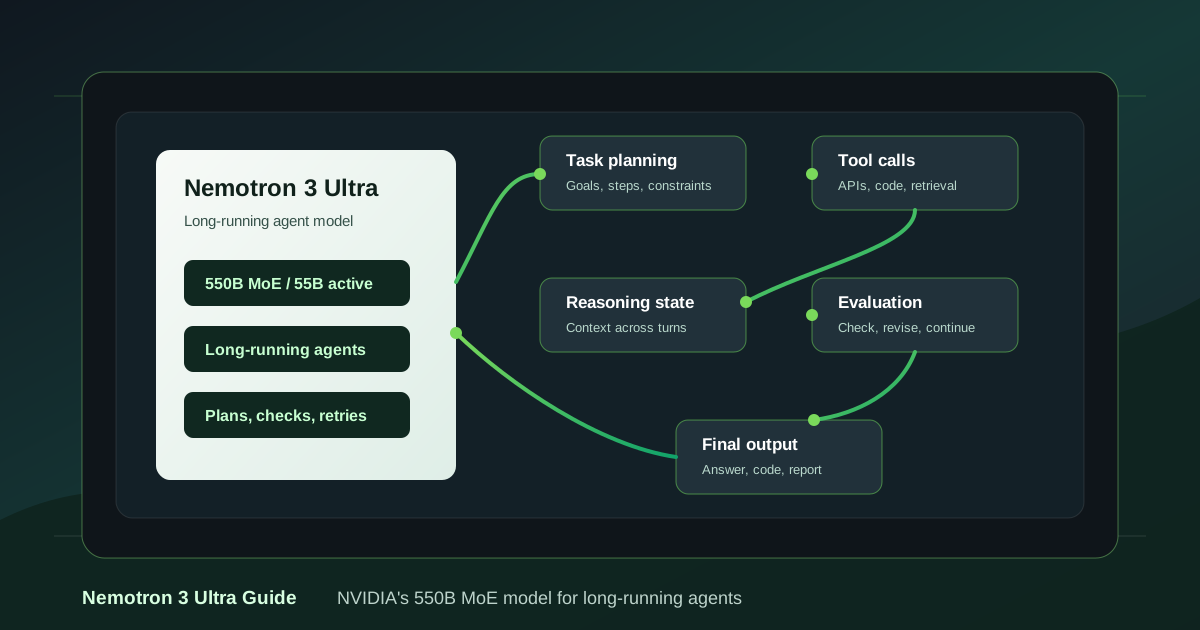
On June 4, 2026, NVIDIA released the final and best model in the Nemotron 3 family — a 550B-parameter Mixture-of-Experts model with 55B active parameters built specifically for complex, long-running agent workflows. This is not a faster chatbot. It is a model optimized for tasks that span multiple reasoning steps, tool calls, context accumulation, and decision loops.
By the end of this guide, you will:
- understand exactly what Nemotron 3 Ultra is and why its architecture is different from conventional LLMs
- know the real meaning behind claims like "5x higher throughput" and "up to 30% cost reduction"
- have a clear decision framework for when Nemotron 3 Ultra fits your workflow and when it does not
- know the fastest path to evaluate it, from Hugging Face weights to hosted APIs
This guide is based on the NVIDIA Developer Blog, the NVIDIA Research page, and the NVIDIA NIM documentation.
What Is Nemotron 3 Ultra?
Nemotron 3 Ultra is the final and best model in NVIDIA's Nemotron 3 family, positioned at the top of the lineup. It is a 550B-parameter Mixture-of-Experts (MoE) model with 55B active parameters, designed from the ground up for agentic tasks — reasoning, planning, tool use, and orchestration workflows that span many turns.
| Component | Specification |
|---|---|
| Total parameters | 550B |
| Active parameters per forward pass | 55B |
| Architecture | Hybrid Mamba-Transformer + LatentMoE |
| Quantization | NVFP4 (native 4-bit floating point) |
| Multi-token prediction | Yes (predicts multiple future tokens per step) |
| Primary use case | Long-running agent workflows and orchestration |
| Family position | Final and best model in Nemotron 3 series |
| Availability | Hugging Face weights, NVIDIA NIM, build.nvidia.com, OpenRouter, Perplexity, Anaconda |
What 550B MoE / 55B Active Actually Means
This is the single most important specification to understand, because it is also the most commonly misunderstood.
A 550B-parameter model does not mean the entire 550 billion parameters are active during every forward pass. In a Mixture-of-Experts architecture, the model has many "expert" sub-networks — in this case, 550B total parameters distributed across expert layers. For each input, a learned router selects only a subset of experts to activate. Only 55B parameters are used per forward pass.
What this means in practice:
- Inference cost is closer to a 55B model than a 550B model. Memory and compute per token stay manageable despite the large total parameter count.
- Capacity is greater than a 55B dense model. With 10x more total parameters, the model can store more knowledge across experts than any single 55B dense model could.
- The trade-off is routing overhead and batch efficiency. MoE models require careful load balancing across experts, and throughput depends on how well the router distributes work.
NVIDIA's LatentMoE is a refinement of the standard MoE approach. It introduces a latent representation layer between the router and the experts, designed to improve expert specialization and reduce routing conflicts when multiple inputs activate overlapping expert sets.
The Hybrid Mamba-Transformer Design
The second architectural decision that defines Nemotron 3 Ultra is the hybrid of Mamba layers and Transformer layers.
Transformer layers provide strong attention-based reasoning — they are what make the model good at instruction following, multi-step logic, and precise token-level decisions. Mamba layers, by contrast, use a state-space model design that processes sequences in linear time relative to sequence length, rather than the quadratic cost of full attention.
By mixing both:
- Mamba layers handle the long-context tracking — maintaining state across long agent sessions without the memory cost of full attention at every layer
- Transformer layers handle the high-resolution reasoning — applying attention where precision matters most
The result is a model that can sustain long agent sessions without the proportional cost increase that a pure Transformer model would incur.
Rule of Thumb: If a task fits in a single chat turn with a 8K-16K context window, you probably do not need Nemotron 3 Ultra's architecture. If a task requires maintaining state across dozens of tool calls, multiple sub-tasks, and accumulated context that grows over time, the Mamba-Transformer hybrid starts to show its advantage.
Why NVIDIA Built Nemotron 3 Ultra
The timing of Nemotron 3 Ultra is not accidental. The AI industry is in the middle of a shift from single-turn generation to multi-turn agentic workflows. Models that excel at answering one question well do not necessarily excel at sustaining coherent reasoning across many interconnected calls.
NVIDIA identified two converging trends:
First, enterprise AI deployment is moving toward agent architectures. The pattern is no longer "ask a LLM, get an answer." It is "deploy an agent that plans, executes tool calls, evaluates results, re-plans, and produces a final output." This pattern requires models that can maintain context across many steps without losing coherence or hallucinating state.
Second, deployment scale changes the cost equation. Running thousands of concurrent agent sessions is fundamentally different from handling a few hundred chat conversations. At that scale, throughput per GPU and cost per completed task become the relevant metrics — not per-token latency or single-turn accuracy.
Nemotron 3 Ultra is NVIDIA's answer to both trends: an architecture that trades some single-turn peak performance for sustained multi-turn efficiency and higher throughput at deployment scale.
What NVIDIA Claims
According to the NVIDIA Developer Blog:
- Up to 5x higher throughput compared to similar open models on agentic benchmarks
- Up to 30% reduction in cost to task completion on certain agentic workloads
- Optimized for systems where efficiency and latency across large deployments matter
These claims come from controlled benchmarks. Throughput advantage varies with workload, batch size, hardware configuration, and the specific agent task being measured. The cost reduction figure depends on how much of the total task cost comes from repeated model invocations versus fixed overhead.
Technical depth moment: The throughput claim is not a simple "our model is faster" statement. It is the compound effect of several engineering decisions: NVFP4 reduces memory bandwidth per token, multi-token prediction reduces the number of forward passes for long outputs, and the Mamba layers reduce the attention overhead for long contexts. In a deployment with many concurrent agent sessions, these savings add up across sessions, not just within a single request. For a single user with a single agent task, the difference will be smaller.
Architecture Deep Dive: The Four Key Innovations
Hybrid Mamba-Transformer
The hybrid design is the most distinctive architectural choice in Nemotron 3 Ultra.
Standard Transformer models use self-attention at every layer. As context length grows, attention cost grows quadratically — doubling the context quadruples the compute per layer. Mamba layers avoid this by using a structured state-space model that processes sequences in linear time.
In Nemotron 3 Ultra, some layers are Mamba and some are Transformer, interleaved. The Mamba layers handle the bulk of long-context state tracking: maintaining what the agent has done, what tools it has called, what results it has seen. The Transformer layers handle the reasoning steps where precise token-level attention is critical: instruction following, structured data parsing, decision points.
The insight is that not all layers need full attention. Most of an agent session is bookkeeping — tracking progress, storing intermediate results, checking completion conditions. Only at decision points does the model need the full attention mechanism. The hybrid design saves compute on the bookkeeping and allocates it to the decisions.
LatentMoE
Standard Mixture-of-Experts architectures route each input token to a subset of expert networks. The router makes a discrete choice: token A goes to experts 12, token B goes to 12.
LatentMoE introduces a latent bottleneck between the router and the experts. Input tokens are first projected into a lower-dimensional latent space, then routed to experts from that compressed representation. This has two effects:
- Reduced routing overhead. The router operates on a smaller representation, making the routing decision itself cheaper.
- Better expert specialization. Because the latent representation captures the core features of the input before routing, experts receive inputs that are already aligned with their specialization, reducing the overlap problem where multiple experts are activated for similar but not identical features.
NVFP4 Quantization
NVFP4 is NVIDIA's native 4-bit floating point format, designed specifically for LLM inference.
Most 4-bit quantization approaches use integer formats (INT4) or non-standard floating-point layouts. NVFP4 uses a floating-point representation with a shared exponent, designed to preserve dynamic range where it matters most — the outliers in activation channels that dominate model quality after quantization.
What this means for deployment: NVFP4 reduces the memory footprint per parameter by 4x compared to FP16 and 2x compared to INT8, while maintaining higher task accuracy than standard INT4 quantization. For a 550B model, the difference between FP16 and NVFP4 is the difference between requiring 16 H100 GPUs and requiring 4, assuming perfect scaling.
The trade-off is that NVFP4 requires hardware support (NVIDIA Hopper architecture or later) to achieve the speed benefit. On older hardware, the model can still run with software-based NVFP4 support, but the throughput advantage will be smaller.
Multi-Token Prediction (MTP)
Standard autoregressive models predict one token at a time: given tokens 1 to N, predict token N+1. Nemotron 3 Ultra predicts multiple future tokens per forward pass.
MTP works by having multiple prediction heads operating in parallel on the same hidden state. The model produces token N+1, N+2, and N+3 in a single forward pass (or fewer, depending on the configuration). This reduces the number of sequential forward passes needed to generate a response.
For agent tasks that produce structured outputs — JSON, tool call arguments, formatted reports — MTP provides a significant throughput advantage because the output can be generated in fewer steps. For open-ended creative text where each token depends heavily on the previous one, the advantage is smaller.
Rule of Thumb: MTP matters most for outputs that follow predictable patterns: tool call sequences, structured data, formatted logs. For free-form reasoning text, the marginal gain over single-token prediction is smaller.
Benchmark Claims in Context
| Claim | Value | Source | What It Depends On |
|---|---|---|---|
| Throughput vs similar open models | Up to 5x higher | NVIDIA Developer Blog | Batch size, hardware, agent task complexity, sequence length |
| Cost reduction in task completion | Up to 30% | NVIDIA internal benchmarks on agentic tasks | Task structure, retry frequency, how much context accumulates |
| Quantization memory savings | 4x vs FP16, 2x vs INT8 | NVIDIA Research | Hardware support (Hopper+), batch size |
Two caveats worth understanding:
First, "cost to task completion" is not the same as "cost per token." A model that produces more tokens but finishes the task in fewer turns might have a higher per-token cost but a lower task-completion cost. Nemotron 3 Ultra's advantage comes from finishing agent tasks in fewer steps, not from cheaper generation per token.
Second, the 5x throughput claim is relative to "similar open models" — other open-weight models in the same capability tier. Against smaller models or heavily optimized closed-source systems, the gap may be smaller or reversed. The number is directional, not universal.
When to Use Nemotron 3 Ultra — and When Not To
This decision framework comes from the architecture itself, not from marketing claims. If your task does not benefit from the design decisions NVIDIA made, the model will not deliver its claimed advantages.
Consider Nemotron 3 Ultra If
| Scenario | Why It Fits |
|---|---|
| Agentic reasoning — multi-step planning with tool calls | Mamba layers maintain long context; MTP reduces steps for structured intermediate outputs |
| Coding and code generation — multi-file refactoring, test generation, code review across a codebase | Long context handling; structured output generation |
| Enterprise orchestration — API chaining, data pipeline coordination, job queue management | Sustained multi-turn sessions; NVFP4 enables concurrent sessions on fewer GPUs |
| Long-running agents — agents that accumulate context over hours or hundreds of turns | Hybrid architecture prevents quadratic attention blowup on long contexts |
| Production deployments at scale — many concurrent agent sessions | Throughput advantage compounds at scale; cost per task completion is the right metric |
Nemotron 3 Ultra is particularly strong when agent tasks have a high ratio of bookkeeping to decision-making — the Mamba layers handle the bookkeeping efficiently, and the Transformer layers allocate attention only where needed.
Skip Nemotron 3 Ultra If
| Scenario | Why It Does Not Fit |
|---|---|
| Short chat exchanges — single-turn Q&A, simple classification | A smaller dense model will be cheaper and faster for these workloads |
| Creative generation — long-form narrative, marketing copy, open-ended content | The architecture is optimized for structured outputs, not creative variety |
| Multi-modal processing — image understanding, audio transcription | Nemotron 3 Ultra is text-only; use a multi-modal model for these tasks |
| Latency-sensitive single requests — sub-100ms response needed | MoE routing overhead and NVFP4 software fallback can add latency per request |
| Tasks that fit in 8K-16K context — no benefit from the long-context architecture | A standard Transformer model of similar size will match or exceed performance on short-context tasks |
Expert-Level Pitfall: The most common mistake teams make when evaluating Nemotron 3 Ultra is testing it on single-turn benchmarks and concluding it is "not impressive." The model is not optimized for single-turn performance — it is optimized for sustained multi-turn agent sessions. If your evaluation protocol does not include at least 5-10 turns of agent interaction with tool calls and state tracking, you are measuring the wrong thing.
Low-friction validation step: Before committing to a full integration, run this test. Take one agent task that your team currently handles manually or with a simpler model — a multi-step data pipeline, a code review loop across multiple files, or a batch API orchestration task. Run it through Nemotron 3 Ultra via OpenRouter or build.nvidia.com. If the model completes the task in fewer turns or with fewer retries than your current approach, the deeper architecture may be worth the integration. If not, your task may not benefit from the long-running agent design.
Access Methods: How to Use Nemotron 3 Ultra
NVIDIA has released Nemotron 3 Ultra through multiple channels with different trade-offs:
| Access Method | Best For | What You Need | Notes |
|---|---|---|---|
| Hugging Face weights | Self-hosting, fine-tuning, custom deployment | GPUs with sufficient VRAM (H100+ recommended) | huggingface.co/nvidia/Nemotron-3-Ultra-550B-A55B |
| NVIDIA NIM | Production deployment with NVIDIA infrastructure | NVIDIA GPU, container runtime, sufficient disk for container image + model cache | NIM docs |
| build.nvidia.com | Prototyping and evaluation | Browser | Free playground for testing prompts and agent patterns |
| OpenRouter | API access without self-hosting | API key | Pay-per-token, no infrastructure management |
| Perplexity | Search-augmented agent access | Perplexity subscription | Integrated into Perplexity's AI search and agent mode |
| Anaconda | Enterprise deployment on existing data science infrastructure | Anaconda environment | Available through Anaconda distribution |
Self-Hosting Considerations
The NVIDIA NIM documentation notes that Nemotron 3 Ultra is a large model requiring sufficient disk space for the container image and model cache. If you are evaluating, start with OpenRouter or build.nvidia.com before committing infrastructure.
For teams evaluating Nemotron 3 Ultra for the first time, the recommended path is:
- Day 1: Test prompt patterns and agent behaviors on build.nvidia.com — free, no setup.
- Day 2-3: Move to OpenRouter for API-based testing with your actual agent workflow — pay-per-token, no GPU management.
- Week 2+: If the model delivers measurable improvement in task completion efficiency, consider NVIDIA NIM for production deployment.
FAQ
What is Nemotron 3 Ultra? Nemotron 3 Ultra is NVIDIA's 550B-parameter Mixture-of-Experts LLM with 55B active parameters, designed for long-running agent workflows, reasoning, and orchestration. It is the final and best model in the Nemotron 3 family, released on June 4, 2026.
How does Nemotron 3 Ultra compare to Nemotron 3 base? Nemotron 3 Ultra is the final and best model in the family, incorporating the full set of architectural innovations — Hybrid Mamba-Transformer, LatentMoE, NVFP4 quantization, and multi-token prediction — across all 550B parameters.
What is the difference between 550B total parameters and 55B active parameters? In a MoE architecture, total parameters (550B) are distributed across expert sub-networks, but only a subset (55B) is activated per forward pass. This means inference cost is closer to a 55B model while capacity is closer to a 550B model.
Is Nemotron 3 Ultra open source? The model weights are available on Hugging Face. The architecture, training methods, and benchmarks are published on the NVIDIA Research page. The NIM deployment stack is available through NVIDIA's enterprise licensing.
How much does Nemotron 3 Ultra cost to use? Cost depends on access method: OpenRouter charges per token with no upfront infrastructure cost; self-hosting requires multiple high-VRAM NVIDIA GPUs; Perplexity bundles access into subscription pricing. For production deployments, NVIDIA NIM typically uses enterprise licensing.
Can I fine-tune Nemotron 3 Ultra? The Hugging Face weights support fine-tuning, subject to the model's license terms. The practical constraint is hardware — fine-tuning a 550B MoE model requires significant GPU resources even with efficient quantization and parameter-efficient methods like LoRA applied to the expert layers.
Does Nemotron 3 Ultra support tool calling? Yes. The model is specifically designed for agentic tasks, which include tool calling, function calling, and structured API interactions. The multi-token prediction architecture aligns well with generating tool call sequences.
What hardware do I need to run Nemotron 3 Ultra locally? Multiple NVIDIA GPUs with high VRAM (H100 80GB or equivalent). The exact count depends on quantization level (NVFP4 reduces requirements vs FP16) and desired throughput. For teams without GPU infrastructure, hosted options (OpenRouter, Perplexity, NVIDIA NIM cloud) are the practical path.
What languages does Nemotron 3 Ultra support? NVIDIA has published English-focused benchmarks. For multilingual agent workflows, test with your specific language set before committing to deployment.
Core Summary
Nemotron 3 Ultra is not a general-purpose chatbot. It is a specialized architecture for a specific problem: making large-scale agentic reasoning efficient enough to deploy in production.
- It is a 550B-parameter MoE model with 55B active parameters — inference cost near a 55B model, capacity near a 550B model
- The Hybrid Mamba-Transformer design allocates compute efficiently: Mamba layers handle context bookkeeping, Transformer layers handle reasoning decisions
- NVFP4 quantization and multi-token prediction reduce memory and forward passes respectively, creating the throughput advantage at scale
- LatentMoE improves expert routing through a compressed latent bottleneck, reducing routing overhead and improving expert specialization
- NVIDIA claims up to 5x higher throughput and up to 30% cost reduction on agentic workloads — these are benchmark results that compound at deployment scale
- Accessible through Hugging Face, NVIDIA NIM, build.nvidia.com, OpenRouter, Perplexity, and Anaconda
- Best for agentic reasoning, coding, enterprise orchestration, and long-running agents. Not for short chat, creative generation, multi-modal tasks, or latency-sensitive single requests
Your Next Step
If you are evaluating Nemotron 3 Ultra for an agent workflow, the fastest path is build.nvidia.com — no setup, no cost, immediate access to the model.
Run a 5-turn agent task through the model. Measure how many turns it takes, whether it maintains coherent state across the session, and how often it needs retries. Compare that with your current approach. If the agent completes the task in fewer turns or with fewer errors, the architectural investment — Hybrid Mamba-Transformer, LatentMoE, NVFP4, multi-token prediction — is delivering real value for your specific workload.
If the improvement is marginal, your task may not be the kind of long-running agent workflow that Nemotron 3 Ultra was built for. The model excels where context accumulates, decisions compound, and efficiency at scale matters — not where every task fits in a single call.