Table of Contents
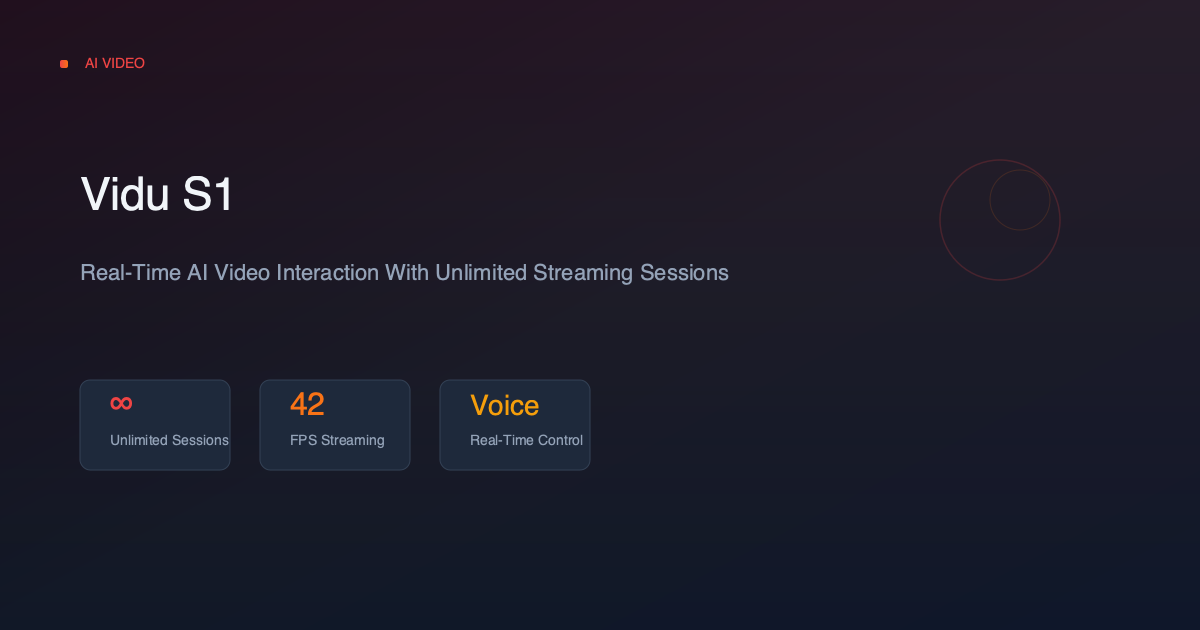
On July 3, 2026, ShengShu Technology did something no AI video company had done before — it turned a static photo into a talking, thinking, reacting digital character you can video-call in real time. The product, called Vidu S1, is not another text-to-video generator. It is a Stream Model: a live, voice-driven AI interaction system where the video renders frame by frame as you speak, and the character on the other end understands you, responds, and moves in sync.
The announcement detonated on X. Within days: 1.8K reposts, 5.5K likes, 339K video views, and 1.5M quote views. The pet-calling demo — a photorealistic animal looking back at its owner through the screen — racked up over 600K views alone. This was not incremental improvement. This was category creation.
What Is Vidu S1? Not Text-to-Video — a Real-Time Interactive Stream Model
The AI video industry has been stuck in a narrow lane: prompt → wait → download → watch. Every major player — Sora, Kling, Runway, Seedance — operates on this offline generation paradigm. Vidu S1 abandons it entirely and replaces it with a video calling system.
Here is how it works. You upload a photo. The system converts it into a digital character — photorealistic human, anime figure, pet, or original creature. You then choose a voice: either a system preset or a clone of your own voice, created from a short recording. Grant microphone and camera access, tap "start call," and you are in a live video conversation.
The character is not playing a pre-rendered loop. It generates frames continuously in response to real-time voice input. It lip-syncs to speech. It reacts with context-appropriate facial expressions and body language. It understands what you are saying — not just the words, but the tone and intent — and it responds naturally, with personality, in an ongoing dialogue that has no artificial endpoint.
ShengShu calls it a Stream Model, and that name is precise. Traditional video diffusion models generate a complete clip, top to bottom, before you see a single frame. Stream Models generate and display frames in a continuous stream, making interactive video calling technically feasible for the first time. According to technical breakdowns published by Chinese AI media Crossing (十字路口), the Vidu S1 diffusion inference pipeline has been compressed to approximately 4 steps, with optimizations extending from individual operators to model architecture to cluster-level serving infrastructure, enabling 540P at 25–42 FPS on consumer-grade GPUs. The bottleneck is no longer the model — it is compute, memory, and scheduling, all of which ShengShu has rearchitected to prioritize latency over throughput.
Key Technical Specifications
| Specification | Detail |
|---|---|
| Resolution | 540P real-time (no offline upscaling) |
| Base Frame Rate | 25 FPS |
| Maximum Frame Rate | Up to 42 FPS (hardware-dependent) |
| Session Duration | Unlimited — no generation cap, no timeout |
| Latency Target | Sub-second response for natural conversation flow |
| Character Types | Human (photo-based), anime, pet, original characters |
| Voice Options | System presets (high-quality real/signature voices) + voice cloning |
| Hardware Requirements | User-side: microphone + camera; inference-side: consumer-grade GPU |
| Supported Platforms | Web (vidu.com) + mobile (Vidu AI Pro app) |
| API Availability | Yes — documented on Vidu Platform developer portal |
The unlimited session length deserves emphasis because it is a claimed world first. Every other real-time AI avatar system on the market imposes hard session limits — 30 seconds, 2 minutes, 5 minutes — because sustained real-time generation compounds memory pressure, model drift, and hardware cost exponentially. Vidu S1 claims to have solved this through the full-stack optimization described above.
How to Create and Call a Vidu S1 Character
The creation process has been simplified to three steps, each of which takes under a minute once your assets are ready.
Step 1: Create Your Character
Open the Vidu website or the Vidu AI Pro mobile app, navigate to the Vidu S1 section, and upload a photo. The system accepts three character categories:
- Human: Upload a portrait or full-body photo. The system extracts facial features, builds a 3D-mapped character model, and applies animation-ready rigging for real-time expression control.
- Anime: Upload an anime-style illustration or character design. Vidu has deep training on anime art styles, and S1 inherits this — anime characters render with natural motion curves and stylized expressions that match the source art.
- Pet: Upload a photo of your cat, dog, or other companion animal. The model maps the animal's facial structure and generates species-appropriate expressions, head tilts, ear movements, and gaze tracking.
After uploading the image, you select a voice. System presets offer a library of high-quality real and signature voices across multiple languages. Voice cloning records a short sample of your own voice and maps the timbre, tone, and speech patterns onto the character — so your digital cat sounds like you, or your anime character speaks with your exact intonation.
Step 2: Grant Permissions and Select Your Character
Select the character from your library. Grant microphone access for voice input and camera access if you want the system to capture your facial expressions for secondary interaction cues. The system does not require a green screen, studio lighting, or dedicated hardware — it works with standard webcam and built-in microphone configurations.
Step 3: Start the Video Call
Tap start. You see the character on screen, animated and looking at the camera. You speak, and the character listens, processes, and responds. The experience is designed to feel like a FaceTime call, not like operating a piece of software.
The interaction model is voice-driven with optional secondary cues. You might tell your pet character to "look excited" or ask your anime companion a philosophical question. The character processes the input through a multimodal pipeline — speech recognition, natural language understanding, emotional state modeling, response generation, text-to-speech synthesis, and real-time facial animation — and returns a coherent, context-aware response that plays out as a live video feed.
Use Cases: Where Vidu S1 Changes the Game
The product page lists six core scenarios, but the implications go deeper than any single use case.
Virtual Companionship and Emotional Connection
The most viral Vidu S1 demo was not a technical showcase. It was a woman video-calling a photorealistic digital version of her pet — a pet who had passed away. The video shows the character looking at the screen, tilting its head, and appearing to listen as the person on the other end speaks. The tagline "If You Could Call Your Pet One More Time" captures the emotional core of the product. This is AI companionship that does not hide behind a chat box. It shows a face.
Beyond memorial use cases, broader companionship applications include: daily check-in companions for isolated elderly users, emotional support AI for people managing anxiety or depression, and always-available conversation partners that provide visual feedback — nodding, smiling, tilting their head in curiosity — to make digital interaction feel less transactional.
Live-Streaming and Content Creation
For streamers on platforms like Twitch, YouTube Live, and TikTok Live, Vidu S1 opens a new production layer. A streamer can create a digital co-host — an anime sidekick, a virtual pet, a brand mascot — that interacts with the streamer and the audience in real time without requiring a second human on camera. The low latency (sub-second) and continuous generation mean the AI character can react to donation alerts, chat messages, and spontaneous moments during a live broadcast.
Several KOLs in China and Japan have already posted S1-generated content on social platforms, using characters as co-hosts for product reviews, gaming commentary, and casual chat segments.
Gaming and Interactive Storytelling
Vidu S1 could function as an NPC (non-player character) that you literally talk to. Upload concept art of a merchant, a quest-giver, or a villain. Give it a personality through voice and behavior prompting. Then embed the character into a game engine or a visual novel interface. Players speak to the character directly through their microphone, and the character responds in real-time with animated dialogue — fully voiced, fully expressive.
This is a step toward what game designers have called "generative NPCs": characters that are not scripted but behave dynamically in response to player input. While full integration into game engines will take time, the API availability means developers can start prototyping immediately.
Language Learning and Education
Speaking practice with a real human tutor is the gold standard for language acquisition — and also the most expensive and logistically difficult component of learning. A Vidu S1 character configured as a native speaker of the target language, with a patient and encouraging personality, provides unlimited speaking practice at zero marginal cost per session. The character can correct pronunciation, adjust complexity based on the learner's level, and maintain conversation on any topic. Because sessions have no time limit, learners can practice for extended periods without fatigue from the AI side.
This use case also applies to public speaking training, interview preparation, and presentation rehearsal — any situation where practicing spoken interaction with a responsive visual audience adds value.
Virtual Receptionist and Customer-Facing Avatars
For businesses that already use text-based AI chatbots for customer service, Vidu S1 represents the visual upgrade. A branded character — a company mascot, a stylized representative, a friendly face — can greet customers on a website, answer questions, handle bookings, and escalate complex issues to human agents, all while maintaining eye contact and natural conversational rhythm.
The API makes this viable for integration into existing customer service platforms, e-commerce storefronts, and mobile apps. The key technical advantage over previous avatar solutions is the unlimited session length: a customer can spend 20 minutes discussing specifications, comparing products, and completing a transaction without hitting a generation cap.
Creative Storytelling and Character-Driven Media
Independent animators, comic artists, and video creators can build entire story worlds populated with Vidu S1 characters. An artist creates character art for each figure in their story, assigns distinct voices and personalities, then records interactive dialogues between them — or goes live and lets audiences drive the narrative by speaking to the characters directly. This blurs the line between passive content consumption and participatory storytelling.
Competitive Landscape: Vidu S1 Does Not Compete With Sora
It is important to clarify what Vidu S1 is and is not competing against. The comparison framework matters because confusing categories leads to misguided expectations and analysis.
Vidu S1 vs Traditional Text-to-Video Models
Vidu S1 does not compete with Sora (OpenAI), Kling (Kuaishou), Seedance (ByteDance), Runway Gen-4, or Pika. Those models are designed for cinematic generation: long inference times, high resolution (1080p+), and complex scene composition. They target filmmakers, advertisers, and social media creators who need polished, pre-rendered clips.
Vidu S1 targets an entirely different use case: live, interactive, real-time video calling with AI characters. Comparing S1 to Sora in terms of visual fidelity is a category error — like comparing a telephone to a cinema projector. They serve different purposes, run on different technical architectures, and answer different user needs.
That said, the Vidu platform does offer both categories. Vidu Q3 (the company's latest traditional generation model) produces up to 16-second clips with native audio, multilingual output (English, Japanese, Chinese), frame-accurate camera control, and multi-speaker support — at a claimed cost as low as "0.7 cents per second." Vidu Q3 competes directly with Sora, Kling, and Seedance. Vidu S1 plays in a different arena.
Vidu S1 vs Real-Time Avatar Competitors
The correct competitive set includes:
| Competitor | Core Offering | Key Difference from Vidu S1 |
|---|---|---|
| Character.AI Video | Chat-based AI characters with optional video avatar | Primarily text-driven; video is a secondary add-on, not the core interaction mode |
| HeyGen Interactive Avatars | Real-time digital human avatars for business communication | Enterprise-focused, higher resolution, but shorter session limits and no anime/pet support |
| Synthesia | AI video presenters from text scripts | Not real-time interactive; designed for pre-recorded corporate videos and training content |
| D-ID | Real-time conversational AI avatars | Strong in enterprise and education but limited session lengths and less expressive animation |
| Decart Lucy 2.5 | Real-time outfit/environment changing for live shopping | Narrow focus on e-commerce try-on; not a general-purpose character interaction system |
Vidu S1's structural advantages in this competitive set are: unlimited session length, character diversity across human/anime/pet categories, voice cloning with system preset alternatives, API access for third-party integration, and a consumer-grade hardware requirement that makes it accessible to individual users — not just enterprise clients.
The Technical Challenge: Why Real-Time Video Generation Is Hard
To appreciate what ShengShu achieved with Vidu S1, you need to understand the technical mountain they climbed. AI video generation as practiced by Sora, Kling, and Runway operates in "offline" or "batch" mode. A diffusion model processes noise through dozens or hundreds of iterative denoising steps, each step refining the image toward the target distribution. This is computationally expensive and inherently sequential — you cannot skip steps without degrading quality.
Real-time video interaction adds three compounding constraints:
-
Latency: If the character takes 3 seconds to respond to your voice, it feels unnatural. The system must keep end-to-end response time below approximately 1 second — from the moment you stop speaking to the moment the character starts its reply. This means speech recognition, language understanding, response generation, text-to-speech, and video generation all need to complete within a tight window, and video generation is by far the slowest step.
-
Sustained throughput: Traditional video generation produces one clip, then stops. A Vidu S1 session must keep generating indefinitely — potentially for hours — without memory leaks, model drift, or performance degradation. The longer the session, the more the system must manage accumulated context, rolling memory buffers, and thermal constraints on the inference hardware.
-
Visual consistency: Character appearance must remain stable across an entire session. AI video models are notoriously prone to subtle face drift — eyes changing shape, skin tone shifting, proportions warping over time. In a 10-second pre-rendered clip, this might be barely noticeable. In a 10-minute live conversation, drift would be disorienting and immersion-breaking.
According to the technical breakdown from Crossing (十字路口), Vidu S1 addresses these through a combination of architectural changes: diffusion steps compressed to approximately 4 (from the typical 50–100), custom operator implementations at the CUDA kernel level, model parallelism optimized for inference latency rather than training throughput, and a cluster scheduler that dynamically allocates GPU resources based on active session load. The result is 540P at 25 FPS base, scaling to 42 FPS when compute headroom allows — all on consumer-grade GPU hardware accessible through the Vidu cloud platform.
The "4-step diffusion" figure is particularly significant. In the diffusion model literature, reducing the number of inference steps while maintaining output quality is one of the hardest optimization problems. Each step removed is a 25% latency reduction at the same step cost — but removing too many steps causes mode collapse, blur, and artifacts. Getting to approximately 4 steps without breaking visual quality suggests ShengShu either developed a novel distillation technique, trained a specialized consistency model variant, or implemented a progressive-distillation pipeline that transfers knowledge from a large teacher model into a compact student model optimized for low-step inference.
Pricing and Monetization Model
ShengShu has not published standalone Vidu S1 pricing as of July 2026. The broader Vidu platform uses a credit-based system with subscription tiers processed through Stripe, including monthly and annual billing options.
The credit economics work as follows:
- Subscription credits: Included in plan, valid for 30 days
- Purchased credits: Buy on demand, valid for 2 years
- Bonus credits: Earned through events, competitions, and the Creator Partner Program, valid for 2 years
New users receive free trial credits upon registration. Daily login bonuses provide additional credits for consistent users. Vidu S1 likely draws from the same credit pool, though the per-minute credit cost for real-time generation has not been disclosed.
As a point of reference for the platform's pricing philosophy: Vidu Q3 (the traditional generation model) operates at a claimed cost as low as "0.7 cents per second" — roughly $0.42 per minute of generated video. If Vidu S1 is priced comparably, an hour of real-time character interaction would cost significantly more than a pre-rendered clip, simply because S1 generates frames continuously rather than once. The economic sustainability of unlimited sessions at consumer price points remains an open question.
The free trial invite codes (VIDUS1B, VIDUS1C) circulating on X suggest ShengShu is currently in user-acquisition mode, prioritizing adoption over immediate monetization. This is consistent with the viral marketing strategy — get users into the product, let them generate shareable content, and convert to paid tiers once the habit is established.
Creator Ecosystem and Community
ShengShu launched Vidu S1 with an accompanying Creator Contest that reveals the company's broader strategy. The contest offers prizes up to $400 cash plus 8,000 credits, with winners getting their characters featured as official Vidu S1 templates in the product. This is not just a marketing tactic — it is a template marketplace play.
By incentivizing high-quality character creation, ShengShu is building a library of ready-to-use characters that new users can jump into without creating their own. Someone who wants to try S1 but does not want to upload a photo or record a voice clone can select a pre-made character from the template library and start a call immediately. This reduces onboarding friction and increases the likelihood of first-session conversion to a paid user.
The Creator Partner Program (CPP), Discord community (discord.gg/3pDU8fmQ8Y), and official social channels (X: @ViduAI_official, YouTube, TikTok) form the engagement infrastructure. The Discord serves as a feedback loop for feature requests and bug reports, while the CPP provides a formal channel for professional creators to earn credits and exposure through official collaborations.
The Vidu Release Cadence: A Company on an Acceleration Curve
Vidu S1 did not appear from nowhere. ShengShu Technology has been iterating at a pace that rivals any company in the generative AI space. The release timeline tells the story:
| Release | Date | Key Capability |
|---|---|---|
| Vidu 1.5 | November 2024 | Multi-entity consistency, foundational video generation |
| Vidu 2.0 | January 2025 | 10-second generation, improved semantic understanding |
| Vidu Q1 | April 2025 | Cinematic quality, higher resolution, refined visual fidelity |
| Vidu Q2 | Mid 2025 | Reference-to-video with multi-reference consistency, up to 7 reference images |
| Vidu Q3 | Late 2025 / Early 2026 | Native audio-video generation, 16-second clips, multilingual output, frame-accurate camera control, multi-speaker support |
| Vidu Claw | Mid 2026 | One-click marketing video generation from product images, designed for e-commerce and advertising |
| Vidu S1 | July 2026 | Real-time interactive Stream Model, voice-driven character calling |
The trajectory is clear: each release either expanded the technical envelope (longer clips, audio integration, higher resolution) or expanded the product category (marketing automation, real-time interaction). Vidu S1 is the first release that does both simultaneously — it expands the technical envelope by solving real-time generation and expands the product category by creating an entirely new interaction paradigm.
With a claimed user base in the millions across 200+ countries, ShengShu has the distribution to turn technical breakthroughs into mainstream adoption. The question is not whether the technology works — the demos are convincing and the viral reception is strong. The question is whether real-time AI character calling becomes a daily habit or a novelty spike.
Industry Implications: What Vidu S1 Signals About Where AI Video Is Heading
Vidu S1 is not just a product launch. It signals three shifts in the AI landscape that will affect product strategy across the industry.
Shift 1: From Generation to Interaction
The first generation of AI video tools treated video as a file to be generated and consumed. The second generation — which Vidu S1 inaugurates — treats video as a medium to be inhabited and interacted with. This is the same transition that happened in computing: from batch processing (submit a program, wait for results) to interactive computing (type a command, see the response immediately). AI video is entering its interactive era, and the companies that win this era will be the ones that optimize for latency, not just quality.
Shift 2: From Prompt Engineering to Voice Conversation
Text prompts are a 2023–2025 paradigm. They work well for precise control (camera angles, lighting, composition) but create friction for casual and emotional use cases. Voice is a lower-friction interface for companionship, entertainment, and customer service — the very use cases where Vidu S1 excels. The product's tagline, "Voice-driven interaction — Connect via video and direct your character's actions in real time," explicitly centers voice as the primary control mechanism. As voice AI models improve (GPT-5.6's voice mode, Claude's extended voice capabilities), the combination of high-quality voice understanding and real-time visual generation will become a compounding advantage.
Shift 3: From Media Production Tool to Social Platform
Vidu S1's contest-driven, template-sharing, Discord-community model suggests ShengShu is building not just a tool but a social ecosystem around character creation and interaction. The recorded S1 conversations shared on X (the "Vidu S1 + Vidu Q3" combined videos, the pet conversations, the anime character dialogues) function as user-generated content that drives organic acquisition. If Vidu can build a network effect around character sharing, remixing, and collaborative storytelling, it moves from being a software provider to being a platform — and platforms command higher valuations and deeper moats than tools.
Shift 4: Hardware Democratization of Real-Time AI
The fact that Vidu S1 runs on consumer-grade GPUs rather than requiring enterprise data center hardware is strategically significant. It means individual developers, small studios, and independent creators can access real-time video AI without the capital expenditure that has historically made this technology exclusive to large enterprises. The API availability further extends this democratization — any developer can build S1-powered applications without managing inference infrastructure.
Risks, Limitations, and Open Questions
Every new AI product launch comes with uncertainties. For Vidu S1, the key open questions include:
Content moderation and safety: Real-time, voice-driven character generation is harder to moderate than text-based chatbots. A character that can say and do anything in response to user input, in a live video call, creates content safety challenges that go beyond what standard image/video safety classifiers can handle. Vidu has not publicly detailed its moderation approach for S1, and the product's viral growth may outpace the safety infrastructure.
Voice cloning ethics: The voice cloning feature, while powerful, raises consent and impersonation risks. Unlike text-to-speech with licensed voices, voice cloning creates a copy of a specific person's vocal identity. Vidu's terms of service and verification requirements (account verification is mentioned as a prerequisite for character creation) will need to be robust enough to prevent misuse.
Cost sustainability: Unlimited real-time generation is a compelling value proposition but an expensive one to deliver. Each minute of S1 usage consumes GPU compute continuously. If adoption exceeds capacity, ShengShu will face a choice between degrading quality (lower FPS, reduced resolution), imposing session limits (contradicting the "unlimited" claim), or raising prices. The platform's ability to scale inference infrastructure while maintaining quality will determine whether the unlimited session promise holds.
Competitive response: ByteDance's Seedance 2.5 (confirmed for early July 2026 launch with 4K, 30-second clips, and a 3D previsualization tool) shows that major competitors are not standing still. Decart's Lucy 2.5 already demonstrates real-time outfit and scene changing for live shopping. The window for Vidu S1 to establish a defensible position in real-time interactive AI video may be measured in months, not years.
Character consistency over long sessions: While Vidu S1 claims unlimited session length, the long-term visual stability of characters during extended conversations has not been independently tested at scale. Minor drift accumulated over hours could degrade the experience, and the fixes (periodic reset buttons, auto-realignment passes) would introduce their own UX friction.
How to Get Started With Vidu S1
For users who want to try Vidu S1 immediately, here is the concrete path:
- Visit vidu.com and click "Vidu S1" in the top-right navigation, or download the Vidu AI Pro app from your mobile app store.
- Use an invite code (VIDUS1C or VIDUS1B, both confirmed working as of mid-July 2026) for free trial access.
- Create your first character: upload a photo, select or clone a voice, and verify your account.
- Grant microphone and camera permissions, then tap to start your first video call.
- Record your interaction and optionally share it — the Creator Contest is running with $400 cash + 8,000 credit prizes for outstanding character creations.
For developers: API integration documentation is available through the Vidu Platform at platform.vidu.com, with detailed integration guides published on Feishu.
FAQ: Vidu S1
What is the Vidu S1 model?
Vidu S1 is a real-time interactive AI video model (Stream Model) developed by ShengShu Technology. Unlike traditional text-to-video generators that produce pre-rendered clips offline, Vidu S1 generates video frames continuously during a live voice conversation, enabling interactive video calling with AI characters created from photos.
How is Vidu S1 different from Sora, Kling, or Runway?
Vidu S1 operates in a completely different category. Sora, Kling, Runway, and Seedance are offline text-to-video generators — you type a prompt, wait for generation, and receive a completed clip. Vidu S1 is a real-time interactive system where video generates live as you speak, designed for conversation, not cinematic output. Comparing them is like comparing a video call app to a movie production tool.
What resolution and frame rate does Vidu S1 support?
540P resolution at 25 FPS base, with the ability to reach up to 42 FPS depending on hardware and session conditions.
Is there a time limit for Vidu S1 sessions?
No. Vidu claims Vidu S1 is the world's first video model supporting unlimited interactive sessions. There is no generation cap or forced timeout — you can stay in a call for as long as you want.
What types of characters can I create?
Three categories: human (from portrait photos), anime (from illustrations and character art), and pet (from animal photos). You can also mix styles within a character to create original, non-realistic figures.
Can I use my own voice for the character?
Yes. Vidu S1 supports voice cloning — record a short sample of your voice, and the system maps your timbre, tone, and speech patterns onto the digital character. Alternatively, you can choose from a library of system preset voices.
How much does Vidu S1 cost?
Standalone Vidu S1 pricing has not been publicly detailed. The Vidu platform uses a credit-based system with subscription tiers (monthly/annual via Stripe). New users receive free trial credits. Vidu S1 likely draws from the same credit pool, with per-minute costs tied to real-time compute usage. Use invite codes VIDUS1B or VIDUS1C for free trial access.
Is there an API for Vidu S1?
Yes. API integration documentation is available through the Vidu Platform developer portal. Developers can embed Vidu S1's real-time character interaction capabilities into third-party applications.
Who developed Vidu S1?
Vidu S1 was developed by ShengShu Technology (生数科技), a Chinese AI company that has been releasing Vidu-branded models since 2024. The company claims millions of users across 200+ countries and maintains an active Creator Partner Program and Discord community.
Does Vidu S1 work on mobile?
Yes. Vidu S1 is available on both the Vidu website and the Vidu AI Pro mobile app. The mobile app supports the full creation, voice cloning, and video calling workflow.
What languages does Vidu S1 support?
The system presets include voices and recognition for multiple languages. The underlying speech-to-speech pipeline supports multilingual input, and the character's responses are generated in the language the user speaks. Vidu Q3, the company's traditional generation model, explicitly supports English, Japanese, and Chinese output — and Vidu S1 inherits much of this multilingual infrastructure.
Vidu S1 represents more than a product launch. It is the first credible demonstration that real-time interactive AI video — the kind of thing that used to exist only in science fiction — can run on consumer-grade hardware, at usable quality, without artificial session limits, and with a user experience simple enough that it goes viral. Whether it becomes a lasting platform or a stepping stone to something larger, the category it created now exists, and the AI industry will spend the next several years filling it in.