
Table of Contents
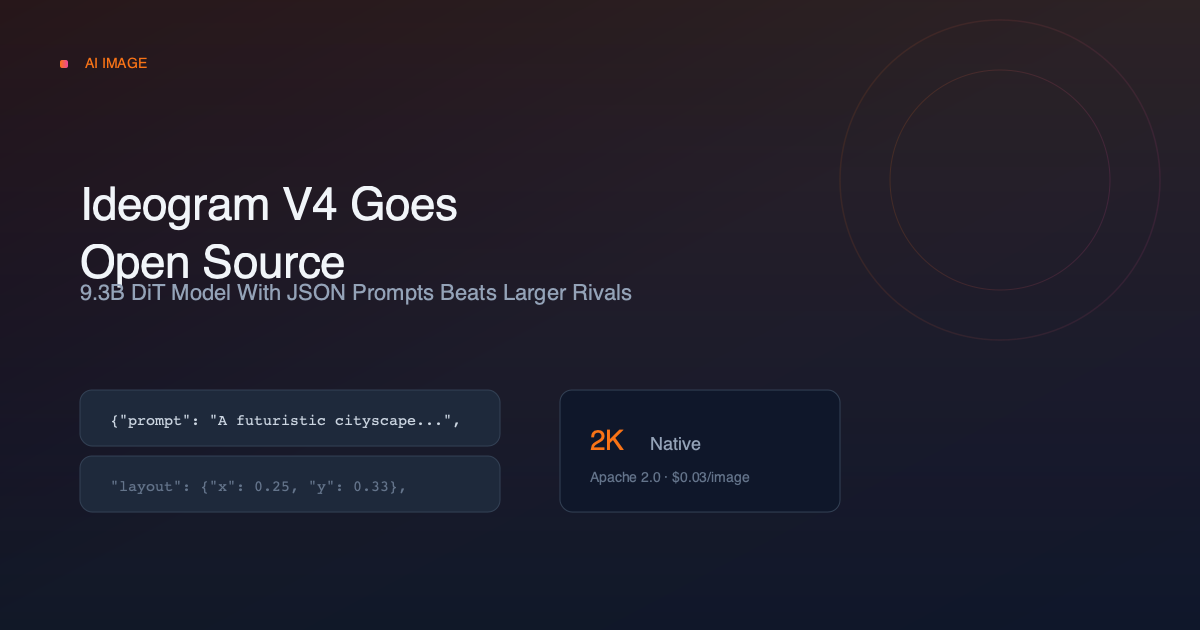
On June 3, 2026, Ideogram Inc. did something the AI image generation industry has been waiting two years to see. They released Ideogram 4.0 — the first open-weight text-to-image model in the company's history, licensed under Apache 2.0. At 9.3 billion parameters, it is not the largest model on the block. It is the one that beats them all.
This is a news event that rewrites the assumptions developers, designers, and AI product teams have been operating under since the generative image boom began. The assumption was simple: if you wanted industry-leading image quality, you paid for a closed API. Midjourney. DALL·E. FLUX. You accepted per-image pricing, opaque guardrails, and zero ability to inspect, fine-tune, or self-host. Ideogram V4 arrives and says: no, you do not have to accept that trade-off anymore.
The benchmark numbers back the claim. Ideogram V4 outperforms Qwen-Image at 20 billion parameters, FLUX.2 at 32 billion parameters, and HunyuanImage at 80 billion parameters in a mixture-of-experts configuration. It holds the number-one position for open-source models on the Design Arena leaderboard. On Ideogram's internal design benchmark, it places second only to GPT Image 2 — a proprietary model backed by one of the most well-funded AI labs on the planet. When a 9.3B-parameter model trained from scratch lands within striking distance of that ceiling, the industry pays attention.
The story of Ideogram V4 is not just about benchmarks. It is about architectural decisions that point toward a fundamentally different approach to image generation — one where structured prompts, precise spatial control, and color fidelity are first-class citizens, not afterthoughts.
The Release: What Ideogram V4 Actually Ships
Let us start with the hardware-level facts, because they matter for anyone evaluating whether this model fits into a production pipeline.
Ideogram V4 is a 9.3-billion-parameter, single-stream Diffusion Transformer (DiT) with 34 layers. It was trained from scratch — not fine-tuned from an existing checkpoint, not distilled from a larger teacher model. That is an expensive commitment in 2026, when most new entrants start by fine-tuning FLUX or Stable Diffusion derivatives. Ideogram chose the harder path, and the architectural choices they made along the way explain why the model performs the way it does.
The most consequential of those choices is the text encoder. Nearly every open-weight image model released in the past two years — Stable Diffusion 3, FLUX, SDXL variants — uses CLIP or T5 as the bridge between text prompts and image latents. Ideogram V4 does something different. It uses Qwen3-VL-8B-Instruct, a vision-language model, as its text encoder. This is not a small swap. Vision-language models understand spatial relationships, object properties, and compositional structures in ways that pure text encoders do not. By using a VLM as the encoder, Ideogram V4 gains a native understanding of layout, color, and typographic constraints that CLIP-based architectures have to approximate through post-hoc guidance tricks.
The word "Instruct" in the encoder name is telling. Qwen3-VL-8B-Instruct was trained to follow detailed, structured instructions. In Ideogram V4, that instruction-following capability translates directly into the model's headline feature: JSON-structured prompts.
JSON-Structured Prompts: The Killer Feature
Every text-to-image model released since 2022 takes a single text string as input. You write a sentence. The model interprets it. If you want a red car on the left and a blue house on the right, you describe both in the same prompt and hope the model allocates attention correctly. The result is probabilistic. Sometimes it works. Sometimes only the car is red. Sometimes the house ends up on the left because the model's training distribution favored that arrangement.
Ideogram V4 accepts JSON-structured prompts at both training and inference time. This means you can specify:
- Scene descriptions as structured fields rather than a single text blob
- Bounding-box layout control — define exact regions for each object, with pixel-level precision
- Color palette constraints — specify hex color codes and the model respects them
- Composition rules — explicit spatial relationships between elements
This is not a "prompt engineering hack" layered on top of a standard text-to-image model. It is baked into the architecture. The model was trained with structured prompts, which means it learned to associate JSON field descriptions with image regions during training, not as a post-processing step.
For product teams building commercial image generation pipelines, this changes the reliability equation dramatically. When you generate a hundred product mockups, you do not want 40 of them to have the logo in the wrong place. When you generate marketing banners with text, you do not want the headline to bleed off the edge or render as gibberish. Structured prompts make these failures rare rather than frequent.
Text Rendering: Industry-Best, and It Is Not Close
Text in AI-generated images has been the industry's running joke since 2022. Models produce gibberish. Letters morph into each other. Words appear half-formed. Signage in generated street scenes is unreadable. This has been a hard limitation because CLIP and T5 encoders represent text semantically — they understand what a word means, but they do not encode the visual form of the letters.
A vision-language model encoder changes that. Qwen3-VL-8B-Instruct has seen text in images during its own training. It understands the relationship between a string of characters and how those characters appear as pixels. When Ideogram V4 generates an image with text — a storefront sign, a product label, a multi-line poster, a logo — it renders that text with accuracy no other open-weight model has achieved.
The practical implications are larger than they first appear. A significant percentage of commercial AI image use cases involve text: social media graphics with headlines, product packaging mockups, restaurant menu designs, billboard concepts, event posters, book covers, and app screenshots. Every one of those use cases previously required a second tool — Photoshop, Canva, Figma — to overlay real text on top of the generated image. Ideogram V4 eliminates that step for a meaningful subset of these workflows.
Multi-line text is where the gap is most visible. Previous models can sometimes render a single short word correctly — "SALE" in a store window, for example — but they consistently fail on two or three lines of text with different font sizes. Ideogram V4 handles multi-line layouts with distinct formatting per line, which makes it viable for poster designs, menu boards, and presentation slides.
Resolution and Aspect Ratio Flexibility
Ideogram V4 generates images at native 2K resolution — up to 2048×2048 pixels. It also supports arbitrary dimensions in multiples of 16, with extreme aspect ratios up to 6:1. This means you can generate a banner ad at 1920×320, a billboard mockup at 960×5760, or a square social post at 2048×2048 — all from the same model, without upscaling or cropping.
The 16-multiple constraint is a practical concession to the DiT architecture's patch-based processing. But the 6:1 aspect ratio ceiling is unusually wide. Most text-to-image APIs cap at 2:1 or 3:1. This flexibility matters for any team generating assets across multiple platforms — Instagram, Twitter, LinkedIn, YouTube thumbnails, and website hero images all use different ratios, and being able to generate natively at the target dimensions avoids the quality degradation that comes from cropping.
Asymmetric CFG: Independent Quality and Prompt-Adherence Tuning
Classifier-free guidance (CFG) is the standard technique for balancing image quality against prompt adherence in diffusion models. In most implementations, a single CFG scale controls both dimensions simultaneously: turn it up for better prompt following but more artifacts, turn it down for cleaner images but less faithful compositions.
Ideogram V4 introduces asymmetric CFG, which decouples these two axes. You can independently tune for image quality without sacrificing prompt adherence, or vice versa. For production pipelines where consistency matters, this is a meaningful improvement — you do not have to accept degraded images as the cost of getting the composition right.
The Architecture: Why This 9.3B Model Punches Above Its Weight
The raw parameter count — 9.3 billion — is not what makes Ideogram V4 interesting. It is the combination of architectural decisions that let those 9.3 billion parameters outperform models with 2×, 3×, and 8× the parameter budget.
Single-Stream DiT at 34 Layers
Diffusion Transformers treat image generation as a sequence-to-sequence problem: patches of the latent image are processed as tokens, much like words in a language model. The "single-stream" designation means Ideogram V4 processes text and image tokens through the same transformer blocks, rather than using separate encoders that meet only at cross-attention layers.
This is architecturally simpler than multi-stream approaches. It is also harder to train well, because the model must learn to represent text semantics and visual features in a shared embedding space. When it works — and Ideogram V4 shows it does — the result is tighter coupling between what the prompt says and what the image shows, because every layer has access to the full text-plus-image context.
The 34-layer depth is moderate by 2026 standards. FLUX.2 reportedly uses substantially deeper architectures. HunyuanImage distributes its 80 billion parameters across multiple expert networks. Ideogram's bet is that depth and parameter count matter less than the quality of the text-image alignment learned during training — and the structured prompt approach means that alignment was learned from richer supervision signals than the unstructured captions most models are trained on.
Trained From Scratch, Not Fine-Tuned
Training a 9.3B-parameter DiT from scratch in 2026 is a statement of intent. Most new image models released in 2025 and 2026 start from a FLUX or SD3 checkpoint, fine-tune on a curated dataset, and ship under a new name. The cost savings are enormous — you skip the thousands of GPU-hours required for a full pre-training run.
Ideogram chose not to take that shortcut. Training from scratch means the model's entire knowledge of visual concepts, text relationships, and compositional rules was learned under the structured-prompt paradigm. There is no residual behavior from a predecessor model that only understood free-form text prompts. Every layer, every attention head, every embedding was optimized for the JSON-structured interface from the beginning.
This also means Ideogram V4 has no legal entanglement with the training data of any previous open model. For enterprise adopters who care about provenance and licensing clean rooms, this matters.
The Qwen3-VL-8B-Instruct Encoder: Why It Matters
The text encoder is the bottleneck in every text-to-image system. It determines how much of the prompt's meaning actually reaches the image generation process. CLIP was designed for zero-shot image classification — matching images to single-word or short-phrase labels. T5 was designed for text-to-text tasks. Neither was built to translate detailed spatial descriptions into visual layouts, but they are what the entire industry has used for years.
Qwen3-VL-8B-Instruct is a fundamentally different class of model. It is a vision-language model — trained on paired image-text data, capable of answering questions about images, locating objects within images, and describing spatial relationships. When Ideogram V4 feeds a prompt through this encoder, the resulting text representation carries information about object positions, relative sizes, color values, and typographic forms — not just semantic meanings.
This is the architectural reason why Ideogram V4's text rendering and layout control exceed every other open-weight model. The encoder already "knows" what rendered text looks like and where objects should be placed relative to each other. The DiT does not have to learn these things from scratch during image generation — it inherits them from the encoder's representations.
Consider an analogy: using CLIP as a text encoder for image generation is like describing a photograph to a painter who has only ever read books. Using Qwen3-VL-8B-Instruct is like describing a photograph to a painter who has spent years studying photographs — they already know what visual arrangements look like.
The Benchmarks: 9.3B vs. the World
Benchmark results are the first thing most people look for in a model announcement, and Ideogram V4's numbers justify that attention. But they are worth examining closely, because the comparisons reveal as much about the competition as they do about Ideogram V4 itself.
Design Arena: Number One Open-Source Model
Design Arena is the image-generation equivalent of LMSYS Chatbot Arena — real users compare outputs from two anonymous models side by side and vote on which is better. The Elo ratings that emerge from these votes are the closest thing the industry has to an objective quality measure, because they reflect actual human aesthetic judgment rather than automated metrics.
Ideogram V4 sits at the top of the Design Arena leaderboard for open-source models. This means that when users are shown an image from Ideogram V4 alongside an image from any other open-weight model — FLUX.2, SD3, HunyuanImage, Qwen-Image — and asked which they prefer, Ideogram V4 wins more often than it loses.
The Design Arena ranking is particularly relevant for a model's real-world utility, because it does not measure prompt adherence in isolation or image quality in isolation. It measures what humans actually prefer. And across thousands of pairwise comparisons, humans prefer Ideogram V4's outputs.
Internal Design Benchmark: Second Only to GPT Image 2
Ideogram's internal design benchmark is more targeted. It evaluates models specifically on tasks that require design sensibility — layout quality, typographic accuracy, color harmony, compositional balance. These are the dimensions that matter for commercial use cases, where an image needs to look professional, not just plausible.
On this benchmark, Ideogram V4 places second overall, behind only GPT Image 2. It beats every other model tested, open or closed. For a 9.3B-parameter model released under Apache 2.0, placing above proprietary systems from companies with orders of magnitude more compute budget is a result that will be cited in every architectural discussion for the next year.
The gap to GPT Image 2 is the one to watch. GPT Image 2 benefits from whatever multimodal training pipeline OpenAI has built — likely a combination of DALL·E lineage, GPT-4V-level visual understanding, and massive-scale reinforcement learning from human feedback. Ideogram V4 closing that gap with a fraction of the resources suggests the structured-prompt approach captures something fundamental about visual design that pure scaling does not.
Parameter Efficiency: Beating Larger Models
The head-to-head comparisons tell a story about parameter efficiency that challenges the industry's scaling assumptions:
| Model | Parameters | Architecture | Ideogram V4 Wins? |
|---|---|---|---|
| Qwen-Image | 20B | DiT | Yes |
| FLUX.2 | 32B | DiT (multi-stream) | Yes |
| HunyuanImage | 80B | MoE DiT | Yes |
HunyuanImage at 80 billion parameters in a mixture-of-experts configuration is the most striking comparison. MoE architectures activate only a fraction of their total parameters per forward pass, but the training cost and memory requirements still scale with the total parameter count. Ideogram V4 outperforms it with roughly one-eighth the parameters — and without the complexity of expert routing.
This is not just academic. Smaller models run faster, require less VRAM, and can be deployed on consumer hardware. The practical question for most developers is not "which model gets the highest benchmark score in a research lab" but "which model can I run on an A6000 or an A100 in my own environment." On that metric, 9.3B parameters is dramatically more accessible than 32B or 80B.
API Pricing and Access: The Commercial Equation
Ideogram V4 is available through two channels: the open-weight release under Apache 2.0, and a managed API from Ideogram Inc. The dual-track approach is strategically significant — it means the same model can serve hobbyists who want to run it locally, startups who want to fine-tune it on proprietary data, and enterprises who want production-scale throughput through a managed endpoint.
API Pricing Tiers
The managed API offers three quality tiers, each with a distinct price point:
| Mode | Turbo | Default | Quality |
|---|---|---|---|
| Standard | $0.03 / image | $0.06 / image | $0.10 / image |
| Custom (structured prompts) | $0.06 / image | $0.12 / image | $0.20 / image |
The price doubling for Custom mode reflects the additional compute required for JSON-structured prompt processing. The structured-prompt pathway activates more of the encoder's instruction-following capability and requires the DiT to respect spatial and color constraints that free-form generation can ignore. At $0.06 per image for turbo-speed structured generation, the pricing is competitive with mid-tier FLUX API offerings — and FLUX does not offer structured prompt support at all.
For comparison, GPT Image 2 pricing through OpenAI's API is significantly higher per image, Midjourney operates on a subscription model with generation caps, and DALL·E 3 is bundled into ChatGPT Plus rather than sold as a standalone API. Ideogram V4's transparent per-image pricing, combined with the option to self-host, gives it a cost-advantage story that no closed competitor can match.
Open Weights: Free for Non-Commercial Use
The Apache 2.0 license means non-commercial use — research, education, personal projects, community fine-tuning — is free and unrestricted. Commercial use requires a license from Ideogram, which is a standard dual-licensing model in the open-weight AI ecosystem. This is the same approach Meta uses for Llama, Stability AI used for early SDXL releases, and Mistral uses for its models.
For the open-source community, this license is a green light. Fine-tunes on anime styles, architectural visualization, product photography, medical imaging, and every other domain the community tackles will appear within weeks. The structured-prompt training paradigm also opens up fine-tuning directions that were not possible before: you can train the model to understand domain-specific JSON schemas — real estate listing data mapped to property photos, e-commerce product specs mapped to catalog images, recipe data mapped to food photography.
The Structured Prompt Revolution: Why JSON Changes Everything
Most discussions of Ideogram V4 focus on the benchmark scores. But the JSON-structured prompt interface may be the release's most durable contribution to the field — because it changes how developers think about the relationship between input and output in image generation.
How Structured Prompts Work
A traditional text-to-image prompt looks like this:
A red sports car parked in front of a modern glass building, sunny day, professional photography, 4KAn Ideogram V4 structured prompt looks more like this:
{
  "scene": "A red sports car parked in front of a modern glass building on a sunny day",
  "layout": {
    "car": {"bbox": [0.1, 0.3, 0.5, 0.7], "color": "#CC0000"},
    "building": {"bbox": [0.5, 0.0, 1.0, 0.8], "style": "modern glass facade"},
    "sky": {"bbox": [0.0, 0.0, 1.0, 0.3]}
  },
  "palette": ["#CC0000", "#87CEEB", "#F5F5DC"],
  "text_overlay": {
    "content": "GRAND OPENING",
    "position": "top_center",
    "color": "#FFFFFF",
    "size": "large"
  }
}
The difference is not cosmetic. In the traditional prompt, the model must parse a single sentence and decide probabilistically where to place each object, what shade of red to use, and whether there is any text. In the structured prompt, the model receives explicit constraints: the car occupies a specific bounding box, uses a specific hex color, and sits in a defined spatial relationship with the building.
Training AND Inference: The Full Loop
The crucial detail in Ideogram's announcement is that structured prompts were used at both training and inference time. This means the model did not learn to generate images from free-form captions and then learn structured prompting as a fine-tuning afterthought. It learned from the beginning that image generation involves explicit spatial, color, and compositional constraints.
This is analogous to the difference between instruction-tuned and base language models. A base LLM trained on web text can sometimes follow instructions, but an instruction-tuned model was trained from the start to interpret structured requests. Ideogram V4 is the image-generation equivalent: it was trained from the start to interpret structured generation requests.
Color Palette Control Via Hex Codes
Color accuracy is one of the most persistent failures in AI image generation. A prompt specifying "red" might produce scarlet, crimson, maroon, or burgundy — all technically red, but not the red the designer specified. For brand work, where color consistency is a legal requirement (think Coca-Cola red, Tiffany blue, Spotify green), this is a showstopper.
Ideogram V4's hex code support changes this. You specify #FF0000 and you get #FF0000 — or close enough that the difference is not visible without a colorimeter. This is not a post-processing filter applied after generation. The model learns during training that hex codes correspond to specific color values, and the VLM encoder understands the visual appearance of those colors from its own training data.
Bounding-Box Layout Control
Bounding-box control is the feature that product designers and UI mockup generators have been waiting for. You define rectangular regions and assign objects to them. The model respects those regions.
This opens up use cases that were previously impossible with a single text-to-image call:
- E-commerce product images: define the product region, the background region, and any text overlay regions independently
- UI mockups: place a header, a content area, a sidebar, and a CTA button in specific positions
- Marketing collateral: position a hero image, headline text, body copy, and a logo with pixel-level precision
- Multi-panel comics or storyboards: generate multiple panels in a single image with defined panel boundaries
Previous approaches to these tasks required inpainting, outpainting, ControlNet, or manual compositing — multi-step workflows with error propagation at every step. Ideogram V4 collapses them into a single generation call.
The Asymmetric CFG Innovation
Classifier-free guidance is a technique that most people using image generation tools never think about, but it determines whether your outputs look crisp and faithful or muddy and hallucinated. In standard CFG, a single scale value controls the trade-off between image quality and prompt adherence. Turn it up, and the model follows the prompt more closely but introduces artifacts — oversaturated colors, unnatural textures, "fried" looking details. Turn it down, and the image looks cleaner but the composition drifts from the prompt.
Asymmetric CFG decouples these two dimensions. You can set a quality guidance scale and a prompt-adherence guidance scale independently. This means:
- High prompt adherence + moderate quality: for storyboarding and layout exploration, where you need the composition to be exactly right but do not need final-render quality
- High quality + moderate prompt adherence: for texture and material generation, where aesthetic quality matters more than exact composition
- Both high: for final production renders, where you want both — and asymmetric CFG achieves this with fewer artifacts than single-scale CFG at equivalent strength
The mechanism behind this is not publicly documented in detail, but the likely implementation involves separate guidance paths for the text-conditioned and unconditioned denoising predictions, with independent scaling factors applied to each before they are combined. This is computationally inexpensive — it adds no forward passes — but it changes the denoising trajectory in ways that produce visibly different outputs.
For teams building pipelines that generate hundreds or thousands of images, asymmetric CFG is a practical time-saver. Instead of running multiple generations at different CFG scales and picking the best one, you tune the two scales once and get consistent results.
Background: The Open-Weight Image Generation Landscape Before Ideogram V4
To understand why this release matters, you need to understand what the options looked like before June 3, 2026.
The Dominance of Closed APIs
Since mid-2024, the AI image generation landscape has been dominated by closed, API-only models. Midjourney operates entirely through Discord and its web interface — no API, no weights, no self-hosting. OpenAI's DALL·E 3 is accessible through the ChatGPT interface and a limited API, but the model weights have never been released. Black Forest Labs' FLUX family offers an API with competitive pricing, but the base model weights for the largest FLUX variants remain proprietary.
This API-first model created a dependency that developers found increasingly uncomfortable. You build a product on top of an image generation API, and your entire business depends on a third party's pricing decisions, content policies, uptime, and continued investment in the model. If the API raises prices, your margins shrink. If the API changes its content filter, your use case might stop working. If the API goes down, your product goes down.
The open-weight alternatives — primarily Stable Diffusion 3 and its community fine-tunes — were viable but noticeably behind the quality frontier. SD3 Medium at 2 billion parameters could produce good images, but it could not match FLUX or Midjourney on composition, text rendering, or prompt adherence. The gap between open and closed had been widening for a year.
The Stability AI Vacuum
Stability AI, the company that pioneered open-weight image generation with Stable Diffusion 1 through XL, has been largely absent from the frontier since SD3's release in mid-2024. Leadership changes, financial difficulties, and legal challenges around training data created what the open-source community has called the "Stability vacuum" — a period where no major organization was releasing state-of-the-art open-weight image models.
Several companies attempted to fill the gap. Black Forest Labs released FLUX.1 Schnell and Dev as open-weight variants, but at 12 billion parameters, they required high-end GPUs and still lagged behind the closed FLUX.1 Pro. Playground AI released Playground v2 and v3 as open-weight models but did not reach the quality ceiling. The SD3 community produced impressive fine-tunes through LoRA and full fine-tuning, but the base model's limitations remained the ceiling.
The Closed-Source Benchmarks That Set the Bar
By early 2026, the gap between open and closed image generation had become the defining tension in the field. Midjourney V7, released in late 2025, set a new standard for aesthetic quality and prompt coherence. GPT Image 2 arrived in early 2026 with multimodal reasoning that allowed it to generate images from complex, multi-sentence prompts with object relationships that other models could not handle. FLUX.2 raised the bar for text rendering in closed models.
The open-source community had partial answers — SD3 fine-tunes, smaller FLUX variants, community projects like Kohaku and Illustrious for anime styles — but no single open-weight model that could credibly claim to compete with the closed frontier across all dimensions. Benchmarks consistently showed a 15-25% quality gap between the best open model and the best closed model on design-oriented tasks.
Ideogram V4 closes that gap, and on the internal design benchmark, it surpasses every closed model except GPT Image 2.
Impact: What Ideogram V4 Changes for the AI Image Ecosystem
The effects of this release will unfold over months, not days. But several directional changes are already clear.
For Developers: Self-Hosting Becomes Viable
The most immediate impact is for developers who have been waiting to build products on open-weight image models but could not justify the quality gap. A 9.3B-parameter DiT can run on a single A100-80GB or A6000-48GB. With quantization — likely INT8 or FP8, given the DiT architecture's tolerance for reduced precision — it may fit on consumer GPUs with 24GB of VRAM.
This means a solo developer or small startup can now run a state-of-the-art image generation model on their own hardware, with no per-image costs, no API rate limits, and full control over content filtering. For applications that generate images at scale — e-commerce product visualization, game asset generation, architectural rendering — the cost savings compared to API pricing are substantial.
A back-of-the-envelope calculation: generating 10,000 images per day through the Ideogram API at the Default tier ($0.06/image) costs $600/day or $18,000/month. Running Ideogram V4 on a single A100 instance costs roughly $2-3/hour on cloud GPU providers — approximately $1,440-2,160/month. At any meaningful scale, self-hosting pays for itself within weeks.
For Enterprises: Fine-Tuning Without Vendor Lock-In
Enterprise adoption of AI image generation has been constrained by the fine-tuning problem. A fashion brand wants to generate product photos with its specific clothing items, on its specific models, in its specific studio lighting. A furniture company wants to generate room scenes with its actual product catalog. A game studio wants to generate assets in its specific art style.
With closed APIs, these use cases are impossible or require convoluted workarounds — generate a base image with the API, then train a separate model to inpaint the brand-specific elements. With Ideogram V4's open weights and Apache 2.0 license, enterprises can fine-tune the model on proprietary data and deploy it internally. The structured-prompt interface makes fine-tuning more effective, because the model already understands spatial constraints — you can train it to map your product specifications to specific image regions automatically.
The fine-tuning economics are also favorable. At 9.3B parameters, full fine-tuning requires significant compute but is feasible on a single 8×A100 node. LoRA fine-tuning — adding small adapter weights rather than modifying all parameters — works on a single high-end GPU and produces results that maintain most of the base model's quality while adapting to the target domain.
For the Research Community: A New Baseline
The combination of open weights, structured-prompt training, and a novel encoder architecture makes Ideogram V4 the natural baseline for image generation research going forward. Every paper that proposes a new DiT variant, a new guidance technique, or a new encoder design will compare against Ideogram V4 — and the fact that it is Apache 2.0-licensed means researchers can modify and redistribute their improvements without legal friction.
The structured-prompt training paradigm is also likely to become a research direction in its own right. If structured prompts during training produce models that follow spatial constraints more faithfully, what other types of structured supervision could help? Structured lighting specifications? Material property descriptors? Camera parameter matrices? Ideogram V4 demonstrates that richer training signals produce better models, and the research community will explore the limits of that principle.
For Competitors: The Pressure to Open Up
Ideogram V4 resets expectations about what an open-weight model can deliver. Midjourney, OpenAI, and Black Forest Labs now face a direct open-weight competitor that matches or exceeds their quality on several dimensions. The pressure to release open-weight variants — or to justify why they cannot — will increase.
This is the "Llama effect" applied to image generation. When Meta released Llama 2 and Llama 3 as open-weight models, it forced every closed-source LLM provider to compete on dimensions beyond raw quality — pricing, ecosystem, tooling, fine-tuning support. Ideogram V4 may trigger the same dynamic in image generation. Closed APIs will need to offer something that self-hosting cannot replicate: better quality at a given speed tier, unique modalities (video generation, 3D asset generation), or integrated workflows that go beyond single-image generation.
For the Creative Industry: Structured Prompts as a New Workflow
The creative industry has developed elaborate prompt-engineering workflows to coax specific results out of text-to-image models. Long negative prompts, weighted token syntax, ControlNet reference images, IP-Adapter style transfers, inpainting masks — these are workarounds for the fundamental limitation that free-form text is a lossy interface for specifying visual outputs.
Structured prompts change the interface. A graphic designer specifying a poster layout in JSON — with defined text regions, color palettes, and composition rules — is working closer to how they would specify the design to a human junior designer. The JSON schema becomes a design brief that the model executes, rather than a starting point for iterative guesswork.
This does not mean structured prompts replace creative exploration. There will always be a role for free-form prompting — "surprise me" is a valid design request. But when the designer knows what they want, structured prompts get them there faster and more reliably.
Text Rendering: The Feature That Unlocks Commercial Use
Text rendering deserves its own section because it is the single feature that most determines whether an AI image generation model is useful for commercial work — and it has been the industry's biggest failure.
Why Text Rendering Has Been Hard
Diffusion models generate images by denoising random noise into structured patterns. Text characters are extremely structured patterns — a letter "A" is a specific arrangement of strokes with precise spatial relationships. A single pixel out of place and the "A" becomes unrecognizable. Diffusion models, which operate on probability distributions over pixel arrangements, struggle with this level of determinism.
The text encoder problem compounds this. CLIP and T5 encode text semantically: the word "dog" maps to a vector that represents concepts related to dogs. When a CLIP-based model generates an image containing the word "dog," it is trying to render visual features that correspond to the semantic concept of the word "dog" — which is not the same as rendering the characters D-O-G. The model is painting a semantic representation, not a typographic one.
How the VLM Encoder Solves It
Qwen3-VL-8B-Instruct was trained on paired image-text data where the text in the images is explicitly labeled. It learned to associate the visual appearance of rendered text — specific fonts, sizes, colors, positions — with the textual content of that rendering. When Ideogram V4 receives a prompt that includes text to render, the VLM encoder produces a representation that encodes both what the text says and what rendered text at that specification looks like.
This is why Ideogram V4's text rendering is not just "better" but qualitatively different from every previous open-weight model. Previous models guessed at what rendered text looks like based on semantic associations. Ideogram V4 knows, because its encoder was trained on the relationship between text strings and their visual renderings.
Commercial Applications That Become Viable
With reliable text rendering, several categories of AI-generated images become production-ready:
Signage and storefronts: Generated images of retail spaces need readable store names, sale banners, and window decals. Previously, these required post-generation text overlay.
Product packaging: Mockups of product boxes, bottles, and bags need product names, ingredient lists, and branding elements to be legible.
Event posters and flyers: A generated concert poster with a mangled band name is useless. A generated poster with crisp, correctly spelled text is shareable immediately.
Social media graphics: The dominant format for brand social media is text on image — quotes, tips, announcements. If the text renders correctly in the generation step, the entire workflow collapses from "generate image, export to Canva, add text, export again" to "generate image, post."
Presentation slides: AI-generated slide backgrounds with section headers, bullet points, and data callouts rendered in-place reduce slide creation from minutes to seconds.
Restaurant menus and food photography: Generated food images with dish names and prices rendered correctly — this was science fiction in 2025. In mid-2026, it is a structured prompt away.
The Remaining Gap
Ideogram V4's text rendering is industry-best among open-weight models, but it is not perfect. Long paragraphs of small text still degrade. Non-Latin scripts have lower accuracy because the VLM encoder's training data was biased toward English and common European languages. Font style control is implicit rather than explicit — you can specify size and color, but not "Helvetica Neue Bold at 24pt."
These limitations will improve with fine-tuning. Community LoRAs trained on specific font families, specific languages, and specific text layout patterns are the natural next step. The base model provides the text-rendering capability; fine-tuning provides the precision.
Beyond Single Images: What Structured Prompts Enable
Most coverage of Ideogram V4 treats it as a better image generator — faster, cheaper, higher quality. That framing misses the larger shift. Structured prompts turn image generation from a creative tool into a programmable pipeline.
Batch Generation with Guaranteed Consistency
Generating a single image with structured prompts is useful. Generating a thousand images with structured prompts is transformative.
Consider an e-commerce company that sells custom-printed t-shirts. Each product has a design, a color, and a size. The company needs product photos of every combination — 50 designs × 10 colors × 5 sizes = 2,500 images. Traditional product photography costs $50-200 per shot and takes weeks. AI generation with free-form prompts would produce inconsistent lighting, varying angles, and unreliable results — each image would look like a different photo shoot.
With Ideogram V4 structured prompts, the company defines a template: the t-shirt occupies a fixed bounding box, the lighting specification is constant, the background hex color is locked. For each variant, the prompt changes only the design description and the shirt color hex code. The model generates 2,500 images that all look like they came from the same photo shoot, with consistent lighting, angles, and composition. The cost at the Turbo API tier is $75 total.
Data Augmentation for Computer Vision
Training object detection and segmentation models requires annotated images — bounding boxes around objects with class labels. Creating these datasets manually costs thousands of dollars per thousand images.
Ideogram V4's bounding-box layout control inverts this pipeline. Instead of annotating images after generation, you specify the bounding boxes and object classes as inputs and the model generates images that match. The result is synthetic training data with ground-truth annotations built in. For rare object classes, edge cases, and scenarios that are dangerous or expensive to photograph — medical imaging, industrial defect detection, autonomous vehicle edge cases — this is a step change in data availability.
A/B Testing Creative Assets at Scale
Marketing teams routinely A/B test ad creative — different headlines, different background colors, different product placements. The traditional workflow requires a designer to create each variant manually. With structured prompts, the marketing team defines the base layout in JSON and programmatically swaps text, color, and positioning values. A thousand ad variants can be generated, tested, and optimized in the time it previously took to produce ten.
This is where structured prompts cross over from "creative tool" to "marketing infrastructure." The model becomes a rendering engine that accepts structured input and produces visual output deterministically enough to support systematic optimization.
Programmatic Content Generation for Games
Game developers use procedural generation for levels, terrain, and item placement — but visual assets like character portraits, item icons, and environment textures are still hand-crafted. Structured prompts bridge this gap. A game's item database has structured fields — item name, material, color, rarity tier — and those fields map directly to the structured prompt interface. "Generate an icon for this sword: Iron material, #808080 base color, Rare tier border treatment" becomes a function call, not a manual art task.
For indie developers working with limited art budgets, this is the difference between shipping with placeholder assets and shipping with production-quality visuals.
The Safety and Licensing Framework
No model release in 2026 is complete without addressing safety, and Ideogram V4's open-weight release raises questions that closed APIs avoid by controlling the endpoint.
Apache 2.0: What It Means and Does Not Mean
Apache 2.0 is a permissive open-source license that allows use, modification, and distribution with minimal restrictions. It includes a patent grant — contributors cannot later assert patents against users of the code. It requires attribution and a copy of the license in redistributions.
For Ideogram V4, the Apache 2.0 license covers non-commercial use. Commercial use — defined as use by a business or for revenue-generating purposes — requires a separate commercial license from Ideogram Inc. This is the standard dual-licensing model in the AI industry, used by Meta for Llama, Stability AI for SDXL, and Mistral for its models.
The important distinction: "open-weight" means the model parameters are publicly available and downloadable. It does not mean the model can be used for any purpose without restriction. Developers planning commercial deployment should review Ideogram's commercial licensing terms before integrating the model into revenue-generating products.
Content Safety and Responsible Use
Image generation models can be used to create harmful, deceptive, or illegal content. Ideogram V4 is no exception. The open-weight release means Ideogram Inc. cannot enforce content restrictions at the inference level — anyone running the model locally can generate whatever the model is capable of producing.
This is the same challenge faced by every open-weight model release in history. The industry consensus is that open-weight releases are net-positive — they enable research, education, accessibility, and innovation that closed APIs prevent — but that consensus comes with a responsibility for downstream users to implement their own safety measures.
For commercial deployments, safety measures include:
- Input filtering: rejecting prompts that violate content policies
- Output filtering: scanning generated images for prohibited content
- Watermarking: embedding invisible provenance markers in generated images
- Rate limiting: preventing automated abuse patterns
- Human review: maintaining oversight for sensitive use cases
Ideogram Inc. implements these measures on their managed API. Self-hosted deployments need to implement their own.
What Comes Next: The Six-Month Outlook
Ideogram V4's release on June 3, 2026 is not the end of a story — it is the beginning of one. The next six months will determine whether this model becomes a lasting foundation for the open image generation ecosystem or a brief moment of parity before closed models pull ahead again.
Community Fine-Tunes Will Define the Ecosystem
The Apache 2.0 license guarantees that community fine-tunes will appear rapidly. Expect:
- Style-specific LoRAs: anime, photorealism, oil painting, pixel art, architectural visualization, product photography — every visual style with an online community will get at least one fine-tune
- Domain-specific full fine-tunes: medical imaging, satellite imagery, fashion photography, food photography — industries with distinctive visual conventions will train specialized variants
- Language-specific fine-tunes: the base model's text rendering is strongest in English; community fine-tunes on non-English signage, labels, and typography will expand the language coverage
- Tool-integrated LoRAs: fine-tunes optimized for specific downstream tools — ComfyUI nodes, Automatic1111 extensions, Diffusers pipelines — will make the model accessible to the existing Stable Diffusion user base
The speed and quality of community fine-tunes are the single best predictor of an open model's long-term impact. Stable Diffusion's longevity came not from the base model's quality but from the ecosystem of fine-tunes, tools, and workflows built around it. Ideogram V4 starts from a higher base quality, which means the fine-tuned ceiling is correspondingly higher.
The Structured Prompt Standardization Question
Ideogram V4's JSON-structured prompt interface is powerful, but it is also proprietary to Ideogram's implementation. If structured prompts become the standard interface for image generation — and Ideogram V4's benchmark results suggest they should — the industry needs an open standard for structured prompt schemas.
Without standardization, structured prompts fragment across model providers. An application built for Ideogram V4's JSON schema would need to be rewritten for FLUX's structured prompt format, Midjourney's parameter syntax, and DALL·E's API extensions. The community may converge on a shared schema — something like "OpenImagePrompt" — or Ideogram's format may become the de facto standard through adoption.
This is worth watching because standards decisions made in the first few months after a breakthrough release tend to stick. The ecosystem that forms around Ideogram V4's structured prompt format in the next three months may define how developers interact with image generation models for years.
Competitor Responses
Every major image generation provider will respond to Ideogram V4. The question is how:
- Midjourney is unlikely to release open weights — the company's business model is built on its managed service and community. Expect feature-level responses: improved text rendering, layout control features, structured prompt support in the web interface.
- OpenAI may accelerate GPT Image 2's API feature set to maintain the quality gap. Structured prompt support in the DALL·E API would be a direct competitive response.
- Black Forest Labs faces the most direct pressure. FLUX.2's 32B parameters at similar or lower quality than Ideogram V4's 9.3B is an uncomfortable comparison. Expect a FLUX.3 announcement with architectural improvements or a smaller, more efficient variant.
- Stability AI, if the company regains momentum, may release SD4 or an SD3 successor that competes on the same open-weight terms. The "Stability vacuum" has lasted long enough that the community may have moved on.
- Chinese labs (Tencent with HunyuanImage, Alibaba with Qwen-Image) will likely respond with their own structured-prompt-capable models. The Chinese AI ecosystem moves fast, and Ideogram V4 provides a clear target to beat.
The "Smaller Is Better" Research Direction
Ideogram V4's parameter efficiency — 9.3B beating 20B, 32B, and 80B — will influence research priorities. The implicit assumption in the image generation field has been that larger models produce better images, and the path to state-of-the-art quality is more parameters trained on more data. Ideogram V4 challenges that assumption by showing that architectural quality — encoder choice, training paradigm, structured supervision — can matter more than parameter quantity.
This parallels the trend in language models, where smaller models trained on higher-quality data (Phi, Gemma, Llama-3.2) match or exceed larger models trained on noisier data. The "data quality over parameter quantity" thesis has been validated for text. Ideogram V4 is the strongest evidence yet that it applies to image generation as well.
Expect research papers throughout the second half of 2026 exploring:
- VLM-based encoders for diffusion models — comparing different VLMs, encoder sizes, and training strategies
- Structured supervision during diffusion training — what types of structured annotations (depth maps, segmentation masks, material properties, lighting parameters) improve model quality
- Parameter-efficient DiT architectures — can the single-stream approach be made even smaller while maintaining quality?
- Asymmetric guidance techniques — formalizing and extending the CFG decoupling to other guidance dimensions
The Platform Opportunity
The most valuable companies in the LLM ecosystem are not the model providers — they are the platforms that make models useful: LangChain, LlamaIndex, Ollama, vLLM. The image generation ecosystem lacks an equivalent platform layer. ComfyUI is the closest analogue, and it is primarily a node-based workflow tool for power users rather than a developer platform.
Ideogram V4's structured prompt interface creates an obvious platform opportunity: a managed service that takes structured prompt JSON, routes it to the appropriate model (Ideogram V4 by default, with fallbacks), handles batching, caching, and cost optimization, and returns images with metadata. Build this, and you have the image-generation equivalent of what OpenAI's API did for text — abstract away model selection and let developers focus on their application logic.
FAQ: What Developers and Teams Are Asking
Can I run Ideogram V4 on my own hardware?
Yes. A single A100-80GB or A6000-48GB is sufficient for the full-precision model. With FP16 or INT8 quantization, a 24GB consumer GPU (RTX 4090, RTX 5090) should handle it. Community quantization efforts will determine the practical minimum VRAM requirement within weeks of release.
How does the pricing compare to alternatives?
At the Default tier, $0.06 per image for Ideogram V4 is competitive with FLUX API pricing. The Custom (structured prompt) tier at $0.12 per image is unique to Ideogram — no competitor offers structured prompt generation at any price. Self-hosting eliminates per-image costs entirely, at the cost of GPU infrastructure.
Does structured prompting require a completely different workflow?
In the short term, yes. The JSON schema is different from the free-form text most users are accustomed to. But the transition is comparable to moving from GPT-3.5's single-turn prompting to GPT-4's system/user/assistant message format — an initial adjustment that pays off in reliability. Tools and libraries that convert natural language descriptions to structured prompt JSON will appear quickly, bridging the gap for users who prefer free-form input.
Is Ideogram V4 good at photorealistic images, or only design-oriented work?
The benchmark results focus on design-oriented tasks — text rendering, layout, color accuracy — because those are Ideogram V4's strongest differentiators. Photorealism is competitive with other models in the same parameter class but is not the headline feature. The structured prompt system is most valuable for tasks where composition, text, and color precision matter, which skews toward design, marketing, and product visualization use cases.
How does Ideogram V4 handle hands, faces, and other traditional failure modes?
Early testing suggests hands and faces are on par with FLUX.2 and better than SD3-base — which is to say, improved but not solved. The structured prompt system does not directly address anatomical accuracy, and the problem of generating convincing human hands remains an active research challenge across the entire field. Post-generation inpainting and manual touch-ups are still recommended for production use where human subjects are central.
What about non-English text rendering?
The VLM encoder's training data was primarily English, so text rendering quality is highest for English and common Western European languages (French, German, Spanish, Italian). East Asian scripts (Chinese, Japanese, Korean) have lower but functional accuracy. Arabic, Hindi, and other scripts with distinct character systems currently have reduced quality. Community fine-tunes on non-English text are the expected path to improvement.
Can I use this for commercial projects?
Non-commercial use is free under Apache 2.0. Commercial use requires a license from Ideogram Inc. — contact their sales team for pricing and terms. The API is available for commercial use immediately with per-image pricing.
The Bottom Line
Ideogram V4 is not an incremental improvement. It is a structural shift in the AI image generation landscape — the moment when open-weight models crossed the quality threshold that makes them genuine alternatives to paid, closed APIs.
The 9.3-billion-parameter DiT with 34 layers, trained from scratch and powered by a vision-language model text encoder, delivers three things no previous open-weight model could: industry-best text rendering, JSON-structured prompt control with bounding-box layout and hex color specification, and benchmark scores that beat models three to eight times its size. Asymmetric CFG, native 2K resolution, aspect ratios up to 6:1, and transparent API pricing from $0.03 per image complete the package.
The structured prompt interface is the feature that will have the longest tail. By training the model from scratch with structured prompts, Ideogram has demonstrated that the interface between human intent and machine output does not have to be a single block of free-form text. It can be structured, precise, and programmable — and when it is, the results are better across every dimension that matters.
For developers, this means self-hosting state-of-the-art image generation is now realistic. For enterprises, it means fine-tuning without vendor lock-in. For researchers, it means a new baseline and a new research direction. For the creative industry, it means a workflow upgrade that replaces prompt-engineering guesswork with structured design specifications.
The next six months will show whether the ecosystem builds on this foundation or whether closed models pull ahead again. The Apache 2.0 license, the structured prompt architecture, and the 9.3B-parameter efficiency all point in the same direction: Ideogram V4 is designed to be built upon, not just used.
The open image generation ecosystem has its Llama moment. What gets built on top of it is now up to the community.