
Table of Contents
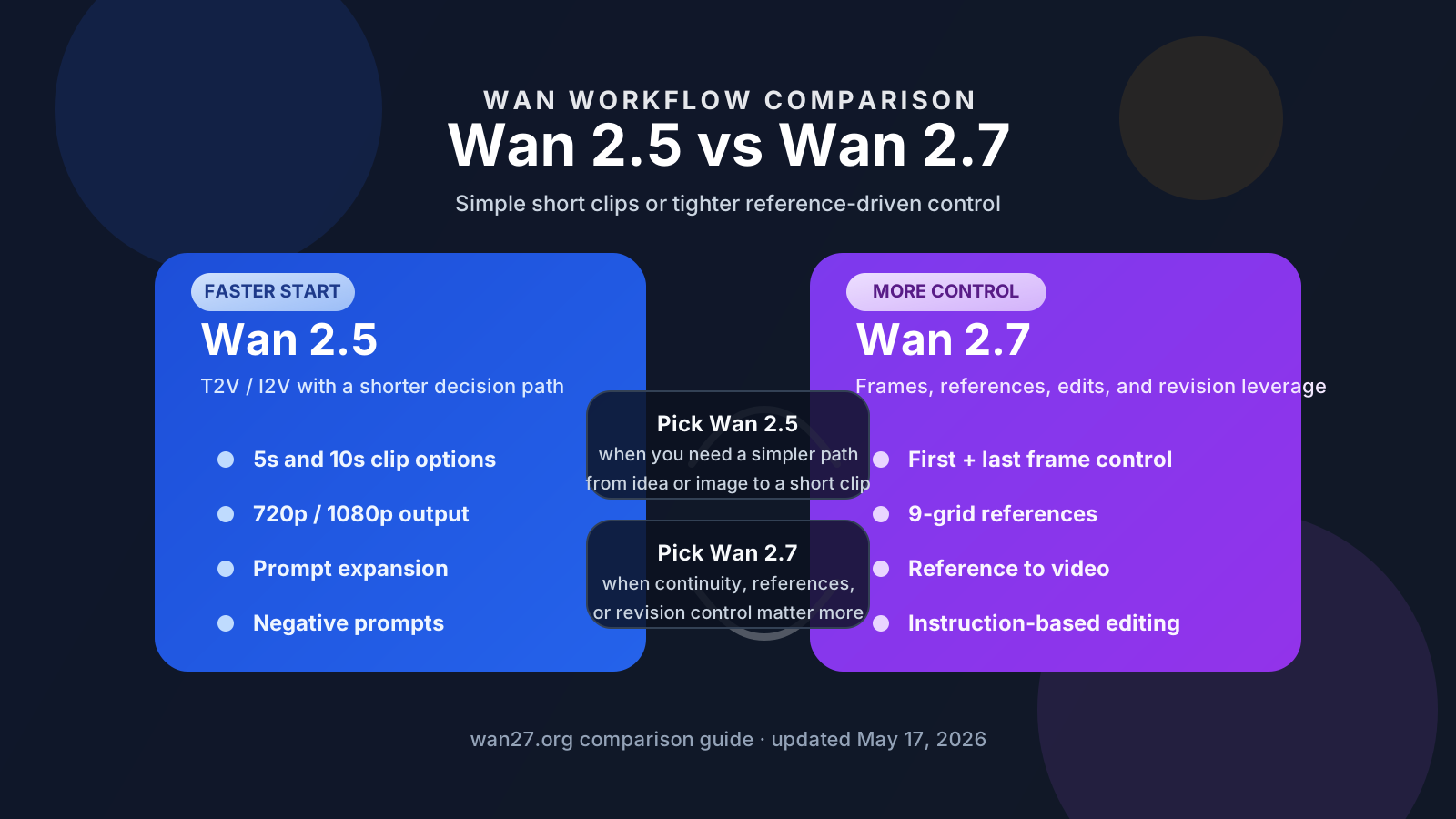
If you want the short answer, use Wan 2.5 when you need a simpler clip workflow.
Use Wan 2.7 when control matters more than simplicity.
That is the clearest split on Wan 2.7 right now.
People searching these two model names are usually trying to answer one of two questions:
- “How do I get a usable short clip fast?”
- “How do I keep more control once the shot starts getting expensive to redo?”
That is why the search results split so cleanly.
For Wan 2.5, top pages keep pushing terms like 1080p, 5s and 10s video, text to video, image to video, lip-sync, and audio-driven video.
For Wan 2.7, top pages keep pushing terms like first and last frame, 9-grid, reference to video, image edit, video edit, and character consistency.
Those keywords map to two different user intents.
On this site, the practical choice is simpler than the hype:
- choose Wan 2.5 for the shorter, narrower path
- choose Wan 2.7 for the more directed, revision-heavy path

Quick Comparison
| Category | Wan 2.5 | Wan 2.7 |
|---|---|---|
| Best role | Fast short-form generation | Higher-control production workflow |
| Main modes in this project | Text to Video, Image to Video | Text to Video, Image to Video, Reference to Video, Video Edit |
| Resolution in this project | 720p, 1080p | 720p, 1080p |
| Clip length in this project | 5s and 10s | 5s and 10s |
| Standout workflow strength | Less setup, faster decisions | More control after direction is locked |
| Best for | Quick hooks, simple drafts, still-to-motion jobs | Frame anchoring, references, continuity, revisions |
The important part is not that one model name sounds newer or more premium.
The important part is where the friction is in your workflow.
If the friction is getting started, Wan 2.5 usually wins.
If the friction is fixing or preserving a nearly-good shot, Wan 2.7 usually wins.
Why People Search These Two Models Differently
The current SERP pattern is useful.
Wan 2.5 pages are mostly trying to capture users who want:
- a short-form video generator
- a prompt-to-video starting point
- a still-image-to-video lane
- 1080p output
- fast social, ad, or creator use cases
Wan 2.7 pages are mostly trying to capture users who want:
- better reference control
- a more stable recurring character workflow
- stronger scene continuity
- editing without full rerolls
- a model that behaves more like a production tool
That search behavior matches what teams do in practice.
They do not move from Wan 2.5 to Wan 2.7 because of brand loyalty.
They move because the job changes.
When Wan 2.5 Is the Better Pick
Wan 2.5 makes more sense when the work is still lightweight.
That includes:
- fast text-to-video tests
- simple image-to-video motion passes
- social hooks that only need 5 seconds
- short product or concept drafts
- early prompt exploration where setup overhead is the real cost
On wan27.org, the Wan 2.5 lane is built around that simpler logic:
The practical benefits are straightforward:
- you can start from text or from an image
- you can choose 5-second or 10-second clips
- you can render in 720p or 1080p
- you can use prompt expansion
- you can use negative prompts
That is a good fit when you do not need a heavy reference stack yet.
Use Wan 2.5 for these jobs
| Job | Why Wan 2.5 fits |
|---|---|
| Testing ad hooks | You can get to a short clip fast |
| Roughing out storyboard beats | The workflow stays simple |
| Animating one approved still | I2V is the obvious path |
| Trying multiple prompt directions | Less setup means more attempts |
| Lightweight social content | 5s and 10s clips are enough for many use cases |
If you are still asking, “What does the idea look like?”, Wan 2.5 is usually enough.
When Wan 2.7 Is the Better Pick
Wan 2.7 becomes the better tool when you already know more about the shot.
That includes:
- where the scene should start
- where it should end
- which references must stay stable
- which subject identity needs to hold
- what needs to change without throwing away the whole result
That is where the Wan 2.7 stack matters:
- Wan 2.7 Prompt Guide
- Wan 2.7 First and Last Frame Guide
- Wan 2.7 9-Grid Guide
- Wan 2.7 Reference to Video
- Wan 2.7 Video Editing Guide
Wan 2.7 is the better pick when rerolling costs more than waiting.
That is the shift.
You stop paying for generation alone.
You start paying for revision leverage.
Use Wan 2.7 for these jobs
| Job | Why Wan 2.7 fits |
|---|---|
| Character-driven campaigns | References and continuity matter more |
| Product reveals with a defined ending frame | First and last frame control is useful |
| 9-grid planning workflows | Multi-reference structure matters |
| Controlled shot refinement | Editing beats full rerolls |
| Reference-heavy production | Wan 2.7 gives you more handles to pull |
If you are already asking, “How do I keep this stable?”, Wan 2.7 is usually the better answer.
The Real Decision Rule
Use this rule if you want the fastest call:
- use Wan 2.5 when the workflow is still prompt-led and short
- use Wan 2.7 when the workflow becomes reference-led or revision-led
That is more useful than asking which model is “better” in the abstract.
Wan 2.5 vs Wan 2.7 by Workflow Stage
| Workflow stage | Start here | Reason |
|---|---|---|
| First concept pass | Wan 2.5 | Lower setup cost |
| Still image animation | Wan 2.5 I2V | Clear, narrow path |
| Short clip variation testing | Wan 2.5 | Faster decision loop |
| Defined start and end frame | Wan 2.7 | More shot control |
| Recurring subject or character | Wan 2.7 | Better reference leverage |
| “Almost right” clip revision | Wan 2.7 | Editing is more efficient than rerolling |
If You Start on Wan 2.5, When Should You Move Up?
Move from Wan 2.5 to Wan 2.7 when one of these becomes true:
- your subject starts drifting
- your ending matters as much as your opening
- one reference image is no longer enough
- you need continuity across multiple outputs
- you keep saying “this is close, but I do not want to start over”
That is usually the handoff point.
Wan 2.5 gets you moving.
Wan 2.7 helps you stop losing good work.
What This Means for wan27.org Users
For this site specifically, the clean path looks like this:
- start with Wan 2.5 if you want a simpler video lane
- use Wan 2.5 Text to Video when the idea starts in words
- use Wan 2.5 Image to Video when the first frame already matters
- move to Wan 2.7 and the Wan 2.7 guides when the work needs tighter control
That keeps the model choice tied to the job instead of to whatever headline is loudest in search.
FAQ
Is Wan 2.5 enough for most short-form content?
Often yes. If the job is a short prompt-led or image-led clip and you do not need a heavy reference workflow, Wan 2.5 is a strong first pick.
Is Wan 2.7 always better because it is newer?
No. Wan 2.7 is better when you need more control. It is not automatically better for every short clip or early draft.
Which one is better for image-to-video?
If you just need to animate one still with a short, direct workflow, start with Wan 2.5 Image to Video. If the shot depends on multi-reference structure, continuity, or later revisions, Wan 2.7 is the stronger lane.
Which one is better for recurring characters?
Wan 2.7 is the better fit. That is where first and last frame control, 9-grid, and reference-to-video matter more than a simpler draft workflow.
Which one should I try first?
Try Wan 2.5 first if you want a quick answer. Try Wan 2.7 first if you already know the shot needs control.
Bottom Line
Use Wan 2.5 when you want the shorter path from prompt or image to a usable clip.
Use Wan 2.7 when you want more control over frames, references, continuity, and revisions.
If you want to test both lanes directly, start with Wan 2.7, then compare the current plans on wan27.org/pricing.