
Table of Contents

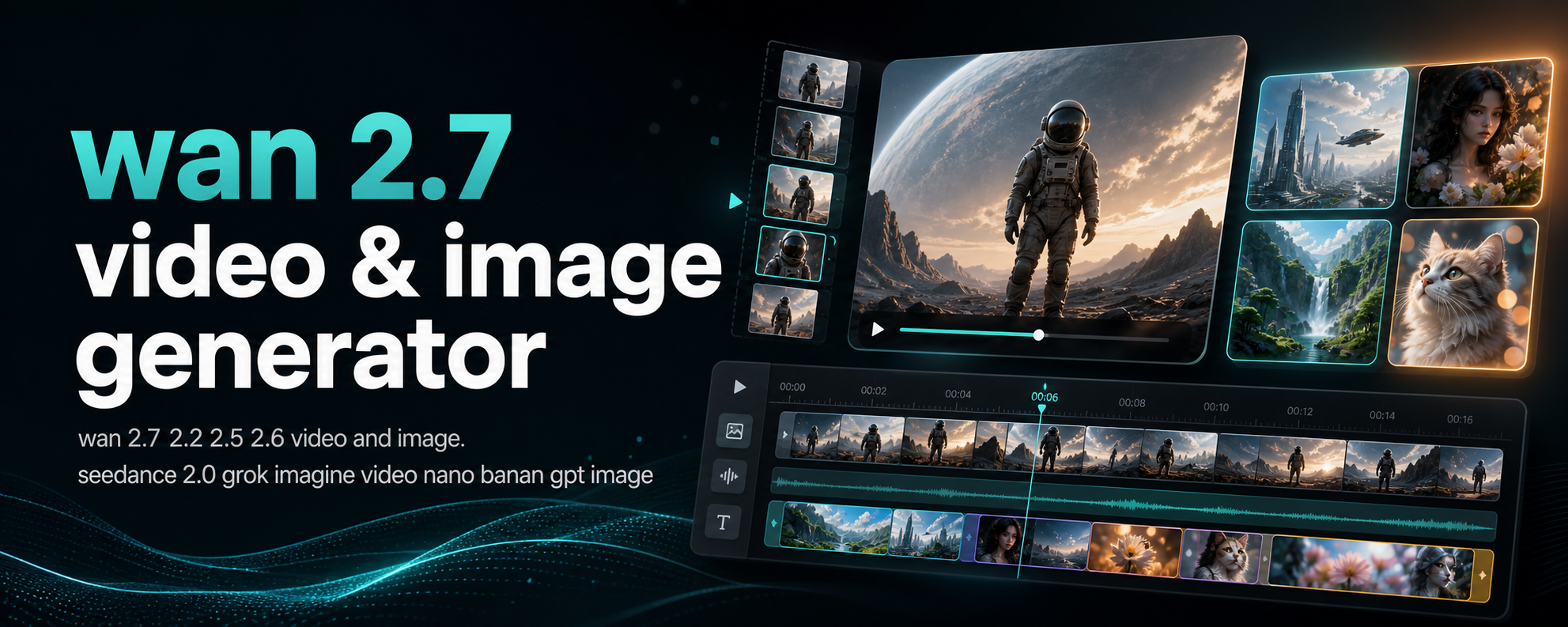
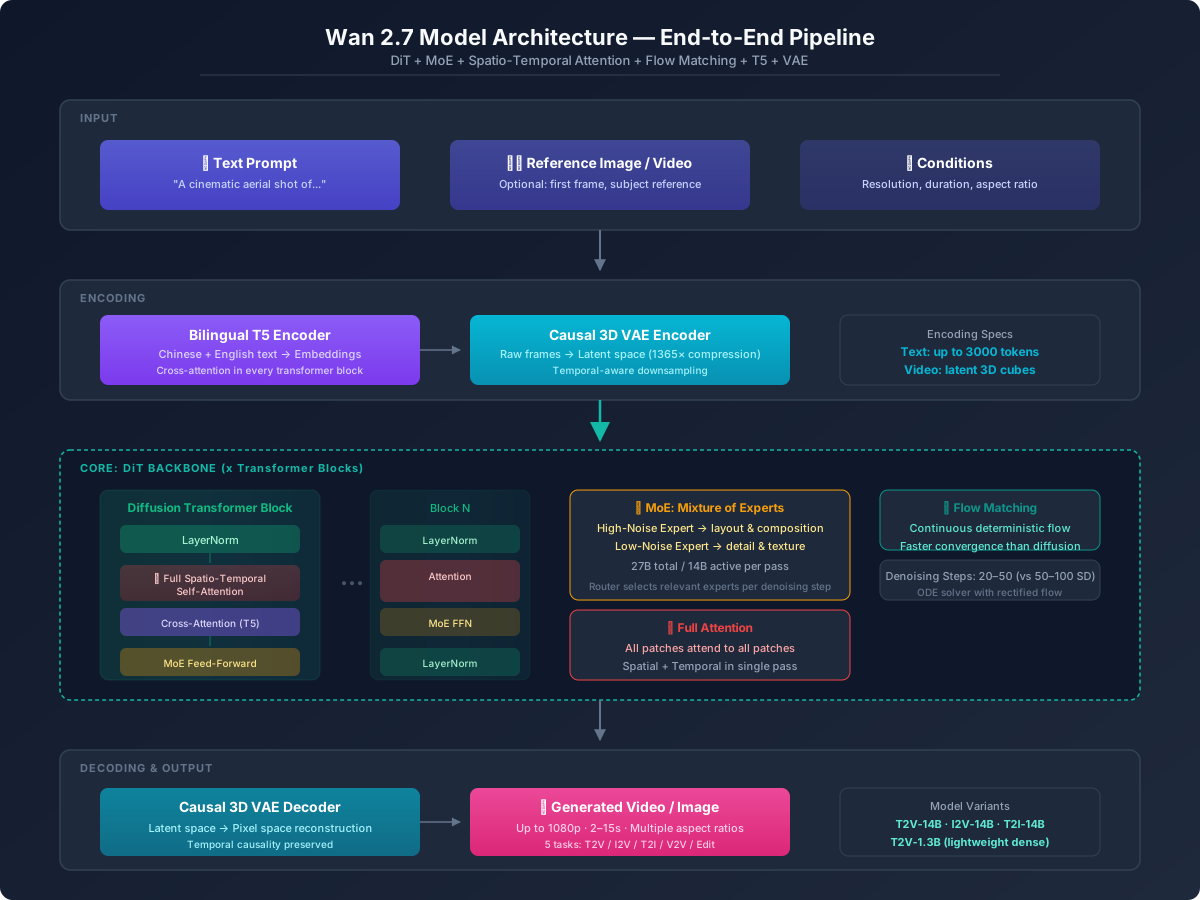
Alibaba just launched Wan 2.7-Video today, and it is not a routine upgrade. It is a fundamental rethink of what an AI video model should do.
The problem with every AI video tool until now has been the same: you type a prompt, you get a clip, and if anything is wrong — a stray pedestrian in the background, a flat expression on the lead actor, a camera angle that kills the tension — you start over. Generation was a slot machine. Editing was not an option.
Wan 2.7-Video changes the equation. Instead of just generating video, it gives creators a full production toolkit: generate, edit, replicate, reshoot, extend, and reference — all through natural language instructions. Think of it as the first AI video model that treats footage like an editable document.
Edit Video Like You Edit Photos
The headline feature: instruction-based video editing. You can now modify specific elements in a generated or uploaded video without regenerating the entire clip.

Add, Remove, and Replace Elements
Tell the model "remove the train from this scene" and it disappears — with the surrounding lighting and texture filling in naturally. Want to swap an object? "Replace the film reel with a dinner plate." Need to change a property? "Make the building red." All of these work as single-instruction edits on existing footage.
Wan 2.7-Video also supports reference-guided addition — feed it a reference image and it will place that object into your video with accurate lighting and material matching.
Environment and Style Transforms
Keep the character's motion intact while swapping the entire environment. Change a summer park into an autumn forest. Convert live-action footage into a felt-wool stop-motion aesthetic. The model preserves the motion graph while rebuilding the visual context around it.
Beyond style, the editing system handles video quality enhancement (colorizing black-and-white footage), visual understanding tasks (subject segmentation), and camera adjustments (modifying depth of field and focus points).
Reshoot Without Reshooting
This is where Wan 2.7-Video gets genuinely interesting for anyone working in narrative content.
You have a scene. The acting is fine. The set looks great. But the dialogue is wrong, or the blocking needs to change, or the director wants a completely different camera angle. In traditional production, that means calling the crew back. In AI video until now, it meant regenerating from scratch and hoping.
Wan 2.7-Video lets you rewrite the performance in place.
Change Dialogue and Actions
Modify what a character says — the model re-renders lip sync, adjusts emotional expression to match the new line, and maintains consistent voice timbre. Change what a character does — "the woman on the couch is now standing and playing a video game" — and only the action logic updates while everything else holds.
Swap the Story, Keep the Stage
Replace a modern gamer with a medieval knight holding a broadsword instead of a controller — but preserve the original grip posture and body mechanics. Or change the camera setup entirely: "switch to a low-angle shot rising from ground level." Same footage, completely different viewing experience.
This is not re-generation. It is directed revision — the kind of iterative control that film editors have always had over live footage, now available for AI-generated content.
Clone the Creative, Not the Content

See a brilliant camera move in a reference clip? A striking particle effect? A distinctive animation style? Wan 2.7-Video lets you extract and reuse dynamic creative elements without manually keyframing anything.
Motion and Camera Replication
Preserve the original video's action sequence or camera movement and generate a completely new scene around it. "Keep the camera work from this clip, but set it on a school playground." Or: "Maintain the character's motion sequence, but now it is Sisyphus pushing a boulder up a mountain."
Style and Effect Transfer
Reference a video's stylistic treatment or particle effects. "Keep the cartoon style from this input video and generate a new scene." Or: "Use the golden sand particle effect, but morph the text into an abstract elephant symbol."
General Reference
Preserve the color grading and environmental mood of a source video while adding new narrative elements. "Keep the original style, add a tall anime character breakdancing while pink storm clouds gather overhead."
Seamless Story Continuation
A persistent problem with AI video has been the braking effect — that jarring moment when a continued sequence suddenly loses momentum or visual coherence. Wan 2.7-Video attacks this directly with upgraded temporal controls.
The model now supports first-frame + last-frame generation, video continuation, and — the key upgrade — continuation with tail-frame control. This hybrid approach preserves the natural dynamic flow of the continued sequence while giving you precise control over where the shot ends up compositionally.
You tell the model "here is what happens next," and it extends the narrative while maintaining visual continuity in lighting, motion, and framing. No more abrupt tonal shifts between generated segments.
Five Subjects, One Consistent Cast

Wan 2.7-Video supports up to 5 subject references simultaneously — combining image, video, and audio inputs to lock both appearance and voice for each character.
The practical impact: you can build an ensemble cast where every character has a dedicated voice timbre and consistent visual identity across multiple shots. Upload reference images for five characters, assign voice references, and write a scene where they interact — complete with dialogue, spatial positioning, and prop handling.
Example prompt from Alibaba's demo: "Character 2 holds Character 4 and plays a soothing folk song on the guitar in Character 5's chair, saying 'The sunshine is really nice today.' Character 1 carries Character 3, walks past, places it on the table, and says 'That sounds great, can you play it again?'"
Multi-subject consistency has been the hardest unsolved problem in AI video. This is the most ambitious attempt at it yet.
Storyboard-Driven Direction
Wan 2.7-Video introduces multi-panel reference image input — optimized specifically for storyboard-style control. Feed it a single composite image with multiple panels, and the model interprets each panel as a directorial instruction: story arc, camera composition, character design, scene transitions.
Alibaba's demo shows a 9-panel Korean manhwa-style storyboard generating a complete short sequence: a late-night convenience store scene with consistent character design, coordinated camera work (wide establishing shot, medium shots, close-ups, cutaways), and coherent emotional arc — all from one reference image and a detailed shot list.
This is the feature that bridges pre-production and production. Storyboard artists can now see their panel layouts animate directly, without an intermediate translation step.
Cinematic Intelligence: Drama at the Core
Beyond the tooling upgrades, Wan 2.7-Video introduces what Alibaba calls drama-core driven generation — the model was trained on professional screenplays and understands narrative structure at a foundational level.
Intelligent Story Design
Give it a one-line concept and it constructs a dramatically sound arc — setup, escalation, climax, resolution — with shot-by-shot breakdowns that follow professional screenplay conventions. The model generates storyboard scripts with rhythm, pacing, and varied shot language built in.
Style as a System
Wan 2.7-Video maps genre to visual language automatically. Specify "Western" and you get warm sunset tones with high-contrast lighting. Specify "sci-fi" and you get neon-and-shadow cyberpunk aesthetics. The model decomposes animation style into independent dimensions — form, line, lighting, material, space — that you can mix and match to create entirely new visual languages while maintaining multi-shot consistency.
Performance Depth
Over 40 distinct facial expressions — not just happy, sad, and angry, but nuanced micro-expressions. Dialogue rendering is more accurate, with voice performance that handles rapid-fire exchanges and subtle tonal shifts in internal monologue. Alibaba credits cross-team collaboration with Tongyi Lab's speech team and Tiger Whale Entertainment's Mocool Lab for the leap in audiovisual realism.
Professional Camera Language
Support for dozens of camera techniques — push, pull, pan, tilt, track, crane — plus compound moves: Hitchcock zoom (conveying psychological vertigo), rising reveal (dramatic scene unveiling), lateral pan with counter-rotation (parallax and voyeuristic tension), and handheld tracking (documentary urgency). These are not filters. They are narrative tools that the model applies based on dramatic context.
The Bottom Line
Wan 2.7-Video is not just a better generator. It is the first AI video model that treats the entire creative workflow as its domain — from initial concept to final cut.
The shift from "generate and hope" to "generate, review, and revise" is what makes this release significant. Every feature — instruction editing, dialogue reshoots, creative replication, storyboard control, multi-subject casting, drama-core intelligence — points in the same direction: giving creators the iterative control they have always had in traditional production, but never had in AI.
For independent filmmakers, content teams, and studios experimenting with AI-assisted workflows, this is the model to evaluate right now.
Try Wan 2.7-Video at Wan 2.7.
Also available on: