
Table of Contents

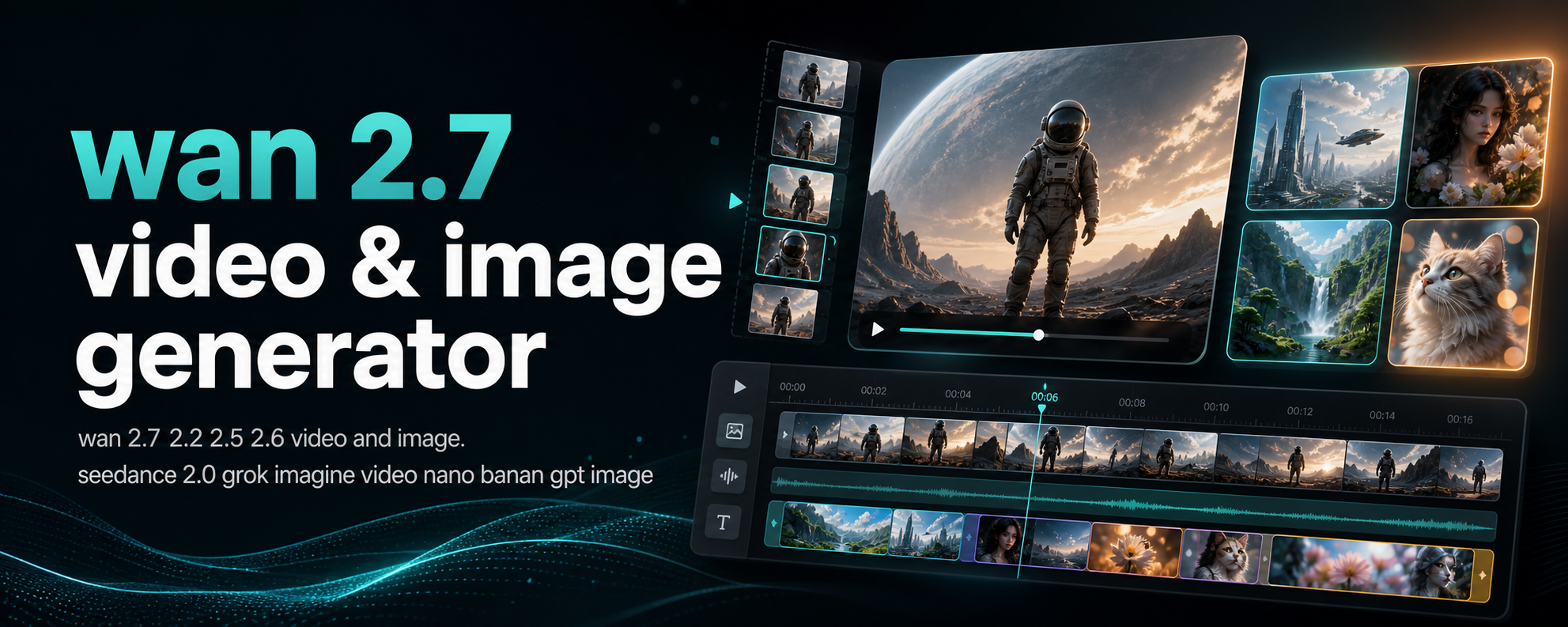
Most AI image generators work the same way: you type a prompt, the model makes a guess, and you iterate until something usable comes out. The gap between what you described and what appeared is the cost of that guessing.
Wan 2.7 Text-to-Image changes the mechanics. Before generating a single pixel, the model reasons about your prompt — analyzing spatial relationships, composition logic, and layout intent — and then generates from that structured understanding rather than from a raw text string.
The result is images that feel directed, not rolled.
How Wan 2.7 Text-to-Image Works
The core difference in Wan 2.7's image generation is the thinking mode — a built-in reasoning step that runs before generation begins.
When you submit a prompt, the model does not immediately begin the diffusion process. Instead, it first constructs an internal plan: how should the subject be positioned, what depth of field makes sense, where does the light source logically sit, how should foreground and background relate? Only after resolving those spatial and compositional questions does it begin rendering.
This is why Wan 2.7 handles complex prompts — crowded scenes, specific typography, multi-subject compositions — more reliably than models that skip the planning step entirely. You are not just describing an image. You are giving instructions to a model that stops to think before it acts.
A Prompt Enhancer is also built in. If your description is short or underdeveloped, the enhancer automatically expands it into a more detailed generation prompt before it reaches the model — so even a simple starting point produces a more fully realized result.
Key Features of Wan 2.7 Text-to-Image
Thinking Mode
The reasoning layer that runs before generation. Resolves ambiguities in your prompt, infers spatial logic, and plans composition before a single pixel is rendered. Most visible on prompts with multiple subjects, specific layouts, or text-heavy designs.
Superior Text Rendering

Text inside AI images has been broken for years. Wan 2.7 fixes it properly:
- Up to 4,000 English characters rendered accurately in a single image
- Full support for Simplified Chinese, Traditional Chinese, Japanese, and Korean
- Tables, charts, and mathematical formulas rendered inline
- Typography that holds up at high resolution
This removes the requirement for Photoshop post-processing when you need text in an image — whether that is a poster headline, a product label, an infographic callout, or a slide visual.
Hex-Based Color Control
Specify up to 8 hex color values per generation to anchor output to a precise palette. Wan 2.7 treats those values as hard constraints on the generation — not suggestions — so brand colors, product colors, and art direction color palettes actually appear in the output.
This is a direct solution to the color drift problem that makes AI images unusable for brand work without post-processing.
Flexible Dimensions and Aspect Ratios
Custom width and height from 512 to 8192px with preset aspect ratios including 1:1, 16:9, 9:16, 4:3, 3:4, 3:2, and 2:3. Whether you are generating a square social post, a widescreen hero image, or a portrait poster, you can match the output dimensions to the destination format from the start.
Reproducible Results With Seed Control
Set a seed value to lock a specific visual direction and iterate on it without losing the character of the output. Useful when you need multiple variations of the same composition, or when you want to hand off a specific look to a collaborator.
Facial Diversity at Scale
Wan 2.7 was designed to produce genuinely distinct faces across generations — not ten slightly different variations of the same AI face. For brand designers, game studios, and story creators, this makes it practical to build a visual cast rather than a single protagonist.
Best Use Cases for Wan 2.7 Text-to-Image
Marketing and Campaign Visuals
Generate campaign hero images with accurate text overlays, correct brand colors, and portrait or landscape orientations matched to placement specs. The text rendering and hex color control eliminate two of the most common reasons AI-generated marketing assets fail at the production stage.
Infographics and Educational Content
Tables, formulas, charts, and multilingual labels all render accurately — making Wan 2.7 unusually capable for educational diagrams, explainer visuals, and slide illustrations that would otherwise require separate design work.
Product and E-Commerce Imagery
Generate lifestyle hero shots, product-in-context images, and variation sets with consistent color treatment. Hex palette control and facial diversity make it viable for catalog-scale work.
Book Covers, Posters, and Print Design
High-resolution output up to 8192px and accurate text rendering make Wan 2.7 one of the few AI image generators capable of producing print-ready design assets without a correction pass.
Character and Concept Art
Seed control and subject consistency let you iterate on a specific character direction — exploring variations in expression, pose, and lighting — without losing the established visual identity between generations.
How to Generate With Wan 2.7 Text-to-Image
Go to Wan 2.7 and open the Wan 2.7 text-to-image tool. The workflow is straightforward:
1. Write your prompt Describe the subject, environment, lighting, style, and any compositional intent. The Prompt Enhancer will refine a short prompt automatically — but a more detailed description gives the thinking mode more to work with.
2. Set your color palette (optional) If you are working to a specific brand or art direction palette, enter up to 8 hex values. The model will anchor the generation to those colors.
3. Choose your output dimensions Select from preset aspect ratios or enter custom dimensions. Match the format to where the image will be used.
4. Set a seed (optional) If you want reproducible results or plan to run variations, set a seed before generating.
5. Generate and iterate Use the thinking mode output and the Prompt Enhancer's expansion as feedback on how the model interpreted your prompt. Adjust your description and rerun — the iterations are fast.
Wan 2.7 Text-to-Image Standard vs Pro
Wan 2.7 ships in two tiers:
| Standard | Pro | |
|---|---|---|
| Max resolution | 2048 × 2048 | 4096 × 4096 |
| Thinking mode | Yes | Yes |
| Text rendering | Superior | Superior |
| Best for | Web, social, content | Print, large-format, production |
The standard tier covers the majority of digital production needs. Pro is the choice when native 4K resolution matters — print campaigns, large-format displays, publication covers.
The Practical Difference Thinking Mode Makes
Here is the concrete difference between a standard text-to-image model and one with a thinking step:
Without thinking mode: "A scientist in a lab holding a beaker with a blue liquid" → the model renders a scientist, a beaker, a blue tint, and a generic lab background, in whatever spatial arrangement it defaults to.
With thinking mode: The model first resolves — where is the light source? Is the scientist looking at the beaker or past it? What is the background depth? How should the beaker be held to be visually clear? — and generates from that resolved plan. The difference is visible in how objects relate to each other in the frame, how lighting behaves consistently, and how text elements (if any) are placed.
It is the difference between a generator and a composer.
Generate your first image at Wan 2.7.