
Table of Contents

If you want one page that answers the practical question, start here.
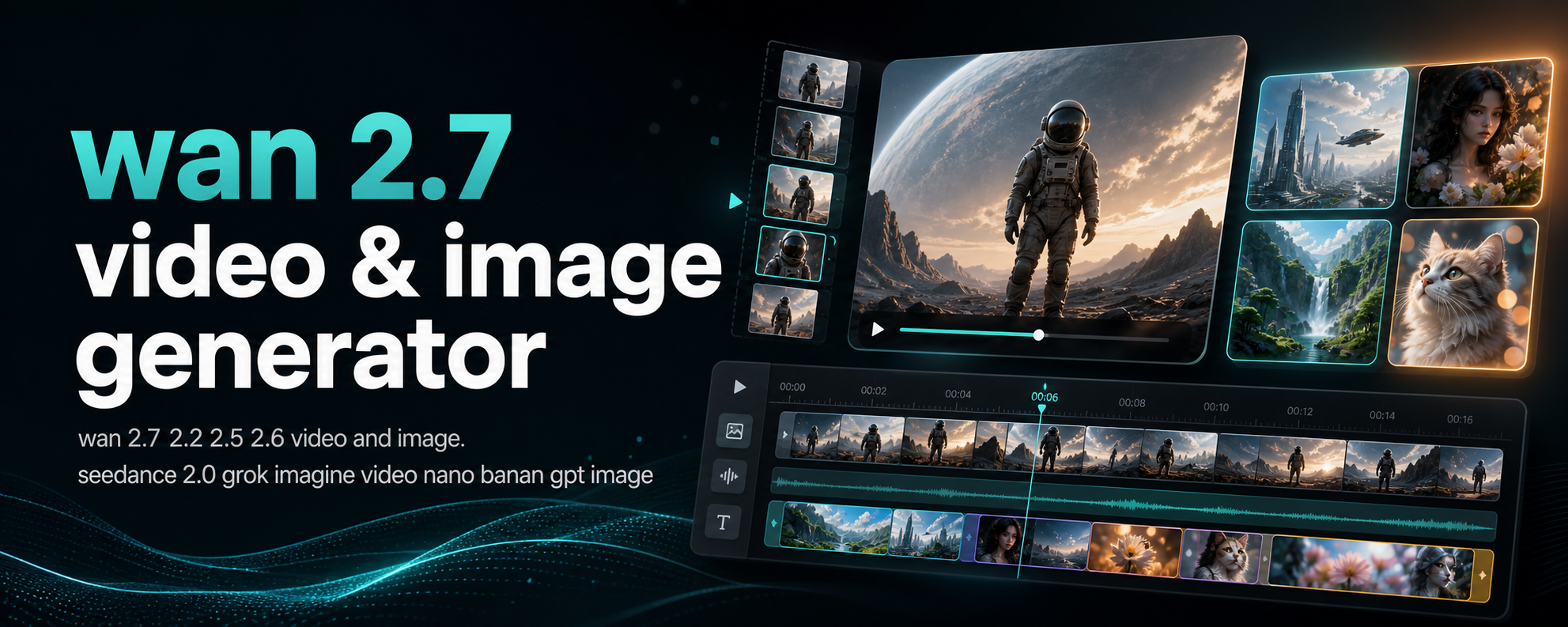
Wan 2.7 Image is Alibaba's image generation and editing model. It is built for people who need more than a single pretty sample. You can generate from text, guide output with multiple reference images, control color more directly, and move to Wan 2.7 Image Pro when you need stronger composition or 4K output.
Updated for April 24, 2026, this guide covers:
- what Wan 2.7 Image is
- the official release date
- the main features people search for
- the difference between Standard and Pro on Wan 2.7
- the current pricing on the site
Wan 2.7 Image Release Date
Alibaba announced Wan2.7-Image on April 1, 2026. On the same date, Alibaba Cloud Model Studio published the official API reference for wan2.7-image and wan2.7-image-pro.
If you want first-party confirmation, start with:
That release date matters because many third-party pages mix together older Wan models, video features, and unsupported claims. For the image model itself, April 1, 2026 is the clean reference point.
What Is Wan 2.7 Image?
At the official docs level, Wan 2.7 Image covers five jobs in one family:
- text-to-image
- text-to-image-set
- image-to-image-set
- image editing
- multi-reference image generation
That is why the keyword wan 2.7 image carries broader intent than "make one image from a prompt." People searching this topic usually want to know whether the model can also handle references, grouped output, and controlled edits. The answer is yes.
Why Wan 2.7 Image Gets Attention
Most competing pages rank by promising one thing: better control.
That is also the real reason the model matters. The interesting part is not just image quality. It is that Alibaba keeps generation and editing inside one system.
1. Text-to-image with thinking mode
In Alibaba's API docs, thinking_mode is enabled by default for plain text-to-image calls when you are not using image-set mode or image inputs. That gives the model more room to interpret layout, composition, and prompt intent before it renders.
In practice, this is why Wan 2.7 Image is a better fit for posters, product visuals, and scene layouts that need more structure than a quick visual guess.
2. Color palette control
The API supports a color_palette field with 3 to 10 hex colors, and Alibaba recommends 8 when you want a stronger palette lock.
That matters for real marketing work. If the page, ad, or product graphic has to stay near brand colors, this is much more useful than hoping the model lands in the right tonal range.
3. Long text, formulas, and tables
Alibaba's April 1 launch post highlights long-text rendering, formulas, tables, and support across 12 languages.
That makes Wan 2.7 Image more relevant for educational graphics, packaging comps, infographic-style assets, and poster layouts than a normal beauty-shot generator.
4. Up to 9 input images and up to 12 outputs
Alibaba says the model can use as many as 9 reference images and generate up to 12 images at once in image-set mode.
This is one of the clearest workflow upgrades over lighter prompt-only tools. It is useful for storyboards, character sets, campaign variations, and e-commerce image batches where consistency matters more than a single hero shot.
5. Targeted image editing
On wan27.org, the editing workflow runs through Wan 2.7 Image Pro. In the official API, you can pass selected boxes for the exact area you want to change.
If your real question is how to select regions, write better edit instructions, and decide when Pro is worth it, read Wan 2.7 Image Edit Guide.
That is the practical difference between "redraw the whole image" and "change only this product label, background area, or object."
Wan 2.7 Image vs Wan 2.7 Image Pro
Alibaba positions Wan 2.7 Image Pro as the stronger tier for stable composition, sharper prompt understanding, and 4K output.
On wan27.org, the split is simple:
| Wan 2.7 Image | Wan 2.7 Image Pro | |
|---|---|---|
| Current site pricing | 3 credits | 7 credits |
| Best for | Fast drafts, everyday generation, concept testing | 4K hero visuals, denser layouts, and image editing |
| Output level | 1K / 2K generation | 1K / 2K generation and editing, plus 4K text-to-image |
| Workflow fit | Speed-first | Control-first |
Use the standard model when you want cheaper iteration.
Use Pro when the output has to hold up under closer review, when dense layout matters, or when you want to edit a specific area instead of starting over.
Wan 2.7 Image Pricing on wan27.org
As of April 24, 2026, the current pricing configured on wan27.org is:
- Wan 2.7 Image: 3 credits per generation
- Wan 2.7 Image Pro: 7 credits per generation or edit
If you want the current plan and credit pack options, check wan27.org/pricing.
Best Use Cases for Wan 2.7 Image
Brand-safe marketing visuals
If palette control is part of the job, Wan 2.7 Image is much easier to steer than a model that treats color as a suggestion.
Product and e-commerce images
Reference-heavy workflows matter here. You often need the same product shape, finish, and framing across multiple outputs.
Posters, diagrams, and educational assets
Text and formulas are part of the asset itself, not an afterthought. That is one of the clearer reasons people choose this model over a general image generator.
Storyboards and visual series
The grouped output and multi-reference support are more useful for sequential work than a single-image model.
Small targeted edits
If you only need to change one region, Pro is a better workflow than rerolling the whole image.
How to Use Wan 2.7 Image on wan27.org
The shortest path is this:
- Open wan27.org/wan2-7-image.
- Start with Wan 2.7 Image if you are generating from text and you care most about cost and speed.
- Switch to Wan 2.7 Image Pro when you need 4K output, stronger layout stability, or image editing.
- Add reference images when subject identity, product shape, or art direction must stay close to target.
- Use a clear palette direction when brand colors matter.
- Generate one clean draft first. Then refine only the part that failed.
If you want deeper workflow detail, read:
FAQ
Is Wan 2.7 Image open source?
As of April 24, 2026, Alibaba's current release materials point to Model Studio and the official Wan site for access. In the Alibaba sources linked above, I did not find a first-party open-weight download page for the image model, so treat Wan 2.7 Image as a hosted and API-first workflow for now.
Is Wan 2.7 Image the same as Wan 2.7 Video?
No. The image model launched on April 1, 2026. Alibaba announced Wan2.7-Video later, on April 7, 2026. If you need motion, read Wan 2.7 Image-to-Video Guide.
Should you use Wan 2.7 Image or Wan 2.7 Image Pro?
Use the standard model for cheaper daily generation. Use Pro when composition is harder, when text density is higher, when you need editing, or when the output needs to be 4K.
Bottom Line
Wan 2.7 Image is not interesting because it can generate one strong sample.
It is interesting because the workflow is broader: text-to-image, reference-led generation, grouped output, palette control, and targeted editing all sit inside one family.
If that is what you need, start on Wan 2.7, compare the current plans on wan27.org/pricing, and pick Wan 2.7 Image Pro only when the extra control actually matters.