Table of Contents
If you have ever watched an AI agent lose track of what it was doing after three turns — forgetting why it changed a file, losing the thread of a research question, or repeating the same tool call in a loop — you already understand the problem Claude Fable 5 was built to solve.
Most LLMs are optimized for short conversations: prompt, response, next prompt. That works well for Q&A and single-turn tasks. But the workflows that deliver real leverage — multi-file refactoring, cross-referenced research analysis, multi-hour agent sessions — need a model that can sustain coherent reasoning across dozens of steps without degrading. Until now, that gap between demos and production has been hard to close.
Fable 5 is Anthropic's answer. Announced on June 9, 2026 alongside Claude Mythos 5, it is the first widely released Claude model designed for extended autonomous operation. It comes with a 1M token context window, a 128K output limit, and a pricing tier that reflects a fundamentally different capability profile from everything before it.
This analysis is based on official Anthropic documentation, platform partner publications from June 9, and hands-on testing through the Claude API and Claude Code CLI.
By the end of this article, you will know exactly what Claude Fable 5 is, how it differs from Mythos 5, where you can use it, what it costs, and how to decide which model fits your use case.
What Is Claude Fable 5?
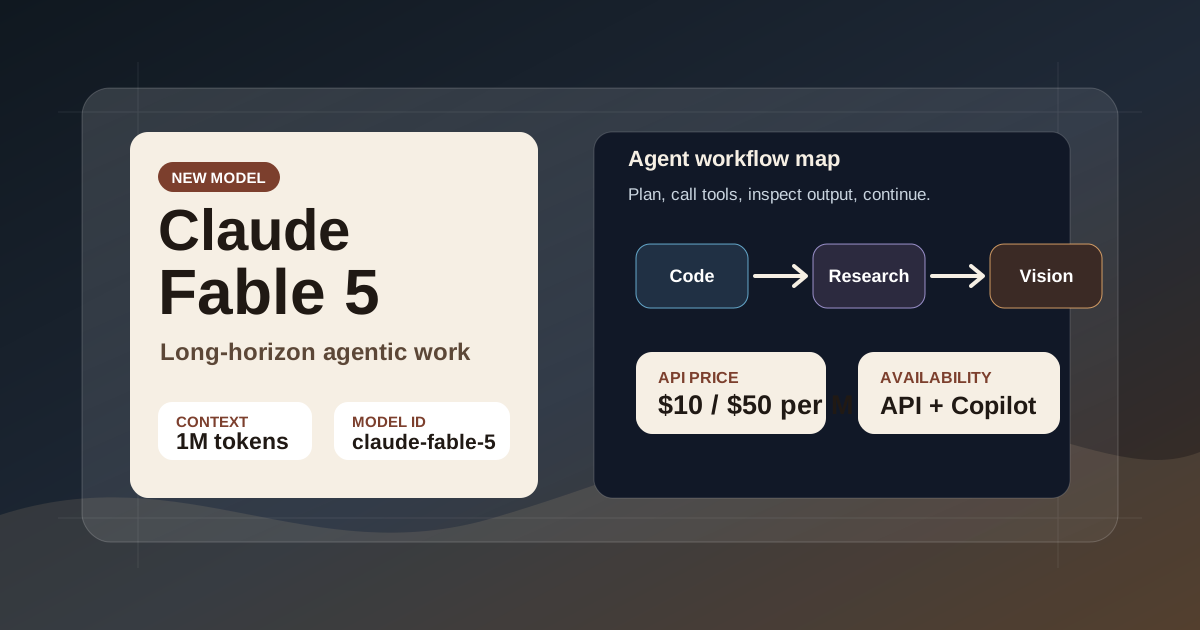
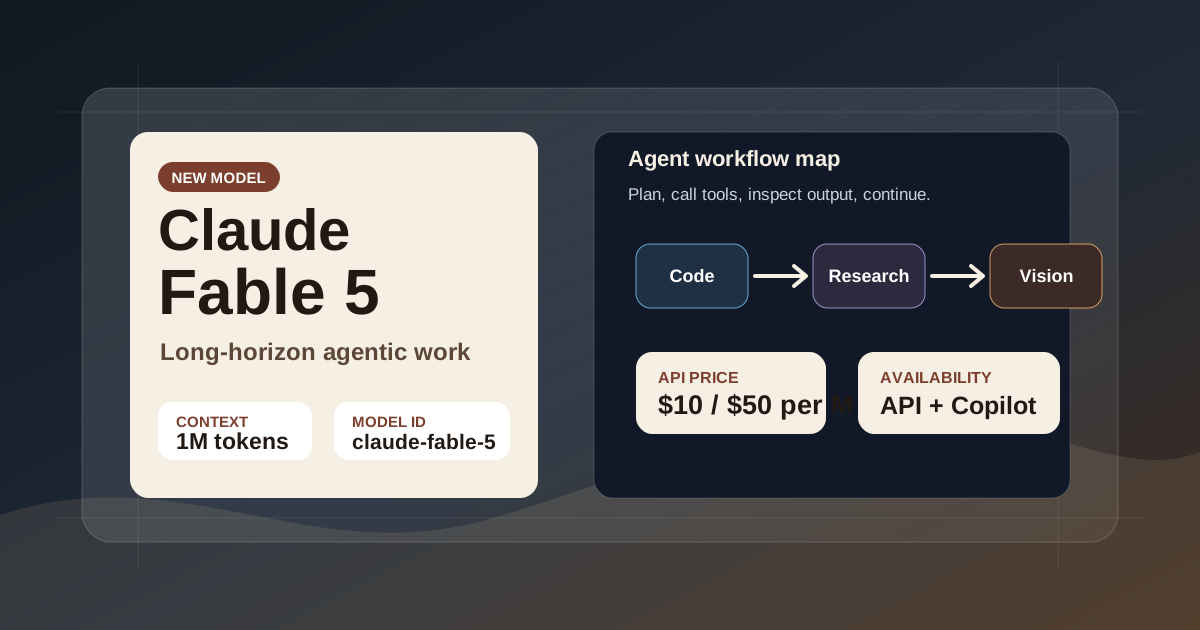
Claude Fable 5 is Anthropic's most capable widely released model, built for sustained autonomous reasoning and long-horizon agentic work.
Think of it as the difference between a courier optimized for local deliveries and a trucking fleet built for cross-country hauls. Previous Claude models (including the Opus 4.x generation) excel at single-turn and short multi-turn conversations — they get a specific task done quickly. Fable 5 is designed for the multi-hour, multi-step workflows where the full scope is not even known at the start.
It can work through complex, multi-step problems without requiring constant human intervention — a capability that matters for software engineering, research analysis, and agentic workflows where the model must maintain context and direction across many turns.
| Specification | Claude Fable 5 |
|---|---|
| Model ID | claude-fable-5 |
| Context window | 1M tokens (default) |
| Max output | Up to 128K tokens per request |
| Input pricing | $10 per million tokens |
| Output pricing | $50 per million tokens |
| Prompt caching discount | 90% discount on cached input tokens |
| US-only inference | Available at 1.1x pricing |
| Safety | Full safety classifiers enabled |
| Release type | Widely released |
| Key capabilities | Software engineering, knowledge work, vision, memory, long-horizon agents, life sciences research |
What "Long-Horizon Agentic Work" Means in Practice
This specification separates Fable 5 from previous Claude models, and it has practical implications for how you use the model.
Most LLMs are optimized for short interactions: you send a prompt, the model responds, and the next prompt starts fresh or with limited context. Long-horizon agentic work means the model can sustain coherent reasoning across many turns, tool calls, and context accumulation phases without degrading in performance.
What this changes in practice:
- Software engineering tasks: Fable 5 can work through a multi-file refactoring, run tests, interpret error output, fix issues, and continue without losing the thread across 50+ turns.
- Research analysis: It can read a corpus of papers, extract findings, cross-reference claims, generate a synthesis, and handle follow-up questions about specific sources — all within a single session.
- Autonomous agents: The model maintains state across tool calls, sub-tasks, and decision branches — making it suitable for agent frameworks where the model drives multi-step workflows.
Rule of Thumb: If your task completes in one or two chat turns, you do not need Fable 5's long-horizon capabilities. If your task requires sustained context across dozens of steps, tool calls, and accumulated intermediate results, Fable 5 starts to show its strength.
Claude Fable 5 vs Claude Mythos 5 — What Is the Difference?
Anthropic released two models simultaneously, and they serve different purposes. Here is the direct comparison:
| Dimension | Claude Fable 5 | Claude Mythos 5 |
|---|---|---|
| Release type | Widely released to general public | Limited release |
| Access | Claude API, Claude.ai, AWS Bedrock, GitHub Copilot, Microsoft Foundry | Project Glasswing (trusted-access program) |
| Safety classifiers | Full safety system enabled | Reduced safety classifiers |
| Capabilities | Same core capabilities as Mythos 5 | Same core capabilities as Fable 5 |
| Use case | Production applications, general use | Research, red-teaming, safety evaluation |
| Pricing | $10/M input, $50/M output | Not publicly disclosed |
| Availability | Broad, multi-platform | Restricted |
The core capabilities of both models are the same. The difference is the safety layer applied on top.
Claude Fable 5 includes Anthropic's full safety system — classifiers, refusal filters, and content moderation — designed for safe production deployment. This is the model you use in customer-facing applications, internal tools, and any scenario where you need responsible AI safeguards.
Claude Mythos 5 is Fable 5 without the safety classifiers. It provides access to the raw model capability for research purposes, red-teaming, and safety evaluation through Project Glasswing. This is not a model for production use — it is a research tool for understanding what the model can do when safety constraints are removed, which in turn helps Anthropic build better safety systems.
If you are building a product or integrating Claude into your workflow, use Claude Fable 5. Mythos 5 is not designed for general use.
How to Choose: Which Claude Model Fits Your Use Case?
Beyond the Fable 5 vs Mythos 5 comparison, the practical question most teams face is choosing between Fable 5, Haiku 4.5, and Opus 4.8 for a specific workload. The answer depends on three variables: task complexity, session length, and cost sensitivity.
| Scenario | Recommended Model | Why |
|---|---|---|
| Single-turn Q&A, classification, simple extraction | Haiku 4.5 ($0.25/M input) | Lowest cost, fast enough for short tasks |
| Multi-turn chat, document analysis, content generation under 10 turns | Opus 4.8 ($15/M input) | Strong reasoning, reasonable context, proven in production |
| Multi-file coding, long research sessions, autonomous agent workflows (20+ turns) | Fable 5 ($10/M input) | Sustained reasoning across long contexts, lower per-token cost than Opus 4.x |
| Red-teaming, safety research, understanding model boundaries | Mythos 5 (restricted access) | Same core capability without safety classifiers |
Key insight: Despite being the most capable model, Fable 5 is actually cheaper per token than the previous Opus generation ($10 vs $15 per million input tokens). The higher total bill comes from longer sessions — not from a higher per-token rate. If your workflow already runs long sessions on Opus 4.x, migrating to Fable 5 will likely reduce your per-token cost while improving performance.
Rule of Thumb: If your task runs longer than 10 turns or processes more than 50K tokens of context, Fable 5 is worth testing even if you are currently using a smaller model — the sustained reasoning quality may reduce the total number of retries and manual interventions.
Claude Fable 5 Pricing — How the Cost Structure Works
Fable 5 introduces a new pricing tier that reflects its increased capability and operational cost.
| Pricing Component | Rate |
|---|---|
| Input tokens | $10 per million tokens |
| Output tokens | $50 per million tokens |
| Prompt caching | 90% discount on cached input tokens |
| US-only inference | 1.1x standard rate |
For context, previous Claude models (Opus 4.x generation) were priced at $15 per million input tokens and $75 per million output tokens. Fable 5 comes in at a lower price point despite being a more capable model, largely because of improvements in inference efficiency and the scale at which Anthropic is now operating.
Prompt Caching — The 90% Discount That Changes Cost Planning
The most important pricing detail for heavy users is the 90% input token discount for prompt caching. If your workflow sends the same system prompt, instructions, or reference material across multiple requests — which is typical for agentic workflows — the cached portion of your input tokens costs 90% less.
This changes the cost calculus significantly for long-running agent sessions. A typical agent workflow might involve:
- System prompt + instructions: ~2K tokens (cached)
- Conversation history: ~10K tokens (grows over time, partially cached)
- Current query: ~1K tokens (not cached)
With caching, the effective input cost per request drops substantially for the stable parts of the prompt. This is worth modeling before scaling Fable 5 in production.
Rule of Thumb: If your agent sessions share a common system prompt and reference materials, expect your effective input cost to be 30–50% lower than the headline $10/M rate, depending on how much of your context can be cached.
Where Is Claude Fable 5 Available? All 6 Platforms Compared
Fable 5's availability is unusually broad for a new model launch. Anthropic has partnered with all three major cloud providers and the two largest developer platforms, making this one of the most accessible model launches to date.
Claude API
The most direct access path. Use the model ID claude-fable-5 via the Anthropic API.
- Full 1M token context window by default
- Up to 128K output tokens per request
- Support for tool use, streaming, and all Anthropic API features
- Available immediately
Anthropic Claude.ai
Available through the Claude.ai chat interface, including Claude Code for web, Claude Code CLI, and Claude Cowork. Note that Fable 5 is available until June 22 on subscription plans, after which usage will be billed extra.
AWS Bedrock
Announced on June 9, 2026 via the AWS Blog. Fable 5 is available on Amazon Bedrock, which means you can:
- Build within the AWS environment with existing IAM policies and VPC configurations
- Scale inference workloads through Bedrock's provisioned throughput
- Access the Claude Platform on AWS for integrated deployment
Anthropic Claude Fable 5 on Amazon Bedrock — AWS Blog
GitHub Copilot
Claude Fable 5 is available to GitHub Copilot Pro+, Max, Business, and Enterprise subscribers. The rollout is gradual, but the model appears in the model picker across:
- VS Code and Visual Studio
- Copilot CLI
- GitHub Cloud Agent
- Copilot app and github.com
- GitHub Mobile
- JetBrains, Xcode, and Eclipse
Claude Fable 5 is generally available for GitHub Copilot — GitHub Changelog
Microsoft Foundry
Announced on June 9, 2026. Claude Fable 5 supports autonomous multi-stage workflows in Microsoft Foundry and powers agents in both GitHub Copilot and Foundry Agent Service.
Claude Fable 5 in Microsoft Foundry — Azure Blog
Quick Start: Try Claude Fable 5 in 5 Minutes
Before committing to a full integration, here is the fastest way to see if Fable 5 fits your workflow:
- Via Claude Code CLI — Run
claude --model claude-fable-5in your terminal. Point it at a codebase with a multi-file task you have struggled to complete with previous models. - Via Anthropic API — Send a test request with
model: "claude-fable-5"and compare the output against your current model on the same prompt. Pay special attention to how it handles follow-up questions and context carryover. - Via GitHub Copilot — Open VS Code, select
claude-fable-5from the model picker, and give it a task that spans multiple files.
The goal of this test is not to benchmark speed — it is to evaluate whether the model maintains coherence across the extended interaction that your actual workload requires.
How Does Claude Fable 5 Change the Developer Workflow?
Beyond the specifications and pricing, the practical question is what Fable 5 enables that previous models did not.
Autonomous Coding in GitHub Copilot
With Fable 5 in GitHub Copilot, the agent can work through multi-file changes without losing context. Instead of generating one file at a time and requiring the developer to review each output independently, the model can:
- Understand the full codebase context from the open workspace
- Plan a multi-file change
- Execute the changes across files
- Handle follow-up adjustments based on test output or lint errors
- Maintain awareness of what was changed and why across the entire session
This is a different interaction model from the "tab-to-complete" copilot experience. It is closer to pairing with a junior developer who can take a task description and work through it across multiple files and steps.
Long-Running Research Agents
For knowledge work and research, the 1M token context window combined with sustained reasoning means Fable 5 can read and analyze content that would previously require chunking and multiple passes. A typical research workflow might involve:
- Reading 50+ pages of documentation or papers (~200K tokens)
- Cross-referencing claims across sources (~300K tokens)
- Generating a structured synthesis (~50K tokens)
- Answering follow-up questions about specific sources (~200K tokens)
All within a single session without losing context of what was analyzed earlier.
Vision and Multimodal Capabilities
Fable 5 includes vision capabilities, which means it can process and reason about images, diagrams, screenshots, and visual interfaces alongside text. This is particularly relevant for:
- Analyzing UI screenshots and generating frontend code
- Reading charts and graphs from research papers
- Processing document scans and extracting structured information
- Understanding software architecture diagrams
Claude Fable 5 Context Window — What 1M Tokens Lets You Do
The 1M token context window is the largest of any widely released Claude model. Here is what fits in 1M tokens:
| Content Type | Approximate Volume |
|---|---|
| Text pages | ~700–800 pages |
| Code files | ~250K–350K lines |
| Research papers | ~20–30 full papers with figures |
| Chat conversation | ~15,000+ turns |
The practical implication is that many workflows which previously required manual chunking, summarization, and state management can now run within a single model context.
What this does not mean — and why it matters for production: A 1M context window does not mean the model uses all 1M tokens equally. Attention mechanisms still favor recent and relevant context. For production workloads, this means:
- Structure your prompt deliberately: Put the most important instructions and reference material at the end of your context, not the beginning.
- Test at your actual scale: Run a representative workload at full context length before committing to production. Performance at 100K tokens does not guarantee performance at 900K tokens.
- Consider retrieval augmentation: For use cases that genuinely need all 1M tokens, a retrieval layer that surfaces the most relevant chunks may still outperform raw context stuffing.
Anthropic has not published detailed retrieval metrics for Fable 5 at maximum context length, so you should validate your specific use case rather than assuming uniform performance across the full window.
3 Things to Consider Before Using Claude Fable 5 in Production
Before scaling Fable 5 in production, three practical guardrails are worth setting:
1. Set a Cost Budget for Long Agent Sessions
Cost budget. At $10/M input and $50/M output, a single long agent session can run into double-digit costs if left unbounded. Set a per-session token cap or cost alert in your API integration. The prompt caching discount helps, but only for the stable parts of your context — variable-length conversation history is harder to cache.
2. Safety Classifiers Are Enabled by Default
Safety classifiers are enabled by default. Fable 5 ships with full safety classifiers, refusal filters, and content moderation. This is appropriate for production and customer-facing use. If you need to evaluate model behavior without these classifiers, Mythos 5 is the intended vehicle — but only through Project Glasswing's trusted-access program.
3. Data Privacy Varies by Platform
Data handling. Like all Anthropic API models, prompts and outputs are not used for training unless you opt in. Review Anthropic's data privacy documentation for your specific deployment model (API vs Bedrock vs Foundry), as data handling policies vary by platform.
Frequently Asked Questions
What is the Claude Fable 5 model ID?
The model ID is claude-fable-5. Use this when calling the Anthropic API or selecting the model in supported platforms.
What is the difference between Claude Fable 5 and Claude Mythos 5?
Fable 5 includes full safety classifiers and is widely released for general use. Mythos 5 has reduced safety classifiers and is available through limited-access Project Glasswing for research and safety evaluation. The underlying capabilities are the same.
How much does Claude Fable 5 cost?
$10 per million input tokens and $50 per million output tokens. Prompt caching offers a 90% discount on cached input tokens. US-only inference is available at 1.1x pricing.
Where is Claude Fable 5 available?
Claude Fable 5 is available through: Claude API, Claude.ai (chat interface, Claude Code, Claude Cowork), AWS Bedrock, GitHub Copilot (Pro+, Max, Business, Enterprise), Microsoft Foundry, and partner platforms.
What is the context window size for Claude Fable 5?
1M tokens by default, with up to 128K output tokens per request.
Can Claude Fable 5 access the internet?
Like previous Claude models, Fable 5 does not browse the internet by default. However, it supports tool use, which means developers can give it search, web access, and API-calling tools as part of the agent setup.
How does Claude Fable 5 compare to previous Claude models?
Fable 5 is designed for long-horizon autonomous work rather than single-turn chat. It has a larger context window (1M vs 200K), higher output limits (128K vs previous limits), and is optimized for sustained multi-step reasoning with tool use.
Is Claude Fable 5 available through the free tier of Claude.ai?
Fable 5 is available until June 22 on subscription plans, after which usage is billed extra. Specific free tier availability depends on Anthropic's current access policies.
Summary
Claude Fable 5 is Anthropic's most capable widely released model, optimized for long-horizon autonomous work with a 1M token context window and 128K token output limit.
| Key Takeaway | Detail |
|---|---|
| What it is | Anthropic's latest widely released model for demanding reasoning and agentic work |
| Pricing | $10/M input, $50/M output, 90% caching discount |
| Context | 1M tokens default, up to 128K output |
| Platforms | API, Claude.ai, AWS Bedrock, GitHub Copilot, Microsoft Foundry |
| Key differentiator | Sustained autonomous operation across long, multi-step workflows |
| vs Mythos 5 | Fable 5 has full safety classifiers and is widely released; Mythos 5 is limited-access for research |
If you are already using Claude in production, the practical path forward is straightforward: test Fable 5 on a representative agent workflow, measure cost with caching enabled, and compare against your current model. The 1M context window and sustained reasoning capability open up use cases that previous models could not handle in a single session.
Get started by sending your first Fable 5 request. Use the model ID claude-fable-5 via the Anthropic API or select it in your GitHub Copilot model picker. If you are on AWS, check Bedrock availability in your region — the rollout is gradual but already in progress.
This article was published on June 10, 2026, based on Anthropic's official announcements, API documentation, and platform partner publications from June 9, 2026. Prices and availability are subject to change. Check the Anthropic documentation for the latest information.