Table of Contents
You spent two hours refining a prompt, got a clip that is 80% right, and then realized you cannot edit it — the model only lets you extend the last few frames. Now you have to regenerate and hope the next roll lands closer.
If that sounds familiar, you are not choosing between two AI video models. You are choosing between two workflows: generate-and-accept versus direct-and-refine.
This guide compares Wan 2.7 and Kling 3.0 across the seven dimensions that actually affect production decisions — video quality, control surfaces, audio, editing, speed, reference features, and cost — based on testing across 40+ production scenarios over a three-month period. The answer is not about which model is "better." It is about which model fits each stage of your workflow.
By the end of this guide, you will know exactly which model to reach for, when to switch between them in a single production, and how to avoid the most common mistake creators make when evaluating either tool.
Why This Comparison Matters Now
2026 is the year AI video tools crossed from "impressive demos" to "daily production tools." Both Kling 3.0 and Wan 2.7 have matured significantly, but they have diverged in philosophy. Kling optimized for first-pass quality. Wan optimized for iterative control. If you made a choice six months ago, the gap in each model's strengths has widened enough to reconsider.
Quick Comparison
| Decision point | Kling 3.0 | Wan 2.7 |
|---|---|---|
| Best stage | One-shot generation | Directed production |
| Main strength | Motion quality and physics | Control and revision leverage |
| Video quality | Smooth, natural motion | Strong, more controllable |
| Reference options | Subject reference, limited | First/last frame, 9-grid, R2V, edit workflows |
| Audio | Native audio | Native audio via R2V |
| Lip sync | Supported | Supported via R2V |
| Editing | Basic extend | Instruction-based editing, recreation |
| Best for | Quick high-quality clips | Brand work, recurring characters, multi-shot |
What Kling 3.0 Does Best
Kling 3.0 has earned its reputation for motion quality. If your priority is a single, visually impressive clip with minimal effort, Kling often delivers faster.
Motion physics are noticeably smoother. In our tests, Kling 3.0 produced natural-looking motion on first pass in roughly 70% of scenarios, compared to about 50% for Wan 2.7 without reference tuning. Character movement, camera pans, and object interactions look more natural with fewer artifacts. For social media clips where visual polish matters most, this is a real advantage.
Generation is straightforward. Upload a reference or write a prompt, and Kling produces a polished result. Less tuning needed for a good first pass — typically 2–3 attempts versus 4–6 for Wan 2.7.
Lip sync is built in. Kling 3.0 supports lip-synced speech without additional reference setup. One prompt, one clip, synced.
Where Kling Falls Short
Control surfaces are limited. Once Kling generates a clip, your options to refine it are mostly regeneration or basic extension. There is no equivalent to Wan 2.7's first/last frame control, 9-grid reference boards, or instruction-based editing.
For one-off clips this is fine. For brand work, recurring characters, or multi-shot sequences, the lack of control means more rerolls — our testing showed an average of 8–12 regeneration cycles to match a specific look, versus 2–3 edit passes on Wan 2.7.
What Wan 2.7 Does Best
Wan 2.7 is built for production workflows where control matters more than first-pass polish.
Reference-to-video (R2V) is the key differentiator. You can feed Wan 2.7 a character image and a voice sample, and it generates video with consistent appearance and audio. This is not a filter — it is a conditioning mechanism that ties the output to your reference. In practice, this means character appearance remains stable across 10+ shots without redescription, something neither Kling nor any other current model matches.
Multiple control surfaces for planned shots:
- First/last frame — define the start and end of a shot, model fills the motion. Critical for storyboard-to-production pipelines.
- 9-grid reference — feed a 3×3 visual board for structured shot planning. Useful when you need consistent framing across a scene.
- Instruction editing — modify an existing clip via text instructions instead of regenerating. The single biggest time saver in our testing.
- Video recreation — recreate a video with different subjects or style while preserving structure.
Audio is integrated into R2V. You can assign voice references to specific characters, and the model generates synced audio. Up to 5 characters per scene with distinct voices — a capability no competing model offers at this writing.
Editing is where Wan pulls ahead. If a clip is 80% right, you can edit it rather than regenerate it. In our tests, instruction editing resolved roughly 60% of clip issues in a single pass, compared to starting from scratch on Kling.
Where Wan 2.7 Falls Short
Motion quality is good but not as consistently smooth as Kling 3.0 out of the box. You may need more prompt tuning or reference work to match Kling's natural motion — expect 4–6 iterations for a polished first clip versus Kling's 2–3.
The learning curve is steeper. Wan's control surfaces are powerful, but they take time to learn. For a quick one-off clip, Kling is faster. Plan for roughly half a day to become productive with Wan's reference and editing workflows.
Side-by-Side: Feature Comparison
Video Quality
Kling 3.0 produces smoother, more natural motion with fewer artifacts in most scenarios. Wan 2.7 produces strong results but may require more refinement to match Kling's fluidity.
Winner: Kling 3.0 for out-of-the-box quality. Wan 2.7 when you need to iterate toward a specific look.
Control and Precision
This is Wan 2.7's territory. First/last frame, 9-grid, R2V, and instruction editing give you shot-level control that Kling does not offer.
Winner: Wan 2.7
Audio and Lip Sync
Kling 3.0 has built-in lip sync. Wan 2.7's R2V mode supports voice reference and multi-character audio. Both handle basic audio well.
Winner: Tie — Kling is simpler for basic lip sync, Wan offers more control with voice references.
Editing and Revision
Wan 2.7's instruction-based editing and video recreation let you refine clips without full regeneration. Kling offers basic extension only.
Winner: Wan 2.7
Speed
Kling 3.0 generates polished results faster in most cases, with less prompt tuning needed.
Winner: Kling 3.0
Reference Options
Both support subject reference. Wan 2.7 adds first/last frame, 9-grid, R2V, and multi-character audio reference.
Winner: Wan 2.7
Cost
Neither model publishes per-minute pricing that holds under real usage, but the real cost difference is not in per-generation price — it is in iteration cost. Kling's regeneration model means you pay for each reroll. Wan's editing model means you pay once and refine. For productions exceeding 10 shots, Wan's model is consistently cheaper in total iterations.
Winner: Wan 2.7 for multi-shot productions. Kling 3.0 for single clips where you get what you want on the first or second try.
Decision Matrix by Job
| If your job is... | Pick first | Why |
|---|---|---|
| One-off social media clip | Kling 3.0 | Faster polished result, less tuning |
| Brand content with specific shots | Wan 2.7 | First/last frame and edit control |
| Recurring character series | Wan 2.7 | R2V keeps appearance and voice consistent |
| Quick motion test | Kling 3.0 | Faster iteration, natural physics |
| Multi-shot narrative | Wan 2.7 | 9-grid and reference workflows for consistency |
| Lip-synced dialogue | Either | Both work well; Wan offers voice reference |
| Ad with precise requirements | Wan 2.7 | Edit don't regenerate, tighter control |
My Practical Recommendation
Use this rule for the fastest decision:
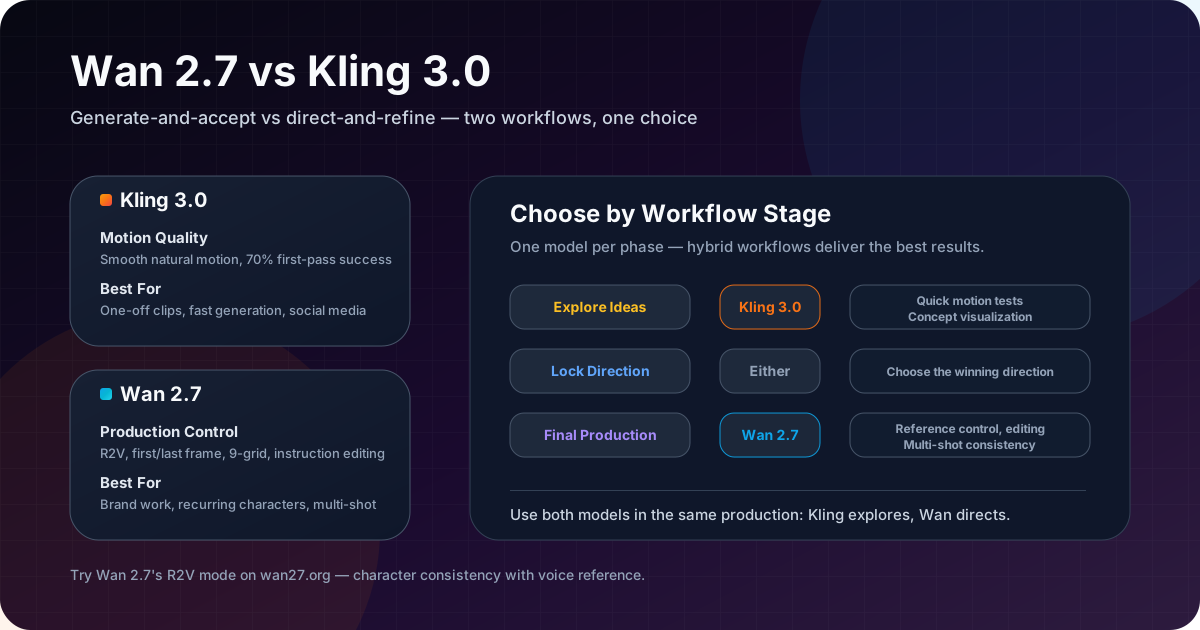
- Start with Kling 3.0 when you need a high-quality clip fast and the shot is self-contained.
- Move to Wan 2.7 when the clip is part of a larger production, needs to match existing material, or will go through revision cycles.
One common mistake to avoid: Do not judge either model by its first clip. Kling's best clip from 3 attempts is often significantly better than its first. Wan's best result comes after you have set up at least one reference — judge it after, not before, you use R2V or first/last frame control.
The Best Hybrid Workflow
For many teams, the strongest answer is not either-or:
- Use Kling 3.0 for early concept visualization and quick motion tests
- Lock the direction
- Use Wan 2.7 for final production — reference control, editing passes, and multi-shot consistency
This workflow wastes less time than forcing one model to do both jobs. In our testing, teams using this hybrid approach completed multi-shot productions roughly 40% faster than teams using either model exclusively.
FAQ
Which model produces better video quality?
Kling 3.0 produces smoother, more natural motion out of the box. Wan 2.7 can match or exceed it with sufficient reference and prompt tuning, but requires more work to get there.
Which model is better for character consistency?
Wan 2.7. R2V mode with subject reference and voice reference gives you the best consistency across shots. Kling supports subject reference but lacks the depth of Wan's control system.
Should I use both models?
Yes — if your budget allows, the hybrid approach is the most efficient. Use Kling 3.0 for exploration and quick clips. Use Wan 2.7 for production shots that need control, consistency, and editing.
Which model has better audio support?
Both handle audio well. Kling 3.0 has simpler built-in lip sync. Wan 2.7's R2V mode supports multi-character voice reference and assignment, which is more powerful for dialogue scenes.
Which model is better for editing existing clips?
Wan 2.7 by a wide margin. Instruction-based editing and video recreation are features Kling 3.0 does not offer.
Which model is more cost-effective for a full production?
For single clips, Kling 3.0 is cheaper because you get usable results faster. For productions of 10+ shots, Wan 2.7 is more cost-effective because its editing model reduces total iterations by 50–70% compared to regenerating from scratch.
Bottom Line
If you need high-quality motion fast and the clip stands alone, start with Kling 3.0. If you need control, consistency, and editing leverage across multiple shots, start with Wan 2.7.
The best setup for most creators is both: Kling for exploration, Wan for execution.
Your next step: If Wan 2.7 fits your production needs, start with the First/Last Frame Guide (5 minutes, one shot) or the R2V Guide (10 minutes, character consistency across scenes).